- Visual Accessibility is Key: Move away from hidden storage; use open shelving, clear bins, and labels to reduce the “out of sight, out of mind” trap that disrupts task completion.
- Implement Zoned Workflow: Organize your kitchen into distinct stations (prep, cook, clean) to minimize physical movement and mental energy spent searching for tools.
- Reduce Decision Fatigue: Limit the number of tools on counters and standardize storage locations to decrease the cognitive load required for simple daily tasks.
If you have ever found yourself standing in the middle of your kitchen, staring at an open fridge, and completely forgetting what you walked in there to do, you aren’t alone. For many of us in our 30s and 40s—juggling career demands, school runs, and the endless mental load of household management—the kitchen is often the site of the most significant executive function “bottlenecks.”
Executive function refers to the brain’s set of cognitive processes that include working memory, flexible thinking, and self-control. When your kitchen is cluttered or poorly organized, your brain has to work overtime just to process the visual noise before you even start chopping an onion. By applying principles of neuro-inclusive design, you can transform your kitchen from a source of daily stress into a supportive environment that does the thinking for you.
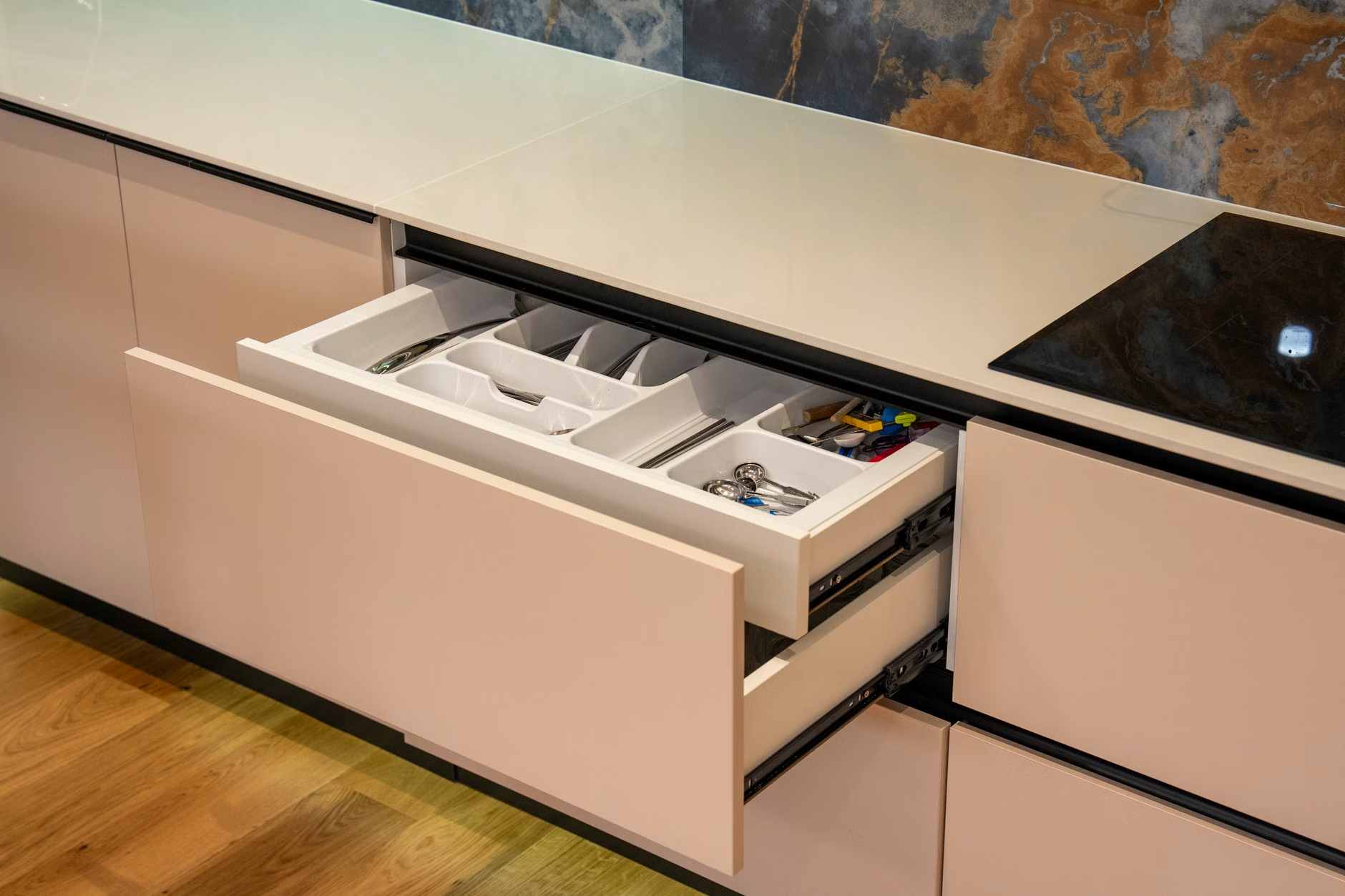
Why Your Kitchen Design Dictates Your Cognitive Load
The kitchen is arguably the most complex room in the house. It requires constant task-switching, sequence management (boiling water while chopping vegetables), and sensory processing. If you are neurodivergent—or simply exhausted by the “mental load” of adulthood—a standard kitchen layout can feel like an obstacle course. The primary issue is cognitive friction: the amount of mental effort required to perform a simple action.
Consider the process of making a simple salad. If your salad spinner is buried behind three heavy pots, and your knives are in a drawer that requires moving a cutting board to access, you have already spent significant executive energy before the first leaf of lettuce is washed. In neuro-inclusive design, we focus on reducing these “micro-decisions.” Every time you have to decide where a tool belongs, or search for an item, you are depleting your limited daily supply of focus.
The “Out of Sight, Out of Mind” Trap
One of the most common pitfalls for those struggling with executive function is the “hidden storage” aesthetic. While minimalist, closed-cabinet kitchens look great on social media, they are often a nightmare for working memory. If you cannot see it, you often forget it exists. This leads to expired groceries, doubled-up purchases, and the frustration of buying things you already own. Transitioning to visual storage—where the items you use daily are visible or clearly labeled—is a fundamental shift in managing household inventory.
Establishing Workflow Zones to Minimize Movement
Efficiency in the kitchen is not about speed; it is about reducing the number of steps required to complete a task. Professional kitchens use the “work triangle” concept, but we can refine this for home use by implementing Activity-Based Zoning. Instead of organizing your kitchen by “type” (e.g., all glassware in one cabinet), organize by “activity.”
| Zone | Core Items | Goal |
|---|---|---|
| Prep Zone | Knives, cutting boards, mixing bowls | Minimize transit to the sink/stove |
| Cook Zone | Pots, pans, spatulas, oils, spices | Keep everything within one arm’s reach |
| Consumables | Plates, bowls, silverware, napkins | Easy access for family members |
When you organize this way, you remove the need for planning. You don’t have to think, “Where is the colander?” because it is physically located in the prep zone where you use it. This reduces the “search and retrieve” cycle that often leads to distraction and task abandonment.

The Role of Sensory Regulation in Kitchen Design
For many adults, kitchen overwhelm is not just about logistics; it is about sensory overload. The sound of a humming refrigerator, the visual clutter of mismatched packaging, and the bright, harsh lighting can trigger a stress response that makes you want to avoid cooking altogether. Neuro-inclusive design acknowledges that your environment should be sensory-neutral.
Lighting: Swap out flickering or overly cool-toned LED bulbs for warmer, diffused lighting. Consider under-cabinet task lighting that illuminates your workspace directly, preventing you from casting a shadow over your own work. This simple change reduces visual strain and makes it easier to focus on the task of chopping or reading a recipe.
Visual Noise: The modern trend of “everything on the counter” is a significant contributor to executive dysfunction. Clear your counters of everything except the absolute essentials (a coffee maker or a knife block). When your workspace is clear, your mind is clearer. Use uniform containers for dry goods to eliminate the chaotic color palettes and text-heavy labels of grocery packaging, which can act as a “visual siren” for your brain.
Step-by-Step Implementation: The 48-Hour Reset
Do not attempt to overhaul your entire kitchen in one weekend. This is a recipe for burnout. Instead, follow a structured, low-pressure approach:
- Day 1, Morning (Audit): Spend 30 minutes identifying the “friction points.” Where do you get frustrated? Is it the spice drawer that never closes? The heavy pots you can’t lift? Write these down.
- Day 1, Afternoon (Declutter): Remove any item you have not used in the last six months. If you are keeping it for “someday,” move it to a high shelf or a box in the garage. If it’s not essential to your current life, it is just taking up executive space.
- Day 2, Morning (Zone): Move your most-used tools into the “prime real estate” zone (between your waist and shoulder height).
- Day 2, Afternoon (Label): Use simple, bold labels. Don’t worry about aesthetics; focus on functionality. A label that says “SNACKS” in large letters is more effective for a tired brain than a beautiful, tiny calligraphy label.
A Common Mistake: Buying organizers before you have purged your items. If you buy a complex drawer organizer before you know exactly what is going in it, you are just creating a more expensive version of your current clutter. Purge first, measure second, buy third.
Addressing the Hidden Costs of Inefficient Layouts
Why does this matter in your 30s and 40s? Because you are likely managing more variables than ever before. If you have children, your kitchen is a high-traffic area. If you are working from home, your kitchen might also be your break room. The “hidden cost” of a poor layout is not just wasted time—it is decision fatigue.
Decision fatigue is a real psychological phenomenon where the quality of your decisions deteriorates after a long period of decision-making. By the time you reach dinner, you have made hundreds of choices. If your kitchen layout forces you to make ten more choices just to start cooking—what pan to use, where the oil is, which knife is sharpest—you are significantly more likely to abandon the plan and order takeout. This is not a failure of willpower; it is a failure of system design.
The “Batching” Mindset
Integrate your storage with your habits. If you often meal prep on Sundays, your storage containers should be at eye level. If you are a “cook as you go” person, your trash bin should be located directly under your primary cutting area to reduce the “transfer” time. Every second you save in movement is a second you keep for your own mental recovery.
Beyond the Basics: Advanced Tips for Sustained Function
Once you have established your zones, the challenge is maintenance. How do you stop the kitchen from sliding back into chaos? The answer lies in reset rituals. A reset ritual is a short, timed task that restores the kitchen to its “baseline” state. For example, the “five-minute nightly reset” involves clearing the sink, wiping the primary prep surface, and ensuring all tools are returned to their designated zones.
Another overlooked variable is the “command center” approach. If you use a paper calendar or a grocery list, place it exactly where you stand when you are most likely to think of something you need. If you always run out of milk while standing at the fridge, put a small whiteboard or a notepad with a magnet directly on the fridge door. Do not rely on your brain to “remember it later.” Your brain is for processing, not for storage.
Practical Decision Criteria: When to Keep vs. When to Toss
If you are struggling to decide whether an item belongs in your “essential” zone, apply the Three-Month Rule. If you haven’t used an item in the last three months, it does not belong in your prime space. If you haven’t used it in a year, it does not belong in your kitchen. This rule helps remove the emotional attachment we often have to “aspirational” kitchen tools (like that expensive pasta maker you bought three years ago).
Remember that the goal of a neuro-inclusive kitchen is not a magazine-perfect home. The goal is a supportive environment. If having a slightly messy “junk drawer” helps you keep the rest of the house organized, that is a valid design choice. The key is that the clutter is contained and doesn’t interfere with your ability to function.
Final Considerations for Your Home
Designing a neuro-inclusive kitchen is an iterative process. You will move things around, realize a zone doesn’t work, and adjust. That is the point. Your kitchen should evolve alongside your life. If your household needs change—perhaps your children are getting older and helping with cooking, or your work schedule has shifted—your kitchen layout should shift with you.
Don’t be afraid to break “design rules.” If you find it easier to keep your spices on the counter instead of in a rack, do it. If you prefer to keep your dishes in a dishwasher-safe basket rather than stacking them in a cupboard, that is perfectly acceptable. The most effective kitchen is the one that minimizes the friction between your intention and your action.
Start small, focus on the areas that cause the most daily frustration, and remember that you are building a tool, not a display piece. Your brain will thank you for the extra space.
Frequently Asked Questions
1. How do I convince my family to follow my new organizational system?
The best way is to keep it simple and visual. Use labels that even younger children can understand (e.g., using icons or large text). If the system is easier than the old way, they will naturally adopt it. Avoid complex or overly specific rules that are hard to remember.
2. What if I have a very small kitchen with no room for zones?
Even in a small space, “micro-zoning” works. You can create zones within a single drawer or cabinet using dividers. The principle remains the same: keep items that are used together in the same immediate physical location. Use vertical space (walls, doors) if your counter or floor space is limited.
3. Does this approach require buying expensive organizers?
Absolutely not. In fact, expensive matching sets can sometimes be counter-productive if they aren’t the right size for your items. Use repurposed boxes, jars, or existing containers first to test your new system. Only invest in permanent solutions once you are certain the layout works for your daily routine.
For more information on executive function and home management, you can explore resources from the CHADD (Children and Adults with Attention-Deficit/Hyperactivity Disorder) website for evidence-based strategies on managing daily life.