The most effective way to recover from the relentless cycle of parenting and professional demands is not to “see more” on your vacation, but to intentionally do less—a trend now defined as “Quiet Tourism.”
- Prioritize “Anchored Stays”: Avoid multi-location trips; staying in one mountain location for at least five days reduces decision fatigue and lowers travel-related stress for children.
- The “Zero-Itinerary” Rule: Plan only one anchor activity per day, leaving 70% of your time unplanned to allow for organic rest and spontaneous exploration.
- Digital Minimalism is Non-Negotiable: Use a physical map and a dedicated “analog” camera to break the screen-dependency cycle that keeps your brain in work-mode.
If you are in your 30s or 40s, your typical “vacation” likely feels like a logistical exercise. You are coordinating flights, managing school schedules, balancing work emails, and trying to squeeze in “fun” for the kids. By the time you get to the mountains, you are often more exhausted than when you left. Quiet tourism isn’t just a buzzword; it is a tactical retreat from the performance-based travel culture that demands we document and “optimize” every moment of our time off.
Why the Mountains are the Ultimate Quiet Tourism Laboratory
The mountains offer a unique psychological reset because they force a change in physical perspective. When you are in a city, your eyes are constantly processing lines, traffic, and digital signage. In the mountains, the visual field is dominated by organic, irregular shapes—trees, rocks, and clouds. This is known in environmental psychology as “soft fascination.”
Soft fascination happens when our attention is held by the environment without requiring any effortful concentration. Unlike watching a movie or checking emails, which demands “directed attention,” looking at a forest or a mountain range allows your cognitive reserves to replenish. For a parent juggling a career, this is the most efficient way to combat mental burnout.
However, the common mistake is assuming that simply being in the mountains is enough. If you arrive with a list of “must-see” peaks and “top-rated” hiking trails, you have simply moved your urban stress into a high-altitude setting. To practice quiet tourism, you must treat your mountain retreat as a space for “low-arousal” activities.
The Architecture of a Low-Arousal Trip
What does this look like in practice? It means shifting from a “collector” mindset to a “dweller” mindset. Instead of collecting photos of three different summits, you dwell in one specific valley. You learn the rhythm of the local birds, you find the best spot for a morning coffee, and you allow your children to get bored—because boredom is the precursor to deep, creative play.
When you remove the pressure to “achieve” during your time off, you lower your cortisol levels. Research indicates that even short periods of immersion in natural settings—without the pressure of performance or scheduling—lead to measurable improvements in executive function and emotional regulation. For the 35-year-old parent, this means you return home not just rested, but more capable of handling the inevitable chaos of your daily routine.
Setting Your “Anchor” Parameters: A Strategic Framework
The biggest barrier to a quiet retreat is the fear of “missing out” (FOMO). To counter this, you need a framework for decision-making before you even leave your house. If you do not define what a successful trip looks like, you will default to the standard tourist experience.
Use the following table to help you decide how to structure your retreat based on your family’s current energy levels:
| Strategy | Purpose | Implementation |
|---|---|---|
| The Basecamp Approach | Reducing cognitive load | Stay in one place for the entire duration. No hotel hopping. |
| The Single-Anchor Rule | Ensuring presence | One activity per day (e.g., one morning hike, the rest is free). |
| The Analog Constraint | Breaking digital habits | Use paper maps and cameras; phones stay in the safe/drawer. |
The “Basecamp Approach” is critical. Many families in their 30s and 40s try to maximize their trip by visiting two or three different mountain towns. Each transition—packing, checking out, driving, navigating, and checking in—is a “decision event.” These events consume your mental energy. By staying in one place, you turn your accommodation into a true home base where you can leave your gear, relax your guard, and settle into a genuine rhythm.
The Hidden Cost of “Optimized” Travel
There is a hidden cost to the modern, hyper-optimized vacation: the loss of the “liminal space.” Liminal spaces are those transitions where nothing specific is happening—the walk to the car, the wait for the bus, the time spent sitting on a bench. In a standard vacation, we fill these spaces with podcasts, social media scrolling, or planning the next activity. In quiet tourism, you reclaim these spaces. This is where the actual restorative magic happens. When you stop filling the gaps, your brain finally has the bandwidth to process the stressors you’ve been carrying for months.
Logistical Realities: What to Pack and How to Plan
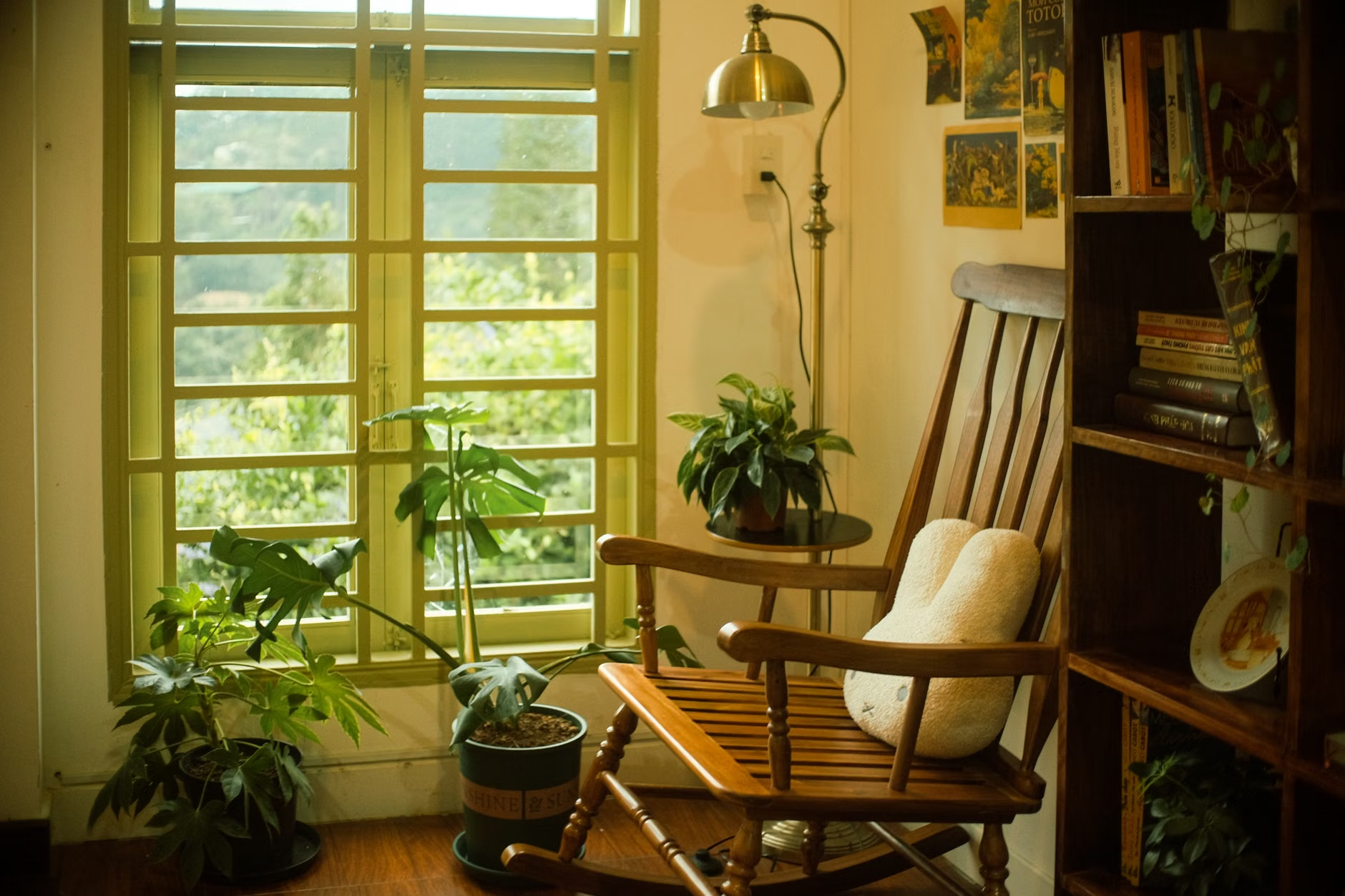
Quiet tourism requires a shift in how you pack. If you are preparing for an “active” vacation, you pack for performance—high-tech gear, specialized shoes, and specific outfits for specific activities. For a quiet retreat, pack for comfort and simplicity.
The “Comfort First” Packing List:
- Versatile Layers: Don’t pack for every possible weather extreme. Focus on base layers that can be worn for both light hiking and lounging.
- The “No-Screen” Kit: Bring physical books, a deck of cards, a journal, and a sketchbook. If you have children, bring board games that don’t require batteries or complex setups.
- Slow-Food Staples: If your accommodation has a kitchen, prioritize ingredients that are easy to prep but high quality. Avoid the stress of finding restaurants for every meal. A simple pasta dinner with local cheese and bread can be more memorable than a crowded, noisy restaurant experience.
Handling the “But What Do We Do?” Question
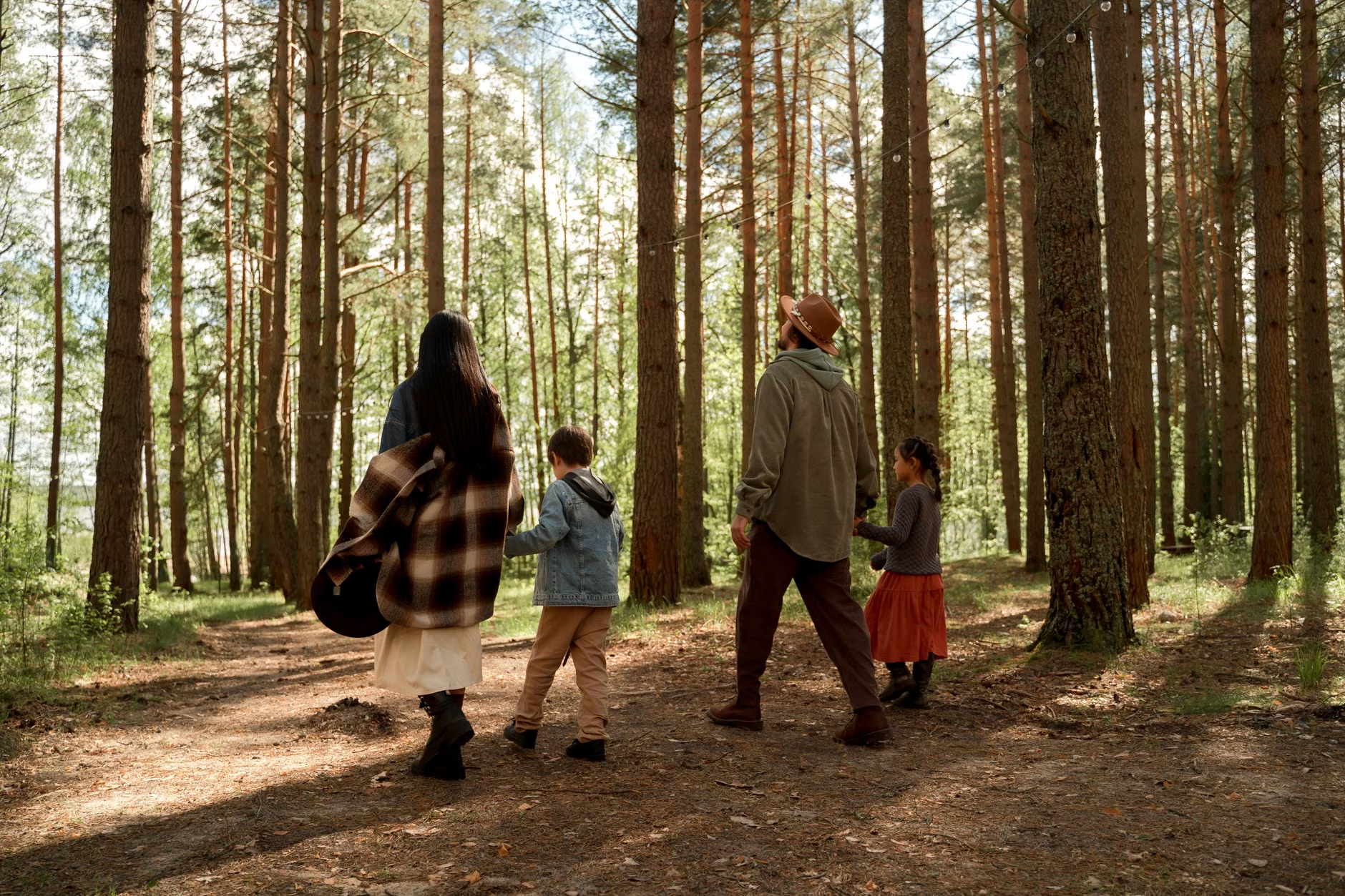
Your kids (and perhaps your spouse) will inevitably ask, “What are we doing today?” The answer should not be a list of attractions. The answer should be an invitation. “Today, we are going to walk to the creek and see what we can find,” or “Today is a reading and drawing day.” This shifts the responsibility from you being a “tour guide” to you being a “facilitator of space.”
If you feel the urge to fill the day, ask yourself: “Is this activity for me, for the kids, or to satisfy the feeling that I ‘should’ be doing something?” If the answer is the latter, cancel it. The goal is to reach a state where you are no longer tracking the time. When you stop looking at your watch to see if you are “on schedule,” you have successfully entered the quiet tourism zone.
It is important to acknowledge that silence can be uncomfortable. If you are used to the constant stimulation of a professional career and the demands of parenting, the sudden drop in noise and activity can actually trigger anxiety. This is a common reaction known as “leisure sickness” or simply withdrawal from stimulation.
If you find yourself feeling restless on day two, do not panic and start booking activities. This is the “detox” phase. Your brain is trying to revert to its high-stimulation state. Acknowledge the feeling, and then lean into it. Go for a slow walk, sit in a field, or do a repetitive, low-stress task like sorting rocks or sketching. The restlessness will pass, and it will be replaced by a profound sense of clarity.
Another common mistake is “social comparison.” You might see other families on social media doing “exciting” mountain activities. Remind yourself that their highlight reel is not your reality. Their version of “fun” might be your version of “exhaustion.” Stick to your own definition of rest.
When to Break the Silence
Quiet tourism is not about asceticism. If your family genuinely loves a specific activity—like a high-altitude hike or a local festival—by all means, do it. The rule is not “do nothing,” the rule is “do only what matters.” If an activity adds genuine joy and connection, it fits. If it adds stress, expense, and logistical burden, it is a candidate for removal.

Practical Steps to Execute Your Next Quiet Retreat
To turn these concepts into a concrete plan, follow this step-by-step approach for your next mountain booking:
- Choose a Location with “Depth”: Instead of a famous tourist town, look for a small village or a secluded lodge that is close to nature but far from the “attraction loop.” Check maps for proximity to trails rather than proximity to museums or shopping centers.
- The 48-Hour Buffer: Give yourself the first 48 hours of your trip with absolutely zero plans. No dinners out, no scheduled tours. Use this time to get to know your accommodation and the immediate surroundings.
- Collaborative Planning: Sit down with your partner and children before you leave. Ask: “What is the one thing you really want to do?” Take those answers, and build your entire trip around them, ensuring there is plenty of “empty” space surrounding those events.
- Set a Digital Boundary: Designate a “tech-free” zone in your accommodation. Maybe the kitchen table is a phone-free area. Keep devices charged in a separate room, and only check them once per day at a set time.
Refining Your Approach: Insights for Long-Term Success
True quiet tourism is a skill you develop over time. Your first attempt might feel strange. You might worry that you are “wasting” your vacation budget by not doing more. This is a misconception. You are investing in your mental health and the health of your family dynamics. The return on this investment is not a photo album full of landmarks, but a family that feels reconnected and a brain that feels uncluttered.
Consider the “Return to Routine” transition. One of the biggest mistakes people make is arriving home on a Sunday night and expecting to be fully functional on Monday morning. If possible, add one “buffer day” to your trip where you are home but not yet back to work or school. Use this day to unpack, do laundry, and slowly re-enter the pace of your daily life. This preserves the “quiet” feeling you cultivated in the mountains for as long as possible.
Finally, remember that the goal is not to be perfect. If you end up having a busy, chaotic day, that is okay. The beauty of quiet tourism is that it is forgiving. You can always revert to the slow pace the next morning. The mountains will still be there, and the silence is always waiting for you to return to it.
Frequently Asked Questions
1. How do I handle kids who get bored during a ‘quiet’ mountain trip?
Boredom is not a failure; it is the catalyst for creativity. Instead of stepping in with a pre-planned activity, provide “open-ended” tools: a set of drawing supplies, a magnifying glass for bug hunting, or a simple deck of cards. Encourage them to explore the immediate area around your accommodation. You will find that after the initial protest, they will naturally begin to engage with the environment in ways that require no intervention from you.
2. Is quiet tourism only for people with a lot of money or time?
Quite the opposite. Quiet tourism is often cheaper than standard travel. By staying in one place, you save on transportation costs and the “hidden” costs of constant dining out and attraction entry fees. You can practice this style of travel in a local state park or a nearby mountain cabin just as effectively as you can in a luxury resort. The “quiet” is a mindset, not a luxury purchase.
3. How do I deal with the anxiety of being disconnected from my work?
The anxiety comes from a fear that something will “go wrong” if you aren’t available. Establish a clear “emergency-only” contact protocol with your colleagues before you leave. Communicate that you will be checking messages only during a specific 30-minute window each day. Once that window is closed, your phone goes away. This provides you with the security of knowing you are reachable if a true crisis occurs, while protecting your mental space for the rest of the day.
The mountains offer a rare opportunity to step out of the “performance” loop that defines so much of our lives. By choosing a slower, quieter pace, you aren’t just taking a vacation—you are reclaiming your ability to focus, to rest, and to simply be present with those who matter most.
For more information on the psychological benefits of nature immersion, visit the American Psychological Association’s resources on nature and well-being.