Green hydrogen is currently being marketed as the “silver bullet” for decarbonizing home heating, but for the average household, it is more likely to be a long-term transition than an immediate fix for high utility bills. In reality, replacing natural gas with green hydrogen will likely increase heating costs in the short-to-medium term due to high production expenses and the massive infrastructure overhaul required to transport it safely to your doorstep.
- Production Costs: Green hydrogen currently costs significantly more to produce than natural gas, meaning your monthly heating bill could rise if your utility grid switches over entirely.
- Infrastructure Reality: Your current boiler likely cannot burn pure hydrogen; upgrading to “hydrogen-ready” appliances is a mandatory, non-trivial investment for homeowners.
- The Efficiency Gap: Using electricity directly for heat pumps is mathematically more efficient than converting electricity to hydrogen and then back to heat, which is why heat pumps—not hydrogen—are currently the preferred policy choice in many regions.
Every time a new energy trend hits the headlines, it’s natural to wonder if it’s the answer to those rising monthly utility statements. We’ve all been there: staring at a heating bill in the dead of winter, wondering why it’s climbing despite our best efforts to seal windows and manage the thermostat. Now, the conversation has shifted toward “green hydrogen.” It sounds clean, futuristic, and promising, but what does it actually mean for the person trying to balance a mortgage, childcare costs, and the sudden urge to upgrade a furnace?
What Exactly Is Green Hydrogen and Why the Hype?
To understand the impact on your wallet, we first need to strip away the marketing. Hydrogen is an element, but “green hydrogen” specifically refers to hydrogen produced using renewable energy—like wind or solar power—to split water into hydrogen and oxygen through a process called electrolysis. Unlike “grey hydrogen,” which is made from natural gas (methane) and releases significant carbon dioxide, green hydrogen is virtually emission-free at the point of production.
The hype exists because hydrogen is a “gas” that can be burned, much like the natural gas currently fueling millions of boilers worldwide. The theory is simple: we keep the existing pipe infrastructure, swap the gas in the pipes for hydrogen, and keep our homes warm without the carbon footprint. It’s an appealing vision because it suggests we don’t have to rip out our entire heating systems. However, the chemistry and the economics suggest a much more complicated path.
For a parent in their 30s or 40s, this matters because energy policy is currently a tug-of-war. If your local government decides to invest heavily in a “hydrogen-ready” gas grid, the costs of that infrastructure will almost certainly be passed down to the consumer. If they decide that hydrogen is too expensive and pivot to electric heat pumps, your home’s heating system might become obsolete faster than you expect.
The Hidden Costs of the Hydrogen Transition
Let’s talk numbers. Currently, natural gas is relatively cheap because the infrastructure is mature and the extraction methods are highly efficient. Green hydrogen, by contrast, is in its infancy. The “round-trip efficiency”—the energy lost when you use electricity to create hydrogen, transport it, and then burn it in a boiler—is quite poor compared to using that same electricity to power an electric heat pump.
Think of it like this: If you have 100 units of wind energy, using them to power a heat pump might provide 300 to 400 units of heat in your home. Using those same 100 units to create hydrogen, transport it, and burn it might only provide 60 to 70 units of heat. That massive loss in efficiency is essentially a tax on the consumer. You are paying for the energy that is lost during the conversion process.
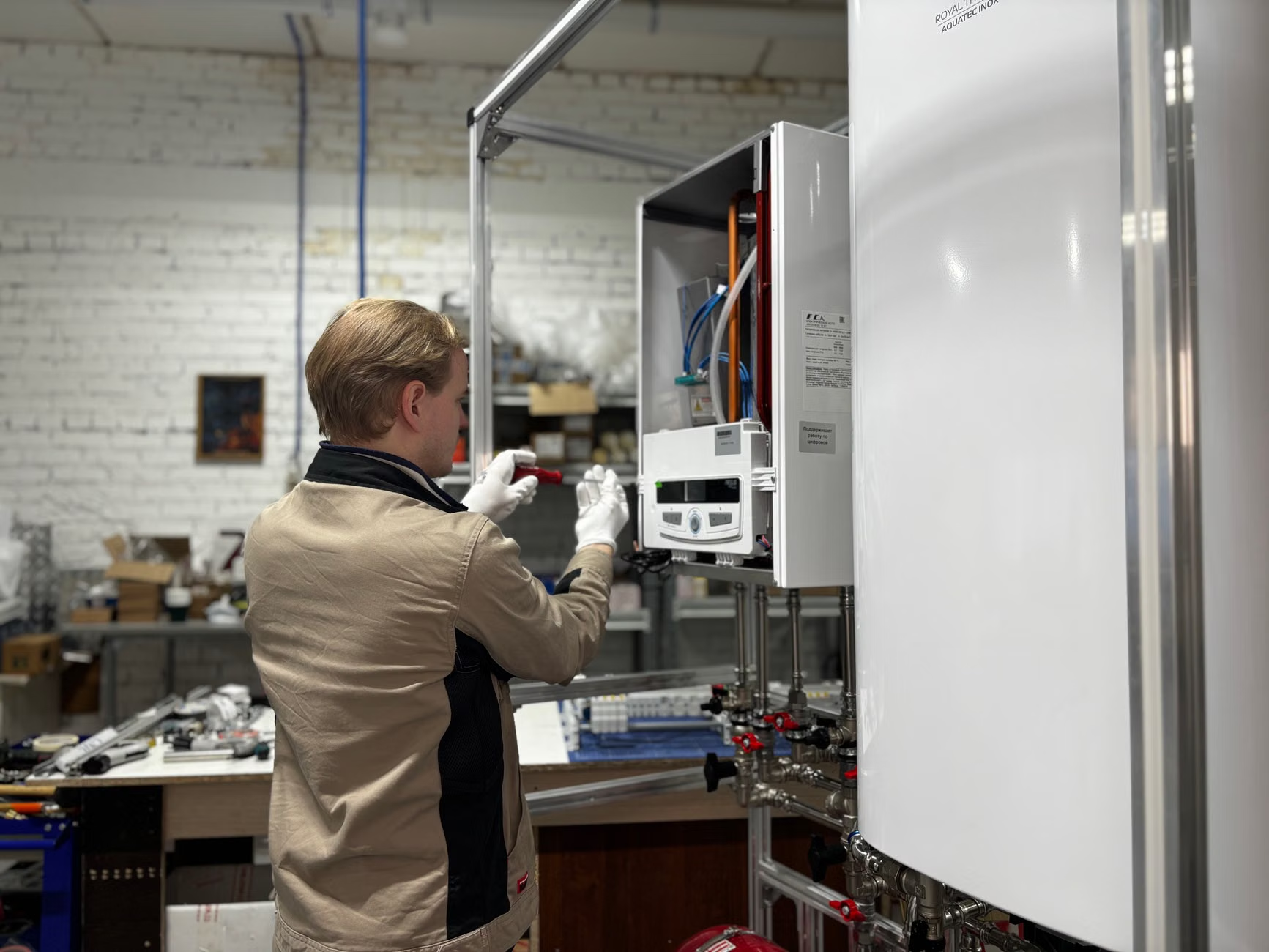
Beyond the raw fuel cost, there is the appliance issue. Most modern gas boilers are designed to burn methane, not hydrogen. Hydrogen molecules are much smaller and burn differently, meaning they can leak through seals that hold methane just fine. To switch to pure hydrogen, you would need to replace your boiler, potentially upgrade your gas lines, and ensure your home ventilation is up to new safety standards. These costs are not covered by the utility company; they fall squarely on the homeowner.
Comparing Heating Alternatives: A Reality Check
To decide if you should be worried about hydrogen or excited about it, we have to compare it to the current alternatives. For most homeowners, the choice is between continuing with natural gas, switching to a heat pump, or waiting for a hydrogen-ready grid.
| Technology | Relative Upfront Cost | Operating Cost (Est.) | Best For |
|---|---|---|---|
| Natural Gas | Low (Existing) | Moderate | Short-term stability |
| Electric Heat Pump | High | Low to Moderate | Long-term efficiency |
| Green Hydrogen | Very High | High (Projected) | Industrial use/Niche cases |
As the table above suggests, green hydrogen is not currently positioned as a cost-saving measure for the average residential user. Its primary role in the global energy transition is likely to be in heavy industry—like steel manufacturing or shipping—where electricity alone cannot provide the high-intensity heat required. If you are a homeowner, you are likely looking at a future where hydrogen is either a luxury or a solution for specific, hard-to-decarbonize regions.
What Should You Do Today?
If you are planning a renovation or facing a boiler replacement, the most common mistake is waiting for a “hydrogen revolution” that may never reach your street. Instead, focus on what you can control right now. The best way to protect your heating budget is to reduce the amount of energy your home requires, regardless of the fuel source.
Step 1: Focus on Insulation. Whether you eventually use hydrogen, natural gas, or electricity, a well-insulated home is the best financial hedge. Upgrade your loft insulation, seal gaps around door frames, and ensure your windows are efficient. This lowers your demand, which acts as a buffer against future price spikes.
Step 2: Evaluate Your Current Boiler. If your boiler is over 10 years old, it is likely nearing the end of its life. Research “hydrogen-ready” boilers if you live in a region where the government has explicitly mentioned a hydrogen grid transition, but don’t pay a premium for “hydrogen-readiness” if you live in an area where electrification (heat pumps) is the primary policy goal.
Step 3: Monitor Local Policy. Energy policy is hyper-local. Check your national or regional government’s “Heat and Buildings Strategy.” These documents often contain a roadmap for whether your specific city will be prioritized for hydrogen conversion or heat pump adoption. Following these documents is more useful than watching global news headlines.

The “Hidden Variable”: Why Infrastructure Matters More Than Price
There is an overlooked variable in this entire conversation: the pipe material. Most existing gas networks are made of steel or older plastics that aren’t necessarily compatible with high concentrations of hydrogen. Replacing these pipes across an entire city is a multi-billion dollar endeavor. Who pays for that? Usually, it’s the utility companies, who then recover that cost through regulated rate increases on your monthly bill.
Even if you never switch your own boiler to hydrogen, you might find your monthly bill increasing simply because the utility company is forced to upgrade the underlying network to prevent leaks. This is a “hidden cost” that many homeowners ignore. It’s not just about the fuel cost; it’s about the cost of maintaining a safe, complex, and potentially aging infrastructure.
When you hear local politicians or utility providers talking about “green hydrogen readiness,” look closely at the fine print. Are they talking about blending hydrogen (adding small amounts to natural gas) or moving to 100% hydrogen? Blending, which is often proposed as a bridge, generally has a negligible impact on your carbon footprint while still requiring infrastructure upgrades. It is, in many ways, the worst of both worlds for the consumer: higher costs for minimal environmental gain.
When you are in your 30s and 40s, you are likely managing a household budget that doesn’t have much room for experimental tech. You need reliability. If your current boiler is functioning, keep it maintained. Regular servicing is the single most effective way to ensure your system runs at peak efficiency. Neglected boilers consume more fuel, and in a market where fuel prices are volatile, that’s money thrown away.
If you are in the market for a new system, compare the “Total Cost of Ownership” (TCO) over 10 years rather than just the purchase price. A heat pump might be $5,000 more expensive upfront, but if it saves you $1,000 a year in energy costs, it pays for itself in five years. If hydrogen is your only other option, ask yourself: is the infrastructure actually coming to my street, or is it just a pilot project five towns over?

Common Misconceptions That Cost You Money
One of the biggest misconceptions is that hydrogen is “free” because it’s just water. While the raw material is abundant, the energy required to extract it is not. Another misconception is that all gas boilers will be easily converted. In many cases, the burner, the valves, and the sensors all need to be replaced. If you’re told a boiler is “hydrogen-ready,” clarify if that means it can burn 20% hydrogen blends or 100% pure hydrogen. These are two very different engineering standards.
Furthermore, don’t fall for the “it will be cheap by the time I need it” trap. While the cost of electrolyzers (the machines that make green hydrogen) is dropping, the cost of transporting and storing hydrogen is inherently high due to its low energy density. Hydrogen takes up a lot of space, which means it’s expensive to move around. Electricity, by comparison, can be sent down a wire at the speed of light with very little loss.
If you live in a region with high electricity prices, you might be tempted to think hydrogen is the answer. But remember: hydrogen is ultimately a form of stored electricity. If electricity is expensive, hydrogen will be even more expensive, because you’re paying for the electricity plus the conversion and storage process. There is no “free lunch” in thermodynamics.
The Long-Term Outlook for Your Household
As we look toward the next decade, the most likely scenario for most households is a mix of solutions. Urban areas with dense housing might see district heating networks, while suburban homes will likely transition toward heat pumps. Hydrogen will likely be reserved for specific industrial clusters. The “hydrogen home” is a compelling marketing image, but for the vast majority of us, it is unlikely to be the most cost-effective way to heat our living rooms.
Instead of betting on a single technology, focus on the fundamentals: home energy efficiency, regular system maintenance, and staying informed about the specific infrastructure plans in your municipality. The energy transition is not a one-size-fits-all event. It is a series of regional decisions that will play out differently depending on where you live, the age of your local grid, and the political priorities of your area.
Finally, avoid the temptation to “future-proof” your home with expensive, unproven technology. Buying a hydrogen-ready boiler today might feel like a safe bet, but if your local grid decides to go the electric route, you’ve spent extra money on a feature you’ll never use. Stick to proven, high-efficiency equipment that meets your current needs, and keep a close eye on the energy roadmap published by your local government.
The transition to a greener home is a marathon, not a sprint. By prioritizing insulation and high-efficiency systems that work with the infrastructure you have today, you’re not just saving money—you’re ensuring that your household remains comfortable and resilient, regardless of which energy source wins the race in the long run.
Frequently Asked Questions
1. Is my current boiler compatible with hydrogen?
Most existing boilers designed for natural gas cannot burn 100% hydrogen. They are designed for the specific combustion properties of methane. While some newer models are marketed as “hydrogen-ready,” this usually means they can be converted with a kit by a professional. Do not attempt to burn hydrogen in a standard boiler, as it poses significant safety risks, including the potential for leaks and improper combustion.
2. Will I be forced to switch to a hydrogen boiler soon?
In most countries, there is no immediate mandate to switch to hydrogen. Governments are currently focused on phasing out the installation of new gas boilers in favor of heat pumps or heat networks. If you are not in a designated “hydrogen trial” area, you are unlikely to be forced to switch anytime soon. Always check your local planning and building authority for specific regulations in your area.
3. Why is hydrogen often called “clean” if it costs so much?
Hydrogen is called “clean” because when it burns, the only byproduct is water vapor—no carbon dioxide is released. However, the “cleanliness” depends entirely on how the hydrogen is made. “Green” hydrogen is made using renewable energy, making it environmentally friendly. The high cost is not about the cleanliness of the fuel itself, but the energy-intensive process of producing, compressing, and transporting it. It is a premium fuel that is currently too expensive for general residential heating compared to direct electrification.
For more information on energy policies and local heating transitions, you can visit the official energy department websites for your respective country, such as the U.S. Department of Energy or the European Commission’s Energy policy pages, which provide detailed roadmaps for the transition to cleaner heating.