- Significant Cost Savings: Borrowing high-end tools instead of buying them saves the average urban family $500–$1,200 annually on equipment they use only once or twice a year.
- Reduced Household Clutter: By utilizing a library model, you reclaim valuable square footage in your apartment, eliminating the need to store bulky items like tile saws, pressure washers, or specialized gardening gear.
- Community Resilience: Tool libraries act as social hubs that foster neighborhood trust and provide access to expert knowledge, allowing you to learn maintenance skills from experienced volunteers rather than trial-and-error.
If you are currently staring at a dusty power drill you bought four years ago to hang a single shelf, you are not alone. For urban parents, the “buy-to-own” model of household management is quietly draining both our bank accounts and our limited living space. We live in a world where we feel pressured to own every piece of equipment required to maintain our homes, even if those items spend 360 days a year sitting in a dark closet. But there is a smarter, more sustainable, and increasingly popular alternative: the community tool library.
A community tool library functions exactly like a book library, but instead of novels, you check out lawnmowers, impact drivers, sewing machines, and carpet cleaners. It is a radical shift in how we think about ownership. Instead of hoarding tools “just in case,” you access them “just in time.” For the parent balancing a chaotic schedule, this isn’t just about saving money; it’s about reclaiming your home environment and participating in a circular economy that makes urban life significantly more manageable.
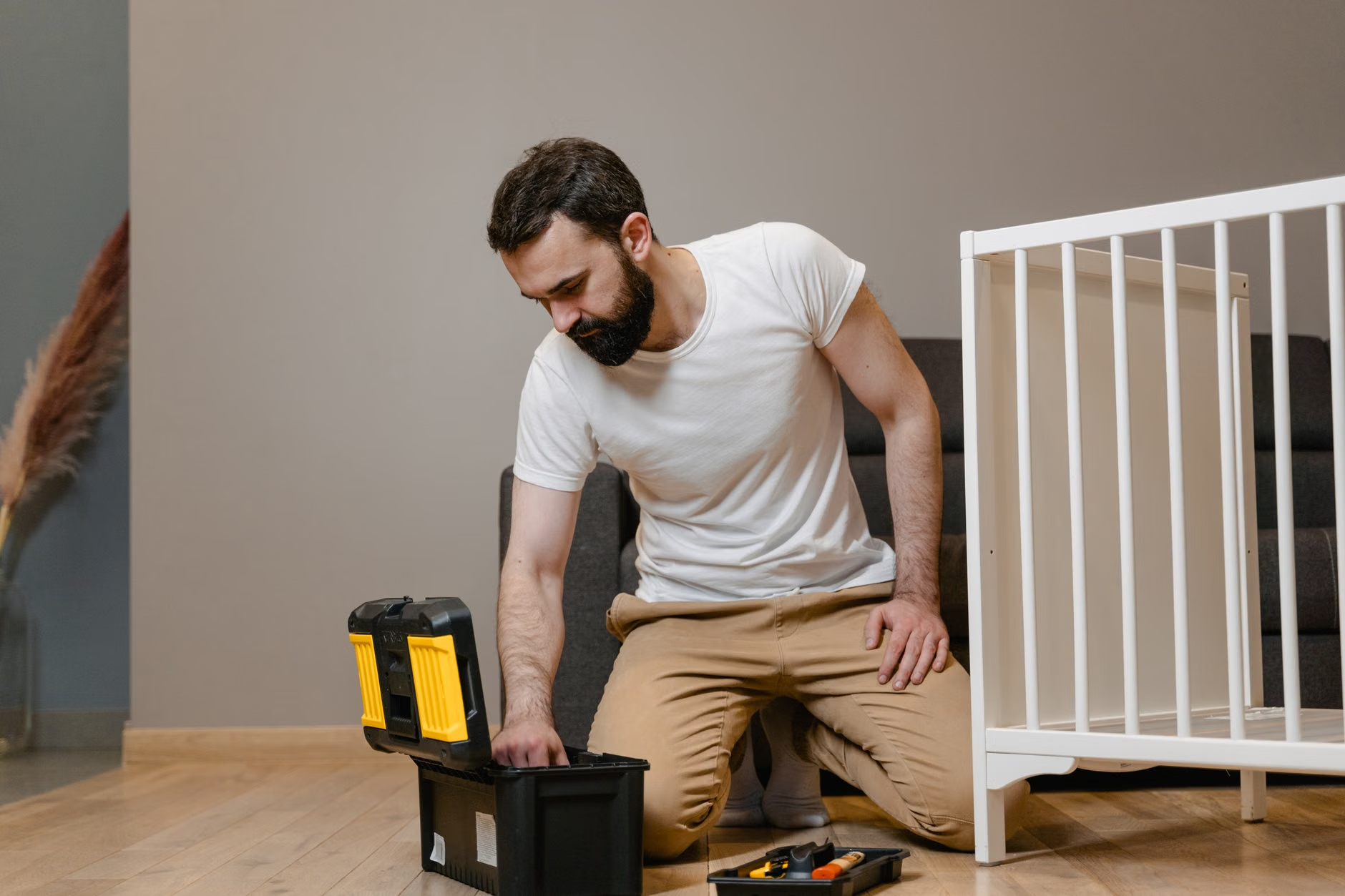
Why Ownership is Often a Trap for Urban Families
In our 30s and 40s, we reach a stage where home maintenance becomes a constant, nagging background task. Whether you are a homeowner or a long-term renter, the list of necessary equipment seems endless. You need a drill for the kids’ furniture, a sander for that thrifted coffee table, or a pressure washer for the patio once a year. When you add these up, the financial cost is staggering. A decent quality cordless drill set alone can cost $150. A decent power washer is $300. A wet-dry vacuum is $100. You have suddenly spent nearly $600 on items that, collectively, will be used for maybe ten hours of labor per year.
Beyond the financial hit, there is the “storage tax.” If you live in an urban center, square footage is the most expensive commodity you possess. Using a closet or a corner of your laundry room to store a heavy-duty ladder or a collection of specialized wrenches is effectively paying rent for your tools to sit idle. This clutter adds to the mental load of parenting; every time you open a cupboard and see a pile of neglected hardware, it serves as a subconscious reminder of unfinished projects. The library model eliminates this by decoupling the need to complete a task from the requirement to own the equipment.
How the Library Model Changes Your Workflow
The transition to a library model requires a shift in mindset. You move from a reactive state—”I need this, I must buy it”—to a planned state—”I need this, I will check it out on Saturday.” This shift actually encourages better project management. Because you have a limited loan period (usually one to two weeks), it creates a natural deadline for your DIY tasks. If you check out a wallpaper steamer, you are incentivized to get the job done within the week, which prevents that half-finished project from lingering for months.
Furthermore, these libraries are often staffed by retired professionals or hobbyists who are happy to offer advice. When you buy a tool at a big-box store, you are on your own with the manual. When you borrow from a library, you are often entering a community of practice. You can ask, “What is the best way to anchor this into drywall?” and get a real-world answer from someone who has done it a hundred times. This reduces the risk of making an expensive mistake—like drilling into a pipe or ruining your wall—which is a hidden cost of DIY that many people overlook.

Calculating the Real-World Savings: A Case Study
To understand the impact, let’s look at a typical annual home project list for a family in an apartment or small townhouse. We will compare the cost of purchasing new equipment versus the annual membership fee of a standard community tool library, which typically ranges from $40 to $100 per year.
| Project | Tool Needed | Purchase Cost | Library Rental Cost |
|---|---|---|---|
| Assemble Kids’ Furniture | Impact Driver | $160 | $0 (Included) |
| Spring Cleaning | Carpet Cleaner | $250 | $0 (Included) |
| Patio Maintenance | Pressure Washer | $350 | $0 (Included) |
| Decorating/Renovating | Laser Level/Stud Finder | $80 | $0 (Included) |
| Total | $840 | $60 (Membership) |
The numbers speak for themselves. Even after paying an annual membership fee, you are saving nearly $800 in the first year alone. This does not even account for the cost of maintaining those tools (battery replacements, oil changes for gas engines, storage upkeep) or the depreciation of the equipment. When you borrow, the library handles the maintenance. If a drill bit dulls or a battery dies, you return it and swap it for a functional one. You are effectively outsourcing the headache of tool ownership.
The first step is locating a facility. Many cities have dedicated “Tool Libraries” or “Library of Things” programs. Start by searching for “tool library near me” or checking with your local municipal library system. Increasingly, public libraries are expanding their services beyond books to include everything from baking pans to specialized electronics and tools. If your city does not have a dedicated facility, look for “Maker Spaces” or “Community Workshops.” Many of these organizations offer memberships that grant you access to their tool inventory.
Once you find a location, there are three criteria you should evaluate before signing up:
- Inventory Depth: Check their online catalog. Do they have the specific, specialized tools you actually need for your home type? If you live in an apartment, you need different things (small power tools, hand tools) than someone in a detached house (large lawn equipment, heavy-duty saws).
- Reservation System: A good library has an online reservation system. If you have to show up and hope they have a tool, it’s not a viable solution for a busy parent.
- Training Requirements: Ensure they offer orientation or safety training. Some high-powered tools require a quick safety check-off before you are allowed to check them out. This is a positive sign—it shows they care about your safety and the longevity of their equipment.
Common mistakes beginners make include failing to check the tool before leaving the premises or forgetting to return it on time. Just like a book library, late fees can accrue, though they are usually nominal. Treat the borrowed tool with the same care you would if you had paid $300 for it. Wipe it down after use and ensure all components are returned to the case. This builds your reputation as a reliable borrower, which often leads to “priority access” for high-demand items during peak seasons like spring or autumn.
Hidden Benefits: Social Capital and Sustainability
Beyond the math, there is a profound social benefit to this model. In our 30s, we often feel the isolation of modern parenting. We are busy, we are tired, and we often lack the “village” that our parents had. A tool library is a third space—a place that isn’t work and isn’t home, where you meet people with shared interests. You might strike up a conversation with a neighbor while picking up a jigsaw, leading to a connection that eventually results in a babysitting swap or a shared carpool arrangement. These organic community links are the bedrock of urban resilience.
Sustainability is another major factor. We are all trying to reduce our environmental footprint, but it is hard to do when consumer culture tells us to buy new for every minor task. By sharing a single drill among fifty households, you reduce the demand for raw materials and energy-intensive manufacturing. You are effectively shrinking your consumption without sacrificing your ability to maintain your home. It is one of the few “lifestyle hacks” that is genuinely better for the planet and your wallet simultaneously.
Addressing Potential Concerns
A common apprehension is: “What if I break it?” It is a valid concern, but most tool libraries have policies in place for this. Typically, normal wear and tear is expected and covered by your membership fees. If you break a tool through negligence, you might be asked to cover the cost of the repair or replacement, which is no different than if you had broken your own tool. However, because these tools are commercial-grade (more durable than what you find at a consumer big-box store), they are often much harder to break than the cheap versions you might be tempted to buy for yourself.
Another concern is hygiene and cleanliness. If you are borrowing a tool that touches dirt, like a shovel or a pressure washer, check how the library cleans them. Most reputable organizations have a rigorous cleaning protocol. If you are particularly sensitive, simply bring a pair of gloves or a disinfectant wipe. In practice, the tools are usually cleaner than those sitting in the average homeowner’s garage because they are subject to regular inspection by the staff.
Decision Criteria for Your Next Project
Before you commit to a purchase, use this quick checklist to decide if you should borrow instead:
- Frequency: Will I use this tool more than once every six months? If no, borrow.
- Storage: Do I have a dedicated, dry, and secure place to store this? If no, borrow.
- Cost: Is the purchase price more than 20% of my monthly discretionary spending? If yes, borrow.
- Skill Gap: Do I need instruction on how to use this safely? If yes, borrow from a library where staff can provide a quick demo.
If you find that you are using a borrowed tool constantly—say, a specific type of screwdriver you use every single week—then you have found a genuine need for ownership. At that point, you can make an informed, confident purchase, knowing exactly what model you like and why. You aren’t guessing; you are making a data-backed decision based on actual usage patterns.
Closing Thoughts for the Modern Parent
The transition to a community-based tool model is about reclaiming agency. We are often sold the idea that we need to be self-sufficient in a way that is actually just “consumer-sufficient”—meaning we are dependent on constant purchasing. True self-sufficiency in an urban environment looks more like knowing how to fix a leaky faucet, how to assemble a desk, and how to maintain a home, all while being connected to a network of resources that makes that possible without breaking the bank.
Start small. Don’t try to get rid of your entire garage or tool chest overnight. The next time you have a project, resist the urge to order a tool online. Look up your local library or tool-sharing network. Take that first step of borrowing, and you will likely find that the process is easier, cheaper, and more rewarding than you ever expected. It is a small change in behavior that pays dividends in space, money, and community connection.
Frequently Asked Questions
What if my local area doesn’t have a formal tool library?
If a dedicated library doesn’t exist, check neighborhood apps like Nextdoor or local Facebook groups. Often, neighbors are willing to lend tools if you offer a small deposit or a trade. Alternatively, consider starting a “tool circle” with 3-4 trusted friends or neighbors. By pooling your existing tools, you create a mini-library that serves the same purpose without the need for a formal organization.
Are borrowed tools reliable and safe for serious home projects?
Most established tool libraries curate their inventory with high-quality, professional-grade tools that are often more reliable than entry-level consumer tools. They are typically maintained by volunteers or staff who perform routine safety checks. If you are ever unsure about a tool’s condition, ask the staff for a quick demonstration or a status update on its maintenance history.
Do I need a truck or a large vehicle to use a tool library?
Most community tool libraries are designed with urban dwellers in mind and focus on tools that are portable via public transit, bicycle, or small car. For larger items like heavy-duty lawn equipment, they often provide transport recommendations or have partnerships with local delivery services. Always check the inventory description online to confirm the size and weight before you plan your trip.
For further reading on the circular economy and community resource sharing, you may want to explore the LocalTools.org network, which tracks and supports the development of tool libraries globally.