The EU AI Act officially classifies most AI-enabled smart toys as “High-Risk,” forcing manufacturers to meet strict safety and privacy standards before they can ever reach your child’s playroom.
Key Takeaways
- Smart toys are now legally “High-Risk”: Because they interact with vulnerable children, toys using AI must undergo rigorous third-party safety assessments.
- Manipulation is strictly banned: The law prohibits AI from using “subliminal techniques” that could lead children to engage in dangerous behaviors or harmful habits.
- Global standards are shifting: Even if you live outside the EU, the “Brussels Effect” means most global toy brands will adopt these higher safety standards for all markets.
If you have a kid in the house, you’ve probably seen the “smart” revolution hit the toy aisle. It started with dolls that could repeat a few phrases and has quickly spiraled into AI-powered robots that recognize your child’s face, remember their favorite color, and hold actual conversations. It sounds like something out of a sci-fi movie, but for us parents in our 30s and 40s, it often feels more like a privacy headache waiting to happen.
We’ve all had that moment of hesitation: “Is this thing recording us? Where is that data going? Can it be hacked?” Up until recently, the answer was often a shrug and a “maybe.” But the European Union has stepped in with the EU AI Act, the world’s first comprehensive law governing artificial intelligence. While it’s a massive piece of legislation, its impact on the toys our children play with is one of its most practical and immediate benefits.
Let’s break down what this law actually does, why it treats a talking teddy bear with the same caution as a self-driving car, and how it changes the way we’ll shop for birthdays and holidays from here on out.
The Risk Hierarchy: Why Your Kid’s Robot Just Got a “High-Risk” Label
The EU AI Act doesn’t treat all AI the same. It uses a “risk-based approach,” which is basically a fancy way of saying: the more damage an AI can do, the stricter the rules. Most people assume “high-risk” AI refers to things like facial recognition used by police or algorithms that decide who gets a bank loan. However, the Act explicitly places AI-enabled toys under the High-Risk category.
Why? Because children are considered “vulnerable users.” Their cognitive development is still in progress, making them more susceptible to influence, emotional bonding with machines, and privacy violations. When a toy uses AI to respond to a child’s voice or emotions, it’s not just a toy anymore; it’s a data-collection device interacting with a minor.
Under the new rules, any toy that falls into this high-risk category must meet a mountain of requirements before it can be sold. This includes detailed logging of how the AI makes decisions, strict data governance to ensure the AI isn’t “learning” bad habits from biased data, and—most importantly—a high level of human oversight. Manufacturers can no longer just “set it and forget it.”

Stopping the “Digital Pied Piper”: Bans on Manipulation
One of the scariest parts of AI in toys is the potential for behavioral manipulation. Imagine a smart toy that subtly encourages a child to ask their parents for a specific brand of cereal, or worse, one that gamifies dangerous physical stunts. The EU AI Act draws a hard line here by prohibiting AI systems that use subliminal techniques to distort a person’s behavior in a way that causes physical or psychological harm.
This isn’t just about preventing “evil” robots. It’s about preventing “dark patterns” in play. In the past, some connected toys were found to have security flaws that allowed strangers to talk to children through the toy’s speaker. The AI Act tackles the intent and design of the software itself. If an AI is designed to exploit a child’s trust to drive engagement or sales, it is now illegal in the EU.
For us parents, this means a shift in the market. We are moving away from the “Wild West” of connected toys where anything goes, toward a regulated environment where “safety” includes a child’s mental and emotional well-being, not just making sure the toy doesn’t have small parts they can swallow.
Data Privacy: Your Living Room is Not a Data Mine
We’ve all seen the headlines about smart speakers accidentally recording private conversations. When that happens in a child’s bedroom, the stakes are significantly higher. Smart toys often use “Natural Language Processing” (NLP) to understand what a child is saying. In many older models, that audio was sent to a cloud server, analyzed, and sometimes even stored indefinitely.
The EU AI Act, working in tandem with the GDPR (General Data Protection Regulation), sets a much higher bar for this. High-risk AI systems must ensure that data sets are high-quality and free of biases. More importantly, they must be transparent. If a toy is collecting biometric data—like your child’s voiceprint or facial features—the requirements for consent and security are incredibly stringent.
Manufacturers are now incentivized to move toward “Edge AI”—where the processing happens on the toy itself rather than in the cloud. This is a huge win for privacy. If the data never leaves the toy, it can’t be leaked from a server or sold to third-party advertisers. When you’re looking at a new gadget, “Local Processing” is the keyword you want to see.
The “Brussels Effect”: Why This Matters Outside of Europe
You might be thinking, “I live in the US (or Canada, or Australia), so why does an EU law matter to me?” This is where the “Brussels Effect” comes in. Large toy companies like Mattel, Lego, and Hasbro operate globally. It is incredibly expensive and logistically difficult for a company to design two completely different versions of a high-tech toy—one that is “safe” for Europe and one that is “less safe” for everyone else.
To keep supply chains simple, most global manufacturers will likely adopt the EU’s strict standards as their global baseline. We saw this happen with the USB-C charger requirement and with website privacy banners. By setting the world’s toughest rules, the EU effectively raises the floor for safety everywhere. When you buy a smart toy in a few years, there’s a high chance its safety features were designed to satisfy a regulator in Brussels, benefiting your family regardless of your zip code.
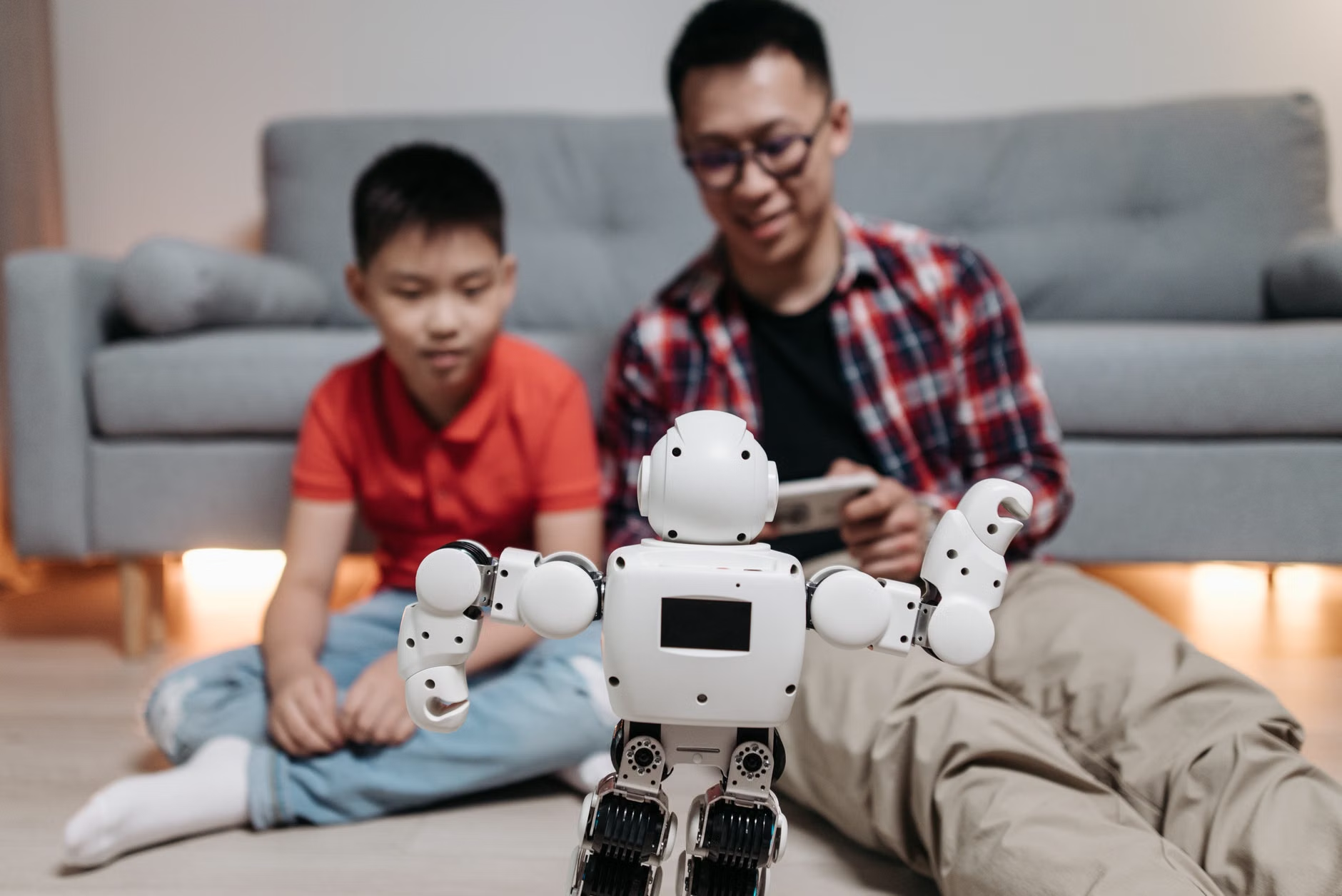
Comparing Toy Types: What’s Actually “High-Risk”?
Not every toy with a battery is an AI threat. It’s important to distinguish between “connected toys” and “AI toys.” The following table helps clarify where the EU AI Act focuses its energy.
| Toy Category | How it Works | Risk Level under EU AI Act | What Parents Should Watch For |
|---|---|---|---|
| Traditional Electronic Toys | Pre-recorded sounds, simple sensors (e.g., light-up cars). | Minimal/Low | Physical safety (batteries, small parts). |
| Connected/IoT Toys | Connects to Wi-Fi/Bluetooth but uses basic logic (e.g., remote control via app). | Limited | Unsecured Bluetooth connections and weak passwords. |
| AI-Driven Smart Toys | Uses AI to learn, adapt, recognize faces, or hold dynamic conversations. | High-Risk | Data privacy, emotional manipulation, and “Always-on” microphones. |
As you can see, the “High-Risk” label is reserved for toys that try to “think” or “interact” autonomously. If the toy has a camera that recognizes who is in the room or a microphone that analyzes the tone of a child’s voice to respond with empathy, it’s in the high-stakes category.
The Practical Shopping Checklist for Parents
While the law does the heavy lifting, we still have to make the final call at the checkout counter. Here is a decision-making framework for your next tech-toy purchase:
- Check for the “CE” Mark (and future AI compliance marks): In Europe, the CE mark will eventually signify compliance with the AI Act. Look for updated packaging that mentions AI safety standards.
- Look for a “Physical Mute” or “Camera Shutter”: The best security is physical. If a toy has a microphone, does it have a physical switch to turn it off? If it has a camera, can it be covered?
- Read the “Offline Mode” Capability: Does the toy need to be connected to Wi-Fi to function? If a toy can perform 90% of its functions offline, it’s inherently safer.
- Research the Manufacturer’s Track Record: Stick to established brands that have a reputation to lose. Startups often have cool tech but lack the budget for the robust security teams required by the AI Act.
- Ask about “Data Retention”: Check the privacy policy (or a summary of it). Does the company delete voice recordings after a certain period? If they keep them forever, put the toy back on the shelf.
Potential Pitfalls: What the Law Can’t Fix
No law is perfect. One major concern with the EU AI Act is the “Innovation Gap.” Some critics argue that the high cost of compliance will drive smaller, creative toy companies out of the market, leaving only the giant corporations. For parents, this might mean fewer choices or higher prices for high-tech toys.
Another issue is “Social Scoring” in toys. While the Act bans social scoring by governments, there is a gray area regarding toys that “rank” children’s performance or behavior. If a smart toy tells a child they are a “bad boy” because they didn’t finish a puzzle, that could have psychological impacts that a set of regulations might struggle to quantify. We still need to be the primary observers of how these toys affect our children’s moods and self-esteem.

Future-Proofing Your Playroom: Beyond the Hype
We are entering the era of “Generative AI” toys—think of a teddy bear powered by something like ChatGPT. These toys will be able to tell infinite bedtime stories and answer any question a child has. The EU AI Act specifically addresses these “General Purpose AI” models, requiring them to be transparent about the fact that the content is AI-generated.
For us, the goal isn’t to ban these toys. Technology can be an incredible tool for learning and creativity. The goal is to ensure that the “magic” of a talking toy doesn’t come at the cost of our children’s privacy or safety. The EU AI Act is a massive step toward making the digital world as safe as the physical one.
Next time you see a “revolutionary” new robot in the store, don’t just look at the cool features. Look for the signs that the company has respected the new rules of the road. Our kids deserve a childhood where their toys are playmates, not undercover data analysts.
Official Sources and Further Reading
- European Commission: Regulatory Framework for AI
- European Parliament: EU AI Act Explained
- Toy Industries of Europe (TIE) – Safety Standards
Frequently Asked Questions
1. When do these smart toy regulations actually take effect?
The EU AI Act was recently approved and is being rolled out in stages. Most of the requirements for “High-Risk” systems, including smart toys, will become mandatory within 24 to 36 months. However, many manufacturers are already changing their designs to be ready in advance.
2. Can I still buy smart toys from international sites like AliExpress or Temu?
You can, but be very cautious. Toys sold directly from outside the EU may not comply with these new safety standards. If a toy doesn’t have clear information about its AI safety or data processing, it’s better to avoid it, as it likely hasn’t undergone the rigorous third-party testing required by the Act.
3. How can I tell if a toy uses “High-Risk” AI just by looking at the box?
Currently, you have to look for features like voice recognition, cameras that track movement, or “adaptive learning” claims. In the near future, look for the CE mark and a declaration of AI compliance in the manual. If the toy claims to “get to know your child,” it’s almost certainly using the type of AI regulated by this law.
The bottom line: The EU AI Act is the legal guardian we didn’t know we needed. It moves the burden of safety from the parent’s shoulders to the manufacturer’s assembly line. While we still need to stay vigilant, we can finally look forward to a future where “smart” doesn’t have to mean “creepy.” Happy (and safe) playing!