- Consistency beats duration: Going to bed at the same time is more effective for long-term energy levels than trying to “catch up” on sleep during weekends.
- The 90-minute rule: Sleep happens in cycles; aiming for sleep durations that are multiples of 90 minutes helps prevent waking up during deep sleep, which causes morning grogginess.
- External cues matter more than internal willpower: You cannot “force” sleep, but you can engineer your environment (temperature, light, noise) to make it biologically inevitable.
If you are a parent in your 30s or 40s, you likely know the feeling of being “tired-wired”—that strange state where you are physically exhausted but your brain won’t shut off after a day of managing school runs, work deadlines, and household logistics. The problem isn’t always that you aren’t getting enough sleep; it is often that the quality of the sleep you do get is being sabotaged by micro-habits you don’t even notice.
Most sleep advice fails because it treats parents like college students with flexible schedules. You don’t have the luxury of “sleeping in” or taking a three-hour afternoon nap. This audit is designed to identify the specific friction points in your routine and replace them with high-leverage, low-effort changes.

The Biology of Your Bedtime Buffer
Before changing your habits, you need to understand the “Bedtime Buffer.” This is the 60-minute window before you actually hit the pillow. Most parents use this time for “revenge bedtime procrastination”—staying up late because it is the only time of the day they have complete control over their own choices.
While this feels like freedom, it is actually a physiological trap. Your body relies on a drop in core body temperature and a rise in melatonin to initiate sleep. When you engage in high-stimulation activities (like scrolling social media or finishing late-night work) during this buffer, you are essentially telling your brain that it is still mid-afternoon. The goal of this audit is not to “go to bed earlier” but to “prepare the brain to switch off” so that when you finally do hit the pillow, you fall asleep within 15–20 minutes.
The 90-Minute Sleep Cycle Framework
Sleep is not a flat line; it is a series of 90-minute cycles. If you wake up in the middle of a deep-sleep phase, you will feel “sleep inertia”—that heavy, confused, and groggy feeling that can last for hours. By aligning your sleep time to a multiple of 90 minutes (e.g., 6 hours, 7.5 hours, or 9 hours), you increase the odds of waking up at the end of a cycle, which makes you feel significantly more alert.
Actionable Rule: If you need to wake up at 6:30 AM, count back in 90-minute blocks. 5:00 AM, 3:30 AM, 2:00 AM, 12:30 AM, 11:00 PM. Aiming for an 11:00 PM bedtime is mathematically superior to a 10:30 PM bedtime if it means you wake up at the end of a cycle rather than in the middle of deep sleep.
Auditing Your Environment: The “Dark, Cool, Quiet” Checklist
We often blame our stress for poor sleep, but frequently, the culprit is environmental. As we age, our sleep becomes more fragile. A noise that wouldn’t have woken you at 20 will absolutely pull you out of sleep at 40. Conduct a physical audit of your bedroom using the following criteria.
| Category | The Goal | The Fix |
|---|---|---|
| Temperature | 18°C (65°F) | Use a fan or lower the thermostat; body heat needs to dissipate to trigger sleep. |
| Light | Total Darkness | Blackout curtains or a high-quality silk sleep mask. |
| Noise | Constant or Silent | White noise machine to mask inconsistent neighborhood or household sounds. |
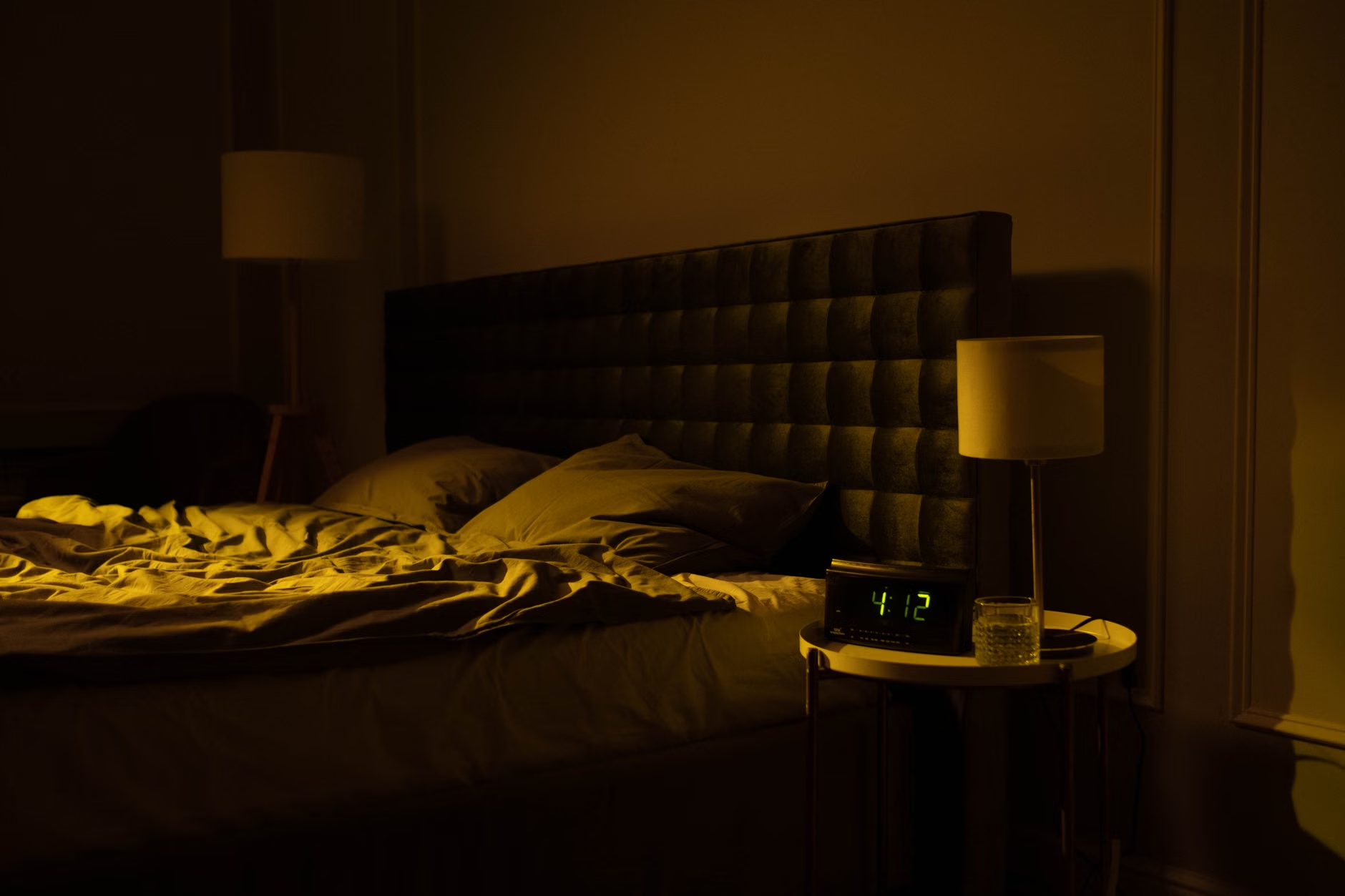
Why this matters: Your body temperature naturally dips at night. If your room is too warm, your body struggles to shed that heat, keeping you in a lighter stage of sleep. If you are a parent with young children, you might be tempted to keep the door cracked or leave a hall light on. This is a common mistake. If you must have light for safety, use a low-lumen, warm-toned (red/amber) nightlight rather than a blue-toned LED.
The Blue Light Paradox and Digital Hygiene
We have all heard that “blue light is bad.” But for the busy parent, the real issue is not just the light—it is the content. When you check your work email or scroll through stressful news headlines right before bed, your amygdala (the brain’s threat-detection center) activates. You are essentially asking your brain to solve complex problems or process emotional data at the exact moment you need it to be in a state of “nothingness.”
The “Digital Sunset” Rule
Implement a “Digital Sunset” 45 minutes before sleep. This does not mean you have to stop using screens entirely if that is unrealistic for your lifestyle. Instead, apply these filters:
- Shift the content: If you must use a screen, avoid anything that requires “executive function” (emails, banking, scheduling). Switch to passive, low-stakes content like a calm documentary or an audiobook.
- The 50% Rule: Dim your screen brightness by at least 50%.
- Night Mode: Ensure “Night Shift” or “Eye Comfort Shield” settings are active on all devices to filter out the most aggressive blue light wavelengths.
The Hidden Cost: Many parents use their phones as alarm clocks. This is a massive mistake. By placing the phone within arm’s reach, you are inviting the “temptation loop.” If you wake up at 3:00 AM, the phone is right there. It is too easy to check the time, see a notification, and suddenly be fully awake. Move the charger to the other side of the room or, better yet, buy a traditional analog alarm clock.
Managing the “Parenting-Sleep” Conflict
Let’s be realistic: if you have an infant or a toddler, your sleep will be fragmented. You cannot “audit” your way out of a crying child. However, you can manage your reaction to that fragmentation. The most common mistake parents make is “catastrophizing” the wake-up. You wake up, check the clock, and immediately think, “I only have three hours left. I am going to be a wreck tomorrow.”
This internal monologue creates a stress response (cortisol spike) that makes it physically harder to fall back asleep. Instead, practice the “Neutral Observer” approach. When you wake up, acknowledge it without judgment. “I am awake. That is fine. I will rest my eyes and breathe deeply.” By removing the emotional weight from the wake-up, you allow your nervous system to return to a parasympathetic (restful) state much faster.

Supplements and Caffeine: Separating Myth from Reality
There is a lot of noise about sleep supplements. Before you spend money on magnesium, melatonin, or specialized teas, understand the mechanics. Caffeine has a “half-life” of roughly 5 to 6 hours. If you have a cup of coffee at 4:00 PM, half of that caffeine is still active in your system at 9:00 PM or 10:00 PM. It might not keep you from falling asleep, but it will significantly reduce the amount of deep, restorative sleep you get.
The Caffeine Cut-Off Rule
For most people, the “10-2-1” rule is the gold standard for sleep hygiene:
- 10 hours before bed: No more caffeine.
- 2 hours before bed: No more food (digestion interferes with deep sleep).
- 1 hour before bed: No more work or screens.
If you find yourself needing caffeine to function every single day, you are likely dealing with a “sleep debt” that cannot be fixed by supplements. Supplements like magnesium glycinate can be helpful for muscle relaxation, but they are not a substitute for a disciplined caffeine cut-off time.
The “Brain Dump” Technique
Often, the reason you can’t sleep is that your brain is trying to “hold” all your tasks for the next day. You are afraid you will forget the school permission slip or the deadline for that report. Your brain is essentially running “background processes” that keep you awake.
The Fix: Keep a notebook by your bed. Before you turn out the light, spend five minutes writing down everything you are worried about or need to do tomorrow. Once it is on paper, your brain no longer feels the need to “loop” the information to ensure you don’t forget it. This is a simple cognitive offloading technique that is surprisingly effective.
Addressing the “Weekend Trap”
We often try to “catch up” on sleep on Saturday and Sunday mornings. While it feels good in the moment, it disrupts your circadian rhythm, leading to “social jetlag.” If you wake up at 6:30 AM on weekdays and 10:30 AM on weekends, your body essentially thinks you are traveling across four time zones every week. To keep your energy consistent, try to keep your wake-up time within 60 to 90 minutes of your weekday schedule.
Common Misconceptions About Sleep Hygiene
There is a pervasive myth that you need “perfect” silence to sleep. In reality, total silence can make every small noise (a creaking floorboard, a car passing by) sound amplified. This is why many people find white noise, pink noise, or brown noise helpful. These sounds create a “blanket” of consistency that prevents your brain from reacting to sudden, sharp noises.
Another misconception is that exercise right before bed is always bad. While high-intensity interval training (HIIT) will definitely keep you awake due to the adrenaline spike, gentle yoga or stretching can actually help lower your body temperature and signal to your brain that it is time to wind down. The key is the intensity, not the movement itself.
Finalizing Your Personal Sleep Audit
You don’t need to change everything at once. In fact, doing so will likely increase your stress levels, which is counterproductive. Pick one area from this audit—perhaps the caffeine cut-off or the digital sunset—and test it for one week. See how your energy levels change during the day. Sleep hygiene is an iterative process. It is about stacking small, evidence-based wins until your routine feels less like a chore and more like a natural, restorative part of your day.
Remember, the goal is not to be a perfect sleeper. The goal is to be a resilient one. By creating a reliable environment and managing your inputs, you give your body the best possible chance to recover from the demands of modern parenting.
Frequently Asked Questions
Q: Is it okay to use a sleep tracker app?
A: Sleep trackers can be useful for identifying patterns, but be careful of “orthosomnia”—the obsession with achieving a perfect sleep score. If the tracker causes you anxiety when you see a “low score,” it is doing more harm than good. Use it for data, not for validation.
Q: What if I have to wake up for my child in the middle of the night?
A: Keep the lights low and your interactions minimal. The goal is to keep your own brain in a “sleep state” even while you are physically active. Avoid checking your phone or turning on bright overhead lights, as these signal to your brain that it is “time to be awake.”
Q: Does taking a hot bath really help?
A: Yes, it is science. When you get out of a hot bath, your body temperature drops rapidly as the heat dissipates from your skin. This rapid drop is a powerful biological signal to your brain that it is time to initiate sleep. Just ensure the bath is at least an hour before you want to fall asleep.
For further reading on sleep science and circadian rhythms, you can refer to the official resources provided by the National Sleep Foundation, which offers evidence-based insights into sleep hygiene and common disorders.