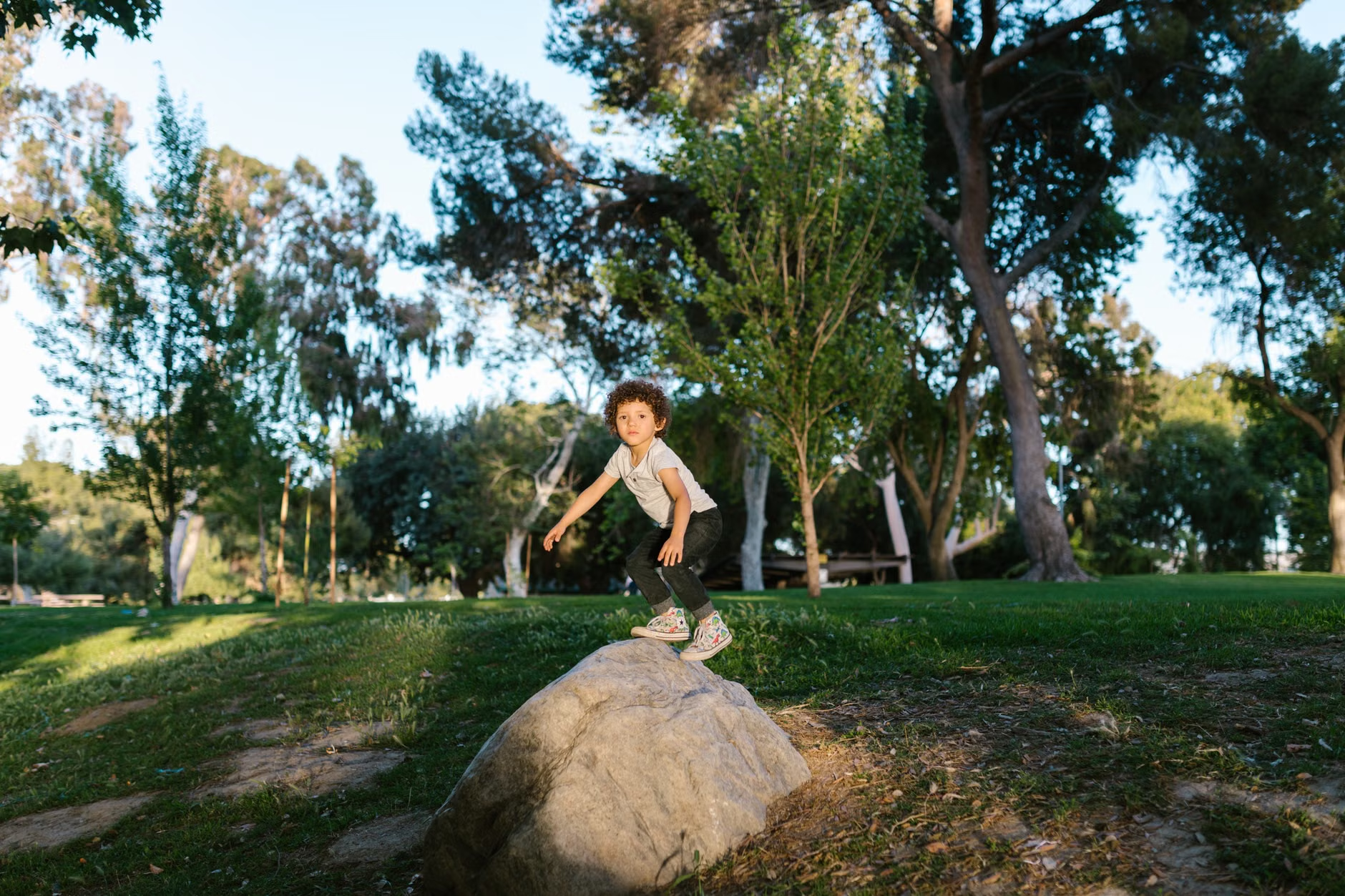
The most important thing to understand about toddler nature-play is that “risk” is not the same thing as “danger.” While danger is a situation that could lead to serious harm, risk is a challenge that allows a child to test their own limits, build physical coordination, and develop the mental resilience necessary for adulthood.
Key Takeaways
- Distinguish between hazards and challenges: A hazard is an unpredictable danger (like a hidden rusted nail), while a challenge (like a slippery log) is an opportunity for skill-building.
- Adopt the 10-second rule: When a child encounters a perceived risk, wait 10 seconds before intervening to see if they can solve the physical problem themselves.
- Implement the Risk-Benefit Assessment (RBA): You don’t have to eliminate risk; you only need to ensure the potential developmental gain outweighs the likelihood of a minor injury.
If you have ever stood at the edge of a playground or a wooded trail, heart hammering, watching your two-year-old attempt to climb a rock that looks just a little bit too high, you know the feeling. It is a specific type of parental anxiety—the “hovering” instinct. We are biologically wired to protect our children, but in our modern, safety-obsessed world, we have inadvertently stripped away the very obstacles that teach children how to handle the world. The shift from “keeping them safe” to “keeping them capable” is the core of modern nature-play.
The Crucial Difference: Hazards vs. Challenges
When we talk about risk, we often lump everything into one bucket. However, developmental psychologists and outdoor educators distinguish between two types of environmental features: hazards and challenges. Understanding this distinction is the single most effective way to lower your own stress levels while increasing your child’s developmental opportunities.
Hazards are unacceptable risks. These are environmental factors where the child has no control and the outcome is potentially severe. Examples include broken glass in the sand, a deep, hidden hole, a road with active traffic, or toxic plants. These are things you must mitigate, fence off, or remove entirely. They offer no educational value and pose a genuine threat.
Challenges are developmental opportunities. These are features like uneven terrain, low-hanging branches, slippery logs, or steep embankments. When a child approaches these, they are forced to engage their proprioception (the body’s ability to sense movement and location), problem-solving skills, and physical strength. The child has control over how they interact with the challenge. If they slip, the consequence is usually a minor scrape or a bruised ego—not a trip to the emergency room.
In practice, you should look at your environment with a “hazard-first” lens. Sweep the area for glass, needles, or heavy debris. Once those are gone, stop looking for ways to “fix” the terrain. If you fill in every dip in the ground or remove every stump, you are removing the curriculum of the forest. The goal is to create an environment that is “as safe as necessary, not as safe as possible.”
The Risk-Benefit Assessment (RBA) for Parents
You don’t need a formal degree in child development to run a risk-benefit assessment. It is a mental framework that takes about five seconds to execute. Before you shout “Be careful!” or rush to catch them, run through this simple mental checklist:
| Factor | Question to Ask | Decision Rule |
|---|---|---|
| Skill Level | Has my child done this or something similar before? | If yes, allow them to attempt it. If no, stay within arm’s reach. |
| Consequence | If they fail, is the injury likely to be minor or severe? | Minor (scrapes, tears) = Allow. Severe (broken bones, concussions) = Intervene. |
| Control | Does the child have agency over the movement? | If they are choosing the path, allow. If they are being pushed or are out of control, intervene. |
This table isn’t just about safety; it’s about calibration. If your child is constantly protected from minor consequences, they never learn the “physics” of their own body. They don’t learn how gravity works, how friction feels, or what happens when they lose their balance. By allowing them to experience the minor “failure” of a stumble, you are teaching them to recalibrate their next attempt. That is a skill that will serve them for the rest of their lives.
The 10-Second Rule: Why Silence is a Tool
One of the most common mistakes parents make in nature-play is the constant, verbal commentary. “Watch out for that root,” “Careful, it’s slippery,” “Don’t go too far.” While intended to keep them safe, this constant stream of warnings actually prevents the child from focusing on the environment. They are listening to you, not the physical world.
Try the 10-second rule. When you see your child approaching a challenging situation, take a breath. Count to ten. Watch their body language. Are they looking at the ground? Are they testing the stability of the log with their foot? If they are actively engaged in assessing the risk themselves, stay silent. Let them work through the physical puzzle.
Often, you will find that the child stops, shifts their weight, and finds a way to navigate the obstacle that you wouldn’t have thought of. If they get stuck, ask an open-ended question instead of giving a command. Instead of saying “Don’t climb that,” try “How are you going to get your foot up there?” This shifts the burden of risk assessment from your brain to theirs. You are training them to be their own safety officer.
The Hidden Benefits of “Risky” Play
The term “risky play” in academic literature refers to play that involves the possibility of physical injury. While it sounds counterintuitive, research consistently shows that children who engage in risky play are actually *less* likely to suffer serious accidents as they age. This is because they have developed a higher degree of physical literacy and better judgment regarding their own capabilities.
Consider the difference between a child who is always carried or pushed in a stroller on flat pavement and a child who spends three hours a week walking on uneven forest floors. The second child is constantly engaging their core, their ankles, and their visual-spatial processing. They are learning to navigate change. When they eventually face a real-world hazard, they are much more likely to have the balance and reflex speed to avoid a major injury.
Furthermore, there is the psychological component. When a child successfully navigates a “scary” obstacle on their own, they experience a surge of competence. They realize, “I can do hard things.” This is the foundation of grit. If we remove every hurdle, we aren’t just removing danger; we are removing the opportunity for the child to build the internal belief that they are capable of handling the world.
Practical Steps to Start Today
If you are used to a more controlled environment, jumping straight into deep-woods exploration can feel overwhelming. Start by slowly expanding the boundaries of your comfort zone using these practical steps:
- Start with familiar territory: Go to a local park or a backyard area you know well. Let the child explore the perimeter while you sit on a bench. Your goal is to be “present but passive.”
- Increase the complexity, not the height: Don’t look for higher trees to climb. Look for more complex textures. A pile of logs, a muddy patch, a rocky stream bed—these provide high sensory and motor-skill feedback without the need for significant height.
- Model the assessment: Talk out loud about your own risk assessment. “Hmm, this rock looks a bit wet and slippery. I think I’ll step over here instead.” By vocalizing your process, you are teaching them the logic of safety rather than just the rules of safety.
- Prepare for the “mess” factor: Often, parents restrict movement because they are worried about clothes or clean-up. Accept that nature-play involves dirt, mud, and water. Dress them in gear that you don’t mind getting ruined. When the fear of a ruined outfit is removed, you will find yourself being much more permissive of their exploration.
Common Misconceptions and How to Avoid Them
One common misconception is that “nature-play” requires a vast, untouched wilderness. This is simply not true. You can conduct a high-quality risk assessment in a small urban park or even a backyard. The “nature” part is about the variety of the terrain, not the acreage of the land. If you only have access to a small patch of grass, create interest by bringing in a few logs, a large cardboard box, or even just some loose stones. The goal is to provide an environment that changes and responds to their touch.
Another pitfall is the “fear of the fall.” We see a toddler trip and our immediate reaction is to pick them up and comfort them. While comfort is necessary if they are truly hurt, if they just trip and land on their hands, pause. Watch. Often, a toddler will look at you to gauge your reaction. If you look panicked, they will cry. If you stay calm and say, “Whoops, you tripped! Are you okay?” they will often just brush off their hands and keep moving. Your reaction dictates their emotional response to the risk.
Finally, avoid the “equipment trap.” You do not need expensive, specialized outdoor gear for your toddler to have a meaningful experience. In fact, too much gear can sometimes hinder their movement. Sturdy shoes that allow for good ground feel are better than stiff, heavy hiking boots. Layers are better than a bulky, restrictive snowsuit. Focus on gear that allows for maximum mobility and sensory feedback.
The Long-Term View: From Toddler to Independent Explorer
As your child grows, the nature of your risk-benefit assessment will change. When they are two, you are physically present to catch them. When they are four, you are observing from a distance. When they are six or seven, you are likely setting boundaries for a larger area, such as “stay within sight of the big oak tree.”
The goal is to gradually transfer the responsibility of risk assessment from your brain to theirs. By the time they are a teenager, you want them to be able to look at a situation—whether it’s a physical challenge in the woods or a social challenge at school—and ask themselves: “What are the risks here? What is the benefit? Do I have the skills to handle this?”
This is not a process that happens overnight. It is built in the small, seemingly insignificant moments of a toddler climbing a stump. It is built in the seconds you spent waiting for them to solve the problem. It is built in the trust you showed by letting them explore their own limits.
Ultimately, parenting is a long game of letting go. Every time you allow your child to safely navigate a small risk, you are proving to yourself and to them that they are capable. You are building their confidence one scraped knee at a time. It can be nerve-wracking to watch them navigate the world, but the payoff is a child who is not only safer in the long run but also more confident, more capable, and more connected to the world around them.
If you find yourself struggling with the urge to intervene, remember that your job isn’t to remove the obstacles from their path. Your job is to make sure they have the tools—the balance, the judgment, and the resilience—to climb over them, walk around them, or find a better way forward. The forest is waiting, and your toddler is ready to explore it. Take a deep breath, step back, and let them lead the way.
Frequently Asked Questions
What should I do if my toddler gets injured during nature play?
First, remain calm. Assess the injury objectively. If it is a minor scrape, bump, or bruise, clean it with water, provide some light comfort, and encourage them to continue their play if they are able. If the injury involves a deep cut, persistent pain, or a head injury, remove them from the environment immediately and seek medical attention. The key is to distinguish between a “lesson” injury (a scrape) and a “medical” injury (a deep wound).
Is there a specific age when I should start letting my child play “risky” games?
Risk assessment starts as soon as a child can move. Even a crawling baby is assessing the risk of a rug or a soft pillow. By the time they are walking and climbing, they are ready for small, age-appropriate challenges. Start small—like walking over a slightly uneven surface—and scale up as their coordination improves. There is no magic age; it depends entirely on your child’s physical development and your ability to observe them closely.
How do I handle other parents who might judge me for letting my child climb or get dirty?
This is a common source of social anxiety for parents. The best approach is to be confident in your philosophy. You can say something like, “I’m focusing on building his physical confidence and problem-solving skills today.” Most of the time, when people see your child successfully navigating a challenge, their judgment turns into curiosity. You don’t need to convince them, but being firm in your own boundaries will make you feel less self-conscious.
For more information on the principles of risky play and child development, visit the Play Scotland resource hub, which provides extensive research and practical guides on the value of outdoor play.