The core of the “post-growth” parenting movement is the realization that family well-being is tied to time-wealth and community connection, rather than the relentless acquisition of new goods and services. By decoupling your family’s happiness from consumer consumption, you can reduce household stress, lower your carbon footprint, and reclaim hours previously spent managing “stuff.”
Key Takeaways
- Circular Economy over Ownership: Shifting to community toy libraries and clothing swaps reduces costs by up to 40% annually while teaching children the value of shared resources.
- Time-Wealth Metrics: True post-growth parenting prioritizes “time-wealth”—the ability to choose how your day is spent—over income-driven status symbols.
- Intentional Consumption: Adopting a “one-in, one-out” rule and prioritizing multi-use, durable goods prevents the “clutter tax” that consumes both physical space and mental bandwidth.
If you are in your 30s or 40s, you likely remember a childhood that felt slower, yet you are currently navigating a parenting landscape defined by “optimization.” We are told to buy the latest educational tech, upgrade to the biggest SUV for safety, and enroll in every extracurricular activity to “give them an edge.” But there is a growing disconnect: despite having more, we are feeling more overwhelmed, more in debt, and, frankly, more exhausted. This is where the post-growth movement offers a practical exit ramp.
The Reality of the “Clutter Tax” in Urban Parenting
In dense urban environments, space is a premium commodity. Yet, many families find their living areas shrinking under the weight of plastic toys, outgrown clothes, and “must-have” gadgets that were used exactly once. This is what economists and psychologists now call the “clutter tax.” It isn’t just a financial cost; it’s a cognitive one.
Research suggests that a cluttered environment increases cortisol levels, particularly for parents who feel the constant pressure to organize, clean, and manage these items. When you have too many choices—whether it’s toys, clothes, or meal options—you experience decision fatigue. By the time you reach the end of a workday, your ability to make intentional, patient parenting decisions is depleted by the sheer volume of low-stakes choices you’ve already made.
How to audit your “Clutter Tax”:
- The 90-Day Rule: If an item hasn’t been used in 90 days, it is costing you space and mental energy. Remove it.
- The Surface Test: Look at your primary living room surfaces. If every square inch is covered, you are likely over-indexed on consumption.
- The Replacement Cost: Ask yourself, “If this broke today, would I spend the time and money to replace it?” If the answer is no, it doesn’t belong in your home.
Post-growth parenting isn’t about deprivation; it is about curation. By removing the excess, you create a “negative space” that allows for deeper play, better focus, and a significant reduction in household maintenance time.
Shifting from “Consumer” to “Member” of a Circular Economy
The traditional model of parenting is linear: buy, use, discard. The post-growth model is circular: borrow, use, repair, share. This is not just an environmental stance; it is a profound shift in how you interact with your community.
Many urban centers now offer “Library of Things” or toy libraries. These services allow families to borrow high-quality, expensive items like specialized building sets, kitchen gadgets, or seasonal gear for a fraction of the retail cost. This solves two problems: the lack of storage space and the financial strain of keeping up with a child’s rapidly changing developmental interests.

Implementing a Circular Household:
| Category | Traditional Path | Post-Growth Path |
|---|---|---|
| Toys | Buying new, storage issues | Local toy library or swap groups |
| Clothing | Fast fashion, high turnover | Second-hand platforms or clothing circles |
| Tools/Gear | Buying for one-time use | Borrowing from neighbors/libraries |
The primary barrier to this is the “newness bias.” We are conditioned to believe that new equals better or cleaner. However, when you frame the use of shared resources as a way to provide your child with more variety rather than less stuff, the psychological friction disappears. It also teaches children that value is derived from utility rather than ownership status.
The Financial Advantage of Time-Wealth
For parents in their 30s and 40s, time is the scarcest currency. The post-growth movement argues that if you lower your cost of living by consuming less, you effectively increase your “time-wealth.” This is the ability to work fewer hours, take more time off, or simply move at a pace that doesn’t require constant scheduling and logistics.
Consider the “lifestyle creep” that occurs as your career progresses. Often, as income increases, so does consumption. By consciously choosing to opt out of this cycle, you can reach a “financial plateau” where your needs are met, your savings are growing, and you are no longer tethered to a high-stress, long-hour career to support an inflated lifestyle. This is not about being poor; it is about being intentional. It is about buying back your weekends from the maintenance of a lifestyle you don’t actually enjoy.
Decision Rule for Financial Intentionality:
Before any major purchase, calculate the “cost in hours.” If you earn $50 per hour after taxes, a $500 toy isn’t just $500—it is 10 hours of your life. Is the item worth 10 hours of your time away from your family? Most of the time, the answer is no.

Repairing and Maintaining: The Lost Art of Resilience
One of the most radical acts in a post-growth society is fixing what you already own. We have become a culture of disposability, where a broken chair or a torn jacket is an excuse to buy something new. This is not just a waste of money; it is a lost opportunity to teach children about mechanics, textiles, and the value of labor.
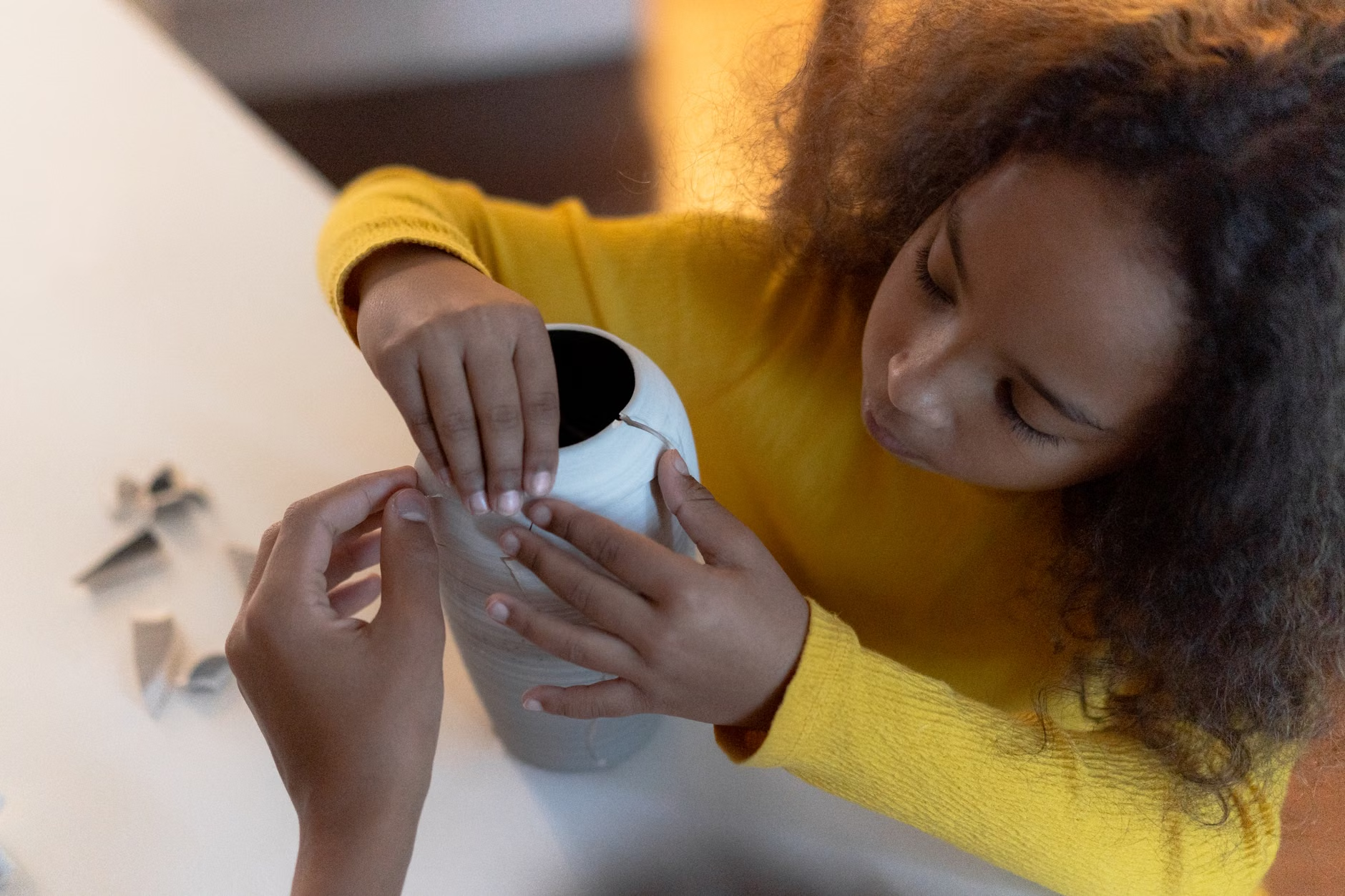
When you involve your child in the repair process—whether it’s gluing a toy, sewing a button, or cleaning a bicycle chain—you are teaching them that they are capable of affecting their environment. You are moving them from a passive consumer role to an active participant role. This builds resilience. A child who knows how to fix their own belongings is less likely to feel distressed when something breaks and more likely to feel a sense of agency.
Step-by-Step Repair Integration:
- The “Repair First” Bin: Keep a designated box for items that need minor fixes. Don’t throw it out immediately.
- Source Knowledge: Use platforms like iFixit or local maker spaces to learn basic repair skills. You don’t need to be an expert; you just need to be willing to try.
- Model the Process: Let your children see you fail at a repair. It shows that perfection is not the goal; persistence is.
One of the hardest parts of the post-growth movement is the social aspect. We live in a society where status is often signaled by what we own. Choosing to have a “smaller” life can sometimes feel like you are failing to provide the “best” for your children. This is a common misconception.
The “best” for a child is rarely a specific brand of shoe or the latest console. The “best” is a parent who is present, calm, and not constantly worried about the next bill or the next organizing project. When you choose to step out of the consumer cycle, you may face questions from friends or family. Have a clear, non-defensive answer: “We’ve found that having fewer things makes our daily life much easier, and we’re prioritizing experiences over objects.”
Remember that the goal is not to be a martyr for sustainability. The goal is to design a life that works for you. If you love high-end gear, that is fine—but keep it to a minimum, ensure it is durable, and use it until it falls apart. The post-growth movement is about the pattern of consumption, not the total absence of it.
Common Pitfalls and How to Avoid Them
As you transition into this lifestyle, there are a few common traps to watch out for:
- The “Minimalist” Trap: Don’t throw everything away just to start over. Use what you have until it is truly unusable. Buying “minimalist” aesthetic items to replace functional items you already own is just another form of consumption.
- The “Comparison” Trap: Don’t compare your “less” to someone else’s “more.” Focus on your own metrics: stress levels, available time, and financial stability.
- The “All-or-Nothing” Trap: You don’t have to overhaul your entire life overnight. Start by choosing one category, like clothing or toys, and applying post-growth principles there first.
Consistency is more important than intensity. Small, incremental changes—like joining a local swap group or committing to one repair session per month—will compound over time, leading to a significantly different lifestyle within a year.
Final Thoughts: The Power of Intentionality
The post-growth movement is not a temporary trend; it is a necessary evolution for families living in an era of infinite demands and finite resources. By shifting your focus from the accumulation of goods to the cultivation of time and community, you are effectively “future-proofing” your family.
You are building a foundation based on resilience, skill, and presence. While the world may continue to push the message that you need more to be happy, your daily life will prove otherwise. Start small, stay curious, and remember that the most valuable things you can provide for your family—time, attention, and a sense of agency—cannot be bought in a store.
Frequently Asked Questions
1. Does post-growth parenting mean I have to stop buying gifts for my children?
Not at all. It means shifting the nature of gifts. Instead of plastic toys that are forgotten in a week, consider gifts that facilitate shared experiences, such as museum memberships, art supplies, or high-quality tools that grow with them. The goal is to prioritize longevity and connection over quantity.
2. How do I deal with family members who insist on buying my children a lot of gifts?
This is a common challenge. Be proactive. Share a “wish list” that includes consumables (like craft supplies), experiences (like tickets to a show), or items you are already planning to get. If they insist on physical gifts, suggest a “one-in, one-out” policy, or keep a small bin for donations to ensure the influx doesn’t overwhelm your space.
3. Is this movement only for those with a lot of extra time?
Actually, it is the opposite. The post-growth movement is a strategy to gain time. While it takes an initial investment of effort to set up systems like toy libraries or repair routines, it significantly reduces the long-term time cost of cleaning, organizing, and managing excess goods. It is a trade-off: spending time upfront to save time (and money) in the long run.
Official Resources for Further Exploration: