The secret to surviving the school-year transition isn’t working harder; it’s identifying the “invisible” tasks that occupy your working memory and systematically offloading them.
- Cognitive load is finite: Your brain has a limited capacity for processing information; when you hold “to-do” items in your head, you reduce your capacity for patience and decision-making.
- The “Audit” method works: By mapping out every recurring task—from school forms to grocery cycles—you can identify what can be automated, delegated, or eliminated.
- Externalization is non-negotiable: Moving information from your brain to a shared digital or physical system is the most effective way to lower anxiety during high-intensity periods like the start of a school term.
If you have felt like you are running a marathon in lead boots since the kids went back to school, you are not alone. The “school-year transition” is a specific type of cognitive overload. It isn’t just about the physical labor of buying supplies or packing lunches; it is the sheer volume of decisions you have to make every morning. What time is the bus? Did I sign that permission slip? Which child has soccer practice today? These aren’t big, life-altering problems, but in aggregate, they create a persistent background hum of stress that drains your executive function.
In your 30s and 40s, you are likely managing your own career, a household, and the shifting needs of growing children. When the school schedule changes, your “operating system” gets an update, and usually, it crashes. Let’s look at how to perform a cognitive-load audit to stabilize your home environment.
What is ‘Cognitive Load’ and Why Does It Spike in September?
Cognitive load refers to the amount of mental effort being used in your working memory. Think of your brain like a computer’s RAM. When you have too many tabs open—”Did I pay the music lesson fee?” “What are we having for dinner?” “Is the uniform clean?”—the computer slows down. It freezes. You might feel irritable, forgetful, or unable to focus on your actual work.
Psychologists distinguish between three types of cognitive load: intrinsic (the difficulty of the task itself), extraneous (the way information is presented, like a messy school email chain), and germane (the effort of creating a permanent schema for doing things). During the school transition, your extraneous load skyrockets. You are inundated with emails, apps, and forms. If you don’t process this information into a “schema”—a repeatable system—you are forced to re-process the same information daily.
Why this matters for your 30s and 40s: You are in the “sandwich generation” or the “peak career” phase. You have less margin for error than you did in your 20s. A minor slip-up, like forgetting a school event, can cause a cascade of guilt and logistical chaos that ruins your entire week. The audit is your way of reclaiming that margin.

The Step-by-Step Audit: Mapping Your Mental Inventory
To conduct an audit, you need to stop guessing what is stressful and start documenting it. For one week, carry a small notebook or open a note-taking app on your phone. Every time you feel a spike of anxiety or a “don’t forget” thought, write it down. Do not filter it. Just capture the noise.
Once you have a list, categorize these tasks into three buckets: Automate, Delegate, or Eliminate.
1. Automate: Removing the Decision Fatigue
If a task happens every week, it shouldn’t require a decision. This is the biggest source of wasted cognitive load. For example, if you are constantly wondering what to pack for lunch, you are wasting mental energy. Create a “Lunch Matrix.” Monday is always sandwiches, Tuesday is leftovers, Wednesday is pasta salad, etc. By standardizing the input, you remove the decision. You aren’t “choosing” lunch; you are following a protocol.
2. Delegate: The ‘Not My Job’ Reality Check
Many parents in their 30s and 40s fall into the trap of “hyper-responsibility.” You think, “I can do it faster, so I will.” This is a cognitive trap. If your partner or older children are capable of performing a task, they must do it. This isn’t about the quality of the work; it’s about the distribution of the cognitive load. If you are the only one holding the “mental map” of the family schedule, you are the only one who can fail. That is an unsustainable position.
3. Eliminate: Questioning the ‘Shoulds’
Look at your list of tasks. How many are there because of social pressure or habit, rather than necessity? Do you really need to bake for the school fundraiser? Is it essential to attend every single PTA meeting, or can you read the minutes later? If a task doesn’t directly contribute to the well-being of your family or your own sanity, cut it. Your goal is to simplify, not optimize.
Building a ‘Single Source of Truth’ for Family Logistics
The most common mistake parents make is having a “distributed” system. The schedule is in your head, the school info is in an email, the grocery list is on a scrap of paper, and the chores are mentioned in passing. This is a recipe for disaster. You need a Single Source of Truth (SSOT).
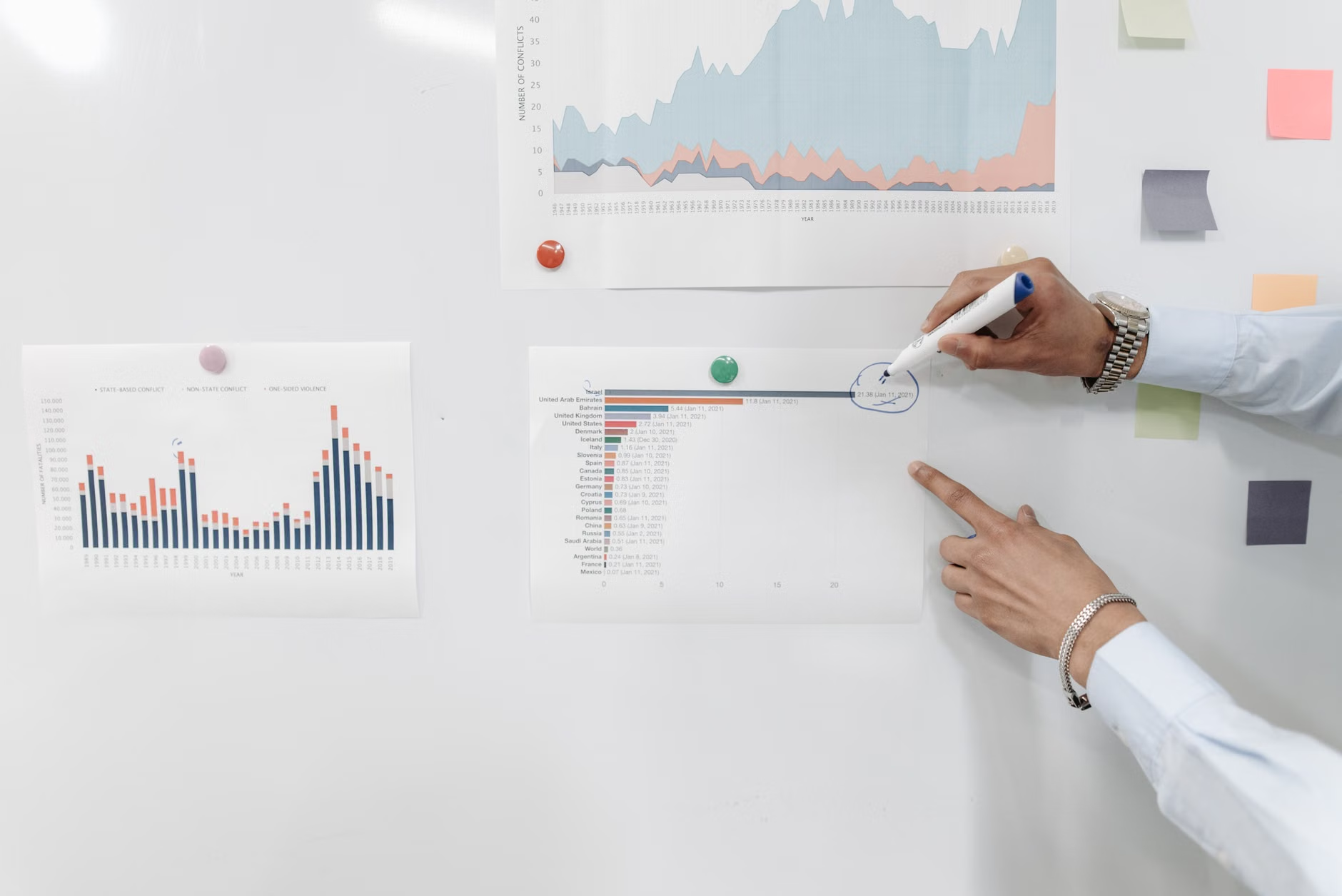
An SSOT is one location where all information lives. If it isn’t in the SSOT, it doesn’t exist. For many families, this is a shared digital calendar (like Google Calendar or iCloud) combined with a physical whiteboard in the kitchen.
| Tool | Best For | Cognitive Benefit |
|---|---|---|
| Shared Digital Calendar | Time-sensitive events (appointments, school pickups) | Prevents double-booking and “surprise” events. |
| Shared Notes App | Ongoing lists (groceries, school supply needs) | Removes the “did I remember to add milk?” worry. |
| Physical Whiteboard | Immediate visual reminders (chores, dinner plan) | Provides a quick “glance-and-go” view for the family. |
The Rule of the SSOT: If an event is not added to the calendar immediately upon receiving the information, it is considered “lost.” Do not trust your memory. Your memory is for living life, not for storing school drop-off times.
Addressing the ‘Hidden’ Costs of Transition
Beyond the logistics, there is the emotional transition. Children are also experiencing cognitive load. When they return to school, they are processing new teachers, new social dynamics, and new academic pressures. When they come home, their “bucket” is often full. This is why you see “after-school restraint collapse”—where children are perfectly behaved at school but melt down the moment they walk through your front door.
If you are already at your limit, you won’t have the capacity to handle their overflow. By performing your own audit and lowering your load, you create the “emotional bandwidth” to act as the container for their stress. This is not just about being a “good parent”; it is about structural stability. When you are calm, you can help them regulate. When you are overloaded, everyone spirals.
Common Misconception: Many people believe that “relaxing” means doing nothing. But if your brain is still churning through a list of 50 unfinished tasks, you aren’t relaxing. True rest requires externalization. You must write the tasks down so your brain feels safe to let them go. A brain that has been “offloaded” can actually engage in restorative activities like reading, exercise, or simply staring at a wall.
Practical Implementation: A 3-Day Reset Plan
If you feel like you are drowning, do not try to fix everything at once. Use this 3-day plan to reset your cognitive environment.
- Day 1: The Brain Dump. Dedicate one hour to writing down everything you are currently worried about or responsible for. Use a notebook. Do not organize it yet. Just get it out of your head.
- Day 2: The Categorization. Review your list. Mark each item as “Must do this week,” “Can be delegated,” or “Can be ignored for now.” If it’s a “Must do,” add it to your SSOT (calendar or shared app).
- Day 3: The Communication. Have a 15-minute family meeting. Review the calendar and the “new” distribution of labor. Be clear about expectations. “I will handle the morning routine, you handle the evening cleanup.”
Don’t expect the system to be perfect on the first try. You will likely forget to add something to the calendar. That is okay. The goal is to move from a state of reactive chaos to proactive management. Over time, this becomes a habit, and the cognitive load of the school year will feel significantly lighter.

The Role of ‘Micro-Rest’ in Maintaining Capacity
Even with a perfect system, life will throw curveballs. A sick child, a last-minute work meeting, or a car breakdown will happen. When this occurs, your cognitive load will spike again. This is where “micro-rest” becomes vital. Micro-rest is not a weekend away; it is a 5-minute interval where you completely disconnect from the “manager” role.
What does this look like in real life? It looks like sitting in your car for five minutes before walking into the house. It looks like putting your phone in a drawer for thirty minutes after the kids go to bed. It is a deliberate act of choosing *not* to process information. Your brain needs these gaps to consolidate what it has learned and to recover from the stress of the day. If you fill every gap with scrolling or planning, you never actually recover.
One overlooked variable is the “digital noise” of the school year. School apps, parent group chats, and email newsletters can be a major source of extraneous load. If you find yourself checking these incessantly, turn off non-essential notifications. Check them at a specific time of day (e.g., 4:00 PM). By batching your information intake, you stop the constant “ping” that interrupts your focus and adds to your load.
Addressing the Trade-Offs
It is important to acknowledge that there are trade-offs to being this organized. You may occasionally miss a niche social event because you didn’t check the “optional” folder in your email. You might have to say “no” to a request from a school volunteer coordinator. Some people may view this as being “less involved.”
But you must weigh this against the cost of burnout. If you are exhausted and snapping at your family, your “involvement” is not effective. By setting boundaries and managing your cognitive load, you are ensuring that when you *are* involved, you are present, patient, and capable. That is a far more valuable contribution to your family than being a stressed-out, over-committed participant.
Remember that the school-year transition is a marathon, not a sprint. You don’t need to have the perfect system by week one. You need a system that is flexible enough to change as the year progresses. If a process stops working, audit it again. Change it. Adapt. The goal isn’t a static, perfect life; the goal is a sustainable one.
Final Thoughts on Sustaining Your Well-being
The transition into the school year is a high-pressure period that exposes every crack in your household management. If you feel overwhelmed, it is a sign that your current systems are no longer sufficient for the level of demand you are facing. Use the audit process to identify the bottlenecks, externalize your mental to-do list, and lean into delegation.
Your brain is your most valuable asset. Do not waste it on holding grocery lists or remembering permission slip deadlines. Use it for the things that actually matter: your relationships, your personal growth, and your own downtime. By offloading the mundane, you make room for the meaningful. Start small, stay consistent, and give yourself grace as you navigate the inevitable hiccups of the season.
Frequently Asked Questions
1. What if my partner isn’t willing to participate in the ‘Single Source of Truth’ system?
Start by sharing the burden, not the system. Instead of asking them to adopt your tool, ask them to take ownership of a specific “domain” of the household (e.g., “You are responsible for all sports logistics”). If they own the domain, they will naturally need to find a way to track it. Often, once they realize the complexity of that task, they will be more open to using your shared system.
2. Is it really necessary to write everything down? Can’t I just use my memory?
Your memory is vulnerable to stress. When you are tired or anxious, your recall drops significantly. Writing things down (externalizing) isn’t about lack of intelligence; it’s about acknowledging your biological limits. By offloading, you free up your working memory to handle the complex, non-routine problems that inevitably arise during the school year.
3. How do I handle school apps that send constant notifications?
Most school communication platforms allow you to adjust notification settings. Go into the app settings and turn off push notifications for anything that isn’t an emergency (like school closures). Instead, set a recurring calendar reminder for yourself to check the app once a day. This moves the interaction from “interruptive” to “scheduled,” which is a massive win for your cognitive load.
For further reading on managing family logistics and reducing household mental load, you can consult resources from organizations like the American Psychological Association on managing stress and executive function.