The most effective way to foster resilience in pre-teens is to shift the focus from their inherent intelligence to the specific strategies they use to overcome obstacles.
- Process-based praise is non-negotiable: Shift your feedback from “You are so smart” to “I noticed how you tried a different approach when the first one didn’t work.”
- Normalize the ‘Learning Pit’: Resilience isn’t about avoiding failure; it is about teaching your child that the feeling of confusion is actually the feeling of the brain building new connections.
- The 10-13 transition window: Pre-teens are uniquely capable of metacognition—thinking about their own thinking—making this the optimal age to teach them how to debug their own problem-solving processes.
If you have a child between the ages of 10 and 13, you have likely encountered the “I’m just not good at this” wall. It usually happens right when schoolwork gets abstract or a hobby shifts from “fun” to “technically demanding.” As parents, our instinct is often to offer reassurance: “Yes, you are, you’re brilliant!” or “Just try a little harder.”
The problem? Neither of those responses helps. In fact, telling a child they are “smart” creates a fragility where they fear that failing will prove they aren’t smart after all. Telling them to “try harder” is often useless because they don’t know how to change their approach. They are already trying; they just don’t have the tools to navigate the frustration.
Understanding the ‘Growth Mindset’ Beyond the Buzzword
The term “growth mindset,” coined by psychologist Carol Dweck, has become a staple of modern educational jargon, but it is frequently misunderstood. It is not simply about telling children they can do anything if they “believe.” It is about understanding that the brain is a muscle that physically changes when it encounters a challenge. For a pre-teen, this is a powerful, tangible concept.
At this age, children are experiencing a massive neurological “pruning” and “rewiring.” They are moving from concrete thinking to abstract reasoning. When they face a difficult math problem or a complex coding challenge, their brain is literally struggling to forge new synaptic pathways. If we frame this struggle as “I’m not smart enough,” they shut down. If we frame it as “My brain is currently under construction,” they gain a sense of agency.
The shift from static to dynamic: A fixed mindset views intelligence and talent as a “fixed pie”—you have a certain amount, and that is it. A growth mindset views intelligence as an “expanding pie.” The difference in outcome is massive. Research consistently shows that students with a growth mindset are more likely to seek out difficult tasks, whereas those with a fixed mindset avoid them to protect their reputation for being “smart.”

Why Pre-Teens Need a Different Approach Than Younger Kids
When children are five, growth mindset is taught through stories about trying again. When they are 12, they are far more cynical. They know when you are trying to “manipulate” their motivation with empty platitudes. To reach them, you need to be precise, logical, and evidence-based.
The Trap of ‘Praising the Effort’ Incorrectly
Many parents assume that “praising effort” means saying “Good job for trying” even when the child fails miserably. This can actually feel patronizing. If a 12-year-old spent four hours on a project and it still looks mediocre, they know it. If you say “Great effort,” they may think you are pitying them.
Instead, focus on the strategy. Ask: “What was the most difficult part of that process? What did you try when you hit that wall? Is there a different way to look at this?” This moves the conversation from a judgment of their character to a technical analysis of their work. It shifts the role of the parent from “cheerleader” to “coach.”
The Metacognitive Advantage
Pre-teens are at the prime age for metacognition. This is the ability to monitor and regulate their own cognitive processes. You can explicitly teach them how to use this. When they are frustrated, ask them to “debug” their approach. This is a term they understand from gaming or technology. If a game level is impossible, they don’t quit; they look up a walkthrough or change their character’s loadout. Applying this “debugging” logic to school or social challenges is a highly effective way to build resilience.
Practical Frameworks for Daily Resilience Building
How do we actually integrate this into the chaotic schedule of family life? It doesn’t require a special curriculum. It requires changing the “feedback loop” in your house.
1. The ‘Not Yet’ Strategy
When your child says, “I don’t get this,” add the word “yet.” It sounds simple, but it creates a timeline for success. It implies that the current state of “not getting it” is temporary. To make this effective, you must follow up with, “What is the next step you need to take to get closer to understanding?”
2. Modeling the ‘Learning Pit’
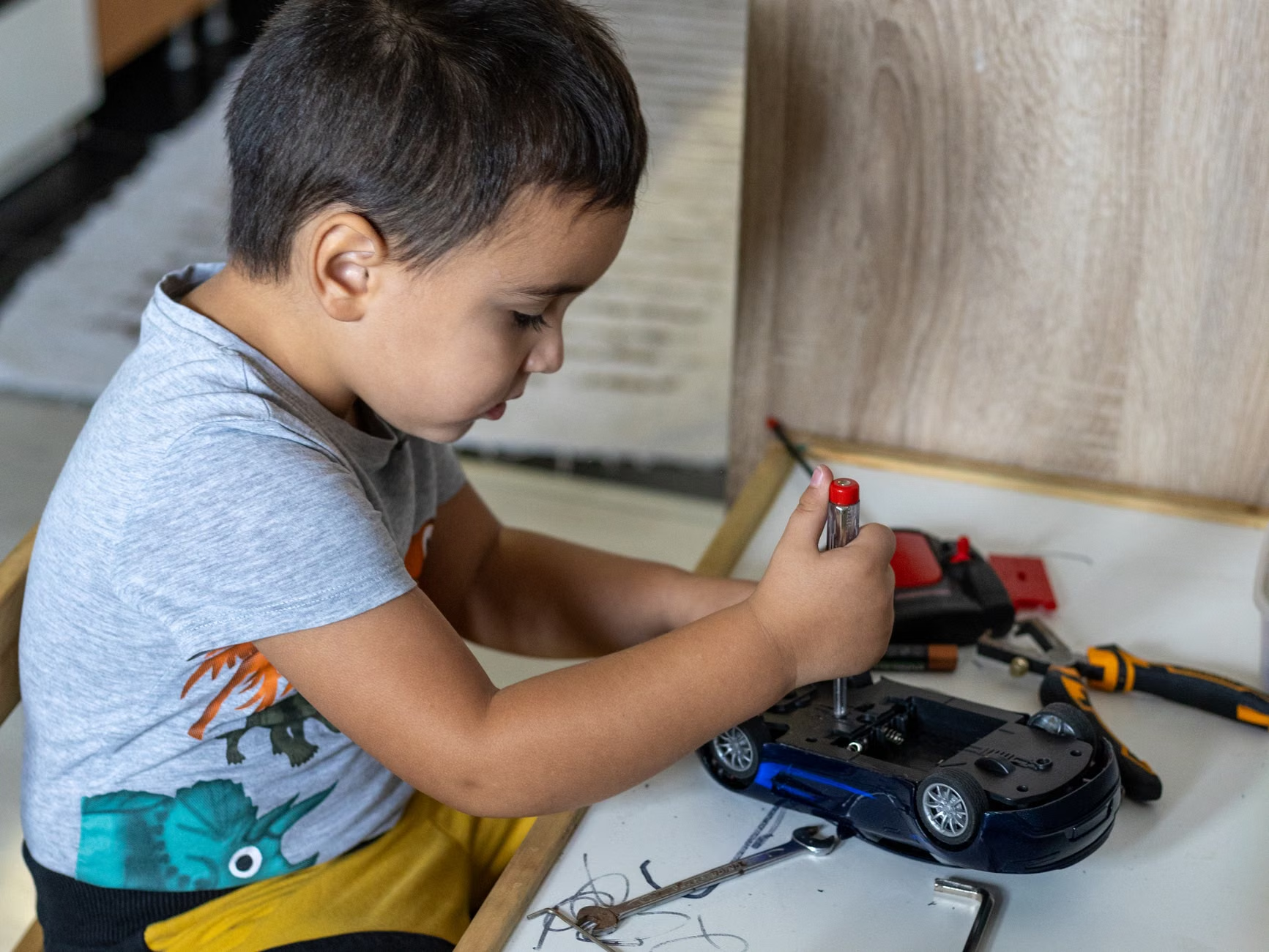
Resilience is caught, not taught. If you are constantly complaining about your own work or giving up on home repairs because “you aren’t good at that,” your child is observing your fixed mindset. Talk about your own challenges. “I had a really hard time with this report today because the data was messy. I had to scrap my first draft and try a completely different organizational structure. It was annoying, but the second draft was much better.”
3. The ‘Failure Resume’
For pre-teens, failure feels like a permanent stain on their identity. Encourage them to keep a “learning journal”—not a diary, but a place to record things that went wrong and, more importantly, what they learned from them. This turns failure into data points rather than character flaws.
| Scenario | Fixed Mindset Response | Growth Mindset Coaching |
|---|---|---|
| Child fails a test | “Don’t worry, you’re still smart.” | “Let’s look at the errors. Was it a lack of understanding or a poor study strategy?” |
| Child quits a sport | “It’s okay, you weren’t into it.” | “What part was frustrating? Was it the skill itself or the practice routine?” |
| Child gets an ‘A’ easily | “You’re a natural at this!” | “That seemed to be a bit easy for you. What would you like to challenge yourself with next?” |
The table above illustrates the difference between providing comfort and providing tools. The goal is to ensure that the child feels capable of navigating their own limitations.
The Hidden Variables: When ‘Growth Mindset’ Isn’t Enough
It is important to be realistic. A growth mindset is not a cure-all. If your child is struggling because of an undiagnosed learning disability, a mental health issue, or a toxic social environment, telling them to “change their mindset” can be harmful and invalidating. This is a common mistake parents make: using “growth mindset” as a way to avoid addressing systemic issues.
The “Condition” Check: Before pushing for more resilience, perform a reality check. Is the task developmentally appropriate? Is the child getting enough sleep? Is there an underlying anxiety disorder being masked as “laziness”?
If your child is showing signs of extreme perfectionism, this is often a sign of a fragile growth mindset. They are terrified of failing because they believe they *should* be able to master everything quickly. In this case, you need to explicitly lower the stakes. Encourage “low-stakes failure.” Let them try a hobby they are guaranteed to be bad at, just for the sake of being a beginner.
Implementing a ‘Resilience Audit’ in Your Household
If you want to move from theory to practice, start with a “Resilience Audit.” For one week, pay attention to the language used in your home. Are you praising outcomes (grades, wins, trophies) or processes (persistence, strategy, adaptation)?
Step-by-Step Action Plan:
- Identify the ‘Trigger’ Areas: Pick one area where your pre-teen frequently shuts down (e.g., homework, chores, specific sports).
- Label the Frustration: Next time they hit a wall, acknowledge the feeling. “I see you’re frustrated. That’s a normal part of the learning process.”
- Ask for a ‘Strategy Pivot’: Instead of helping them solve the problem, ask: “You’ve tried X, and it didn’t work. What is one other strategy we could try? Could we look at the instructions again? Could we break this into smaller pieces?”
- Celebrate the ‘Pivot’: If they try a new strategy, acknowledge it even if they still don’t succeed. “I love that you tried a different approach. That is exactly how you solve complex problems.”
This approach moves the focus from the result (which they cannot always control) to the process (which they can). It empowers them to see themselves as scientists of their own lives, testing hypotheses and adjusting based on the results.

Common Misconceptions That Sabotage Your Efforts
One common trap is the “Over-Praising” trap. Parents often think that if a little encouragement is good, a lot is better. However, research from Stanford suggests that excessive praise can actually make children more dependent on external validation. They start looking for your approval rather than developing their own internal sense of competence.
Another misconception is that growth mindset training should be a “lecture.” Please, do not give your pre-teen a lecture on growth mindset. They will roll their eyes and tune you out. Instead, make it part of your casual conversation. Use the “I wonder” technique. “I wonder why this is so difficult for us right now. Do you think we’re missing a piece of information, or do we just need a different strategy?”
Finally, avoid the “False Growth Mindset.” This occurs when parents tell children, “You can do anything you want if you try hard enough.” This is statistically false and sets the child up for a crash. A better approach is: “If you want to achieve this, you will need to develop specific skills and strategies. It will be hard, and you will fail along the way, but the process of failing will teach you what you need to succeed.”
The Long-Term View: Resilience as a Life Skill
Ultimately, the goal of this training is not to make your child a straight-A student or an elite athlete. The goal is to provide them with the psychological resilience to handle the inevitable failures of adulthood. The world of the future—with its rapidly changing technology and shifting job markets—will reward those who can learn, unlearn, and relearn.
By teaching your pre-teen how to navigate the “learning pit,” you are giving them the most valuable tool they will ever possess: the understanding that their abilities are not set in stone, and that they have the power to shape their own cognitive development. This is not about being “positive”; it is about being effective.
When they leave home, they will face bosses, partners, and situations that are far more challenging than a math test. If they have spent their pre-teen years learning how to analyze their own failures and adjust their strategies, they will have the confidence to face those challenges without collapsing. They will know that a setback is not a dead end, but a signal to change their map.
Frequently Asked Questions
My child is already discouraged and refuses to try. How do I start?
Do not start with schoolwork. Start with something they enjoy but find difficult, like a video game, a craft, or a sport. When they fail at that, model the “growth mindset” language in a low-pressure environment. If they see you being resilient with your own hobbies, they will eventually drop their guard. Avoid talking about their school performance until you have built a foundation of trust in these other areas.
Is it ever okay to let them give up?
Yes, but there is a distinction between “quitting” and “pivoting.” If your child is miserable because they are forcing themselves to do something they have no aptitude for and hate, it is okay to stop. However, the lesson should be: “We are stopping this because we have identified that this isn’t a good fit, not because it was ‘too hard.’ What have we learned from this experience that we can apply to the next thing?”
How do I handle the ‘fixed mindset’ influence of school?
Schools are often structured around grades and rankings, which are inherently “fixed” metrics. You cannot control the school system, but you can control the narrative at home. When they get a grade, ask: “What does this grade tell you about your learning process?” This helps them see the grade as a piece of feedback rather than a label of their intelligence. Encourage them to be their own advocate by asking teachers for help on specific concepts, not just for “more credit.”
For more reading on the science of mindsets and learning, you can refer to the resources provided by the Mindset Works research portal, which bridges the gap between psychological theory and classroom application.
Take a breath. This is a marathon, not a sprint. Your role is not to pave the road for your child, but to teach them how to build their own vehicle so they can handle the bumps along the way. Stay consistent with your language, keep the stakes low, and remember that every time they struggle and keep going, they are building a brain that will serve them for the rest of their lives.