Key Takeaways
- Calculate your true cost: The real cost of a family car includes depreciation, insurance, parking, and maintenance—often exceeding $10,000 annually.
- Start with the “Hybrid Pivot”: Don’t go car-free overnight; replace two short weekly trips with transit or cycling to build the habit without the burnout.
- Optimize for the ‘Last Mile’: The success of a green commute depends on the final transition, such as using a folding scooter or high-quality walking gear for the school-to-office leg.
The most effective way to improve your daily quality of life in your 30s and 40s isn’t a new gadget or a faster car; it is the intentional transition to a “green-commute” strategy. If you feel like your mornings are a frantic race against traffic, you aren’t alone. Between school drop-offs, work deadlines, and the sheer mental load of managing a household, the traditional car-dependent lifestyle has become a primary source of stress rather than a solution for efficiency.
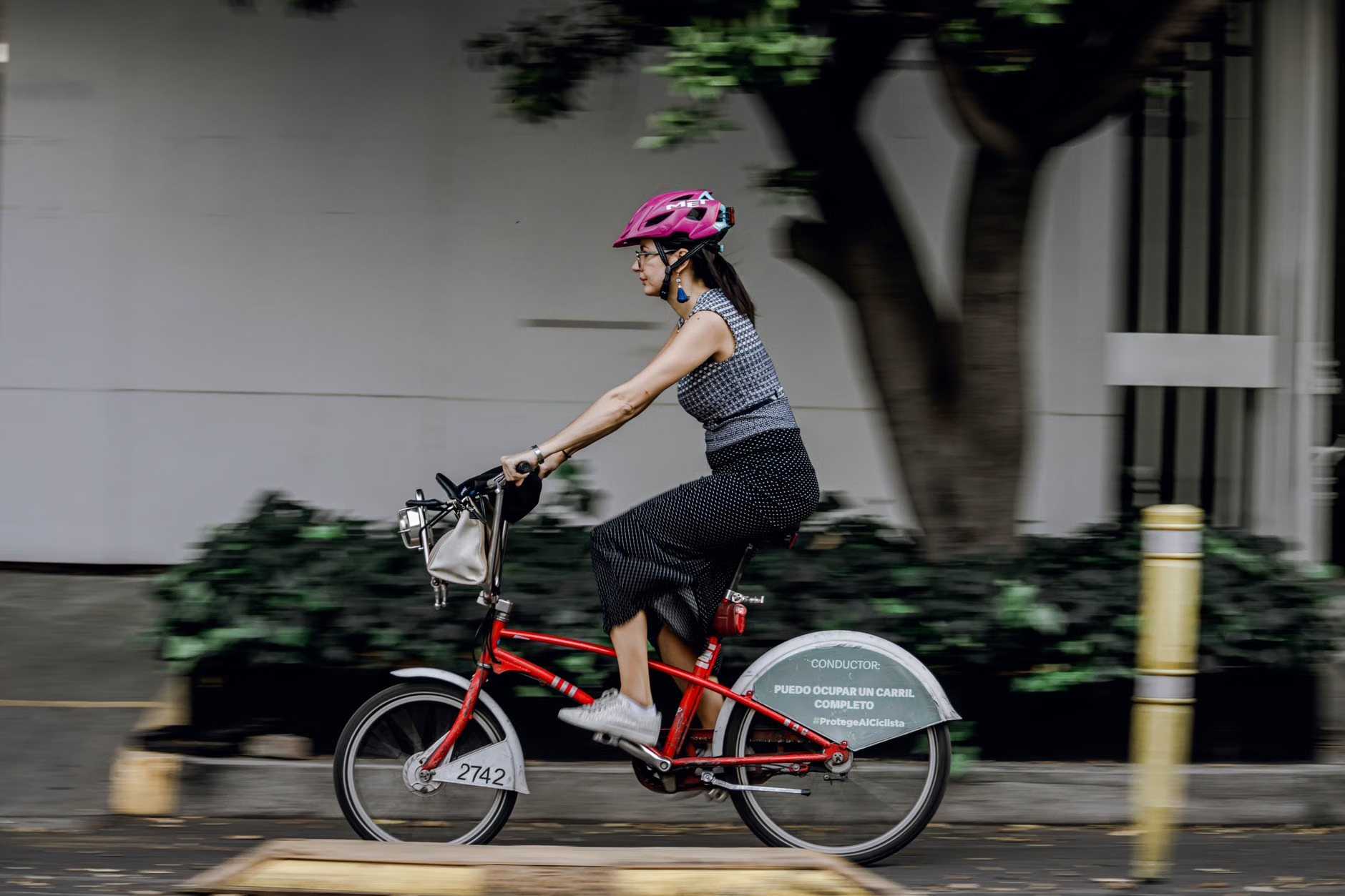
A green commute—defined as using public transport, cycling, walking, or micro-mobility—is often misunderstood as a “sacrifice” of comfort. In reality, when executed with the right systems, it is a reclaimation of time. When you are on a train, you are answering emails or reading to your child. When you are cycling, you are hitting your daily movement goals without needing a gym membership. This guide breaks down how to pivot your family routine into a sustainable, cost-effective, and surprisingly calm operation.

The Real Math: Why Your Car is Costing You More Than Just Gas
Before changing your habits, you need to understand the financial and temporal “sunk cost” of the private vehicle. Many urban families view the car as a necessity, but the math tells a different story. If you look at the total cost of ownership—depreciation, insurance, fuel, maintenance, and the “opportunity cost” of your time spent in traffic—the numbers are staggering.
For a family with one or two children, a mid-sized SUV in a major metropolitan area can easily cost between $8,000 and $12,000 per year when factoring in hidden costs. If you are in a city like London, New York, or Singapore, the parking fees alone can account for a significant portion of that budget. When you switch to a green-commute strategy, you aren’t just “saving the planet”; you are liquidating a depreciating asset and buying back your time.
The “Total Cost” Comparison Table
| Expense Category | Private Car (Estimated) | Green Commute (Estimated) |
|---|---|---|
| Fuel/Energy | $2,000 – $3,000 | $600 – $1,200 (Transit Pass) |
| Insurance/Tax | $1,500 – $2,500 | $0 |
| Parking/Maintenance | $2,000+ | $200 – $500 (Bike Tune-up) |
The table above highlights a clear reality: the “Green Commute” isn’t just an environmental choice; it is a strategic financial reallocation. By shifting $5,000+ per year from a car to other priorities—like savings, travel, or childcare—you are fundamentally changing your family’s financial trajectory. However, the true benefit is the removal of the “parking search” variable, which is one of the most frustrating aspects of urban parenting.
Building Your Family’s “Green-Commute” Infrastructure
Moving from a car-first mindset to a multi-modal strategy requires infrastructure, both in your home and in your gear. The biggest mistake families make is trying to transition all at once. Instead, apply the “Hybrid Pivot.”
1. The Equipment Audit
You cannot have a successful green commute if your gear is fighting you. If you are cycling, a heavy, ill-maintained bike will make you dread the ride. If you are using public transit, a bulky stroller will make you hate the subway. Invest in “commute-optimized” gear. For example, a high-quality cargo bike or a lightweight, foldable stroller can be the difference between a smooth experience and a total meltdown.
2. The “Last Mile” Strategy
Public transit is rarely “door-to-door.” The “last mile”—the distance from the station to your office or school—is where many people quit. Solve this by pairing transit with micro-mobility. A folding scooter or a high-quality pair of walking shoes can turn a 20-minute walk into a 5-minute glide. If you are commuting with kids, teach them to treat the transit portion as “quiet time” for reading or audiobooks, which transforms the commute into a learning opportunity rather than a chore.

3. Managing the Weather Variable
The common misconception is that you can only commute green when it is sunny. In reality, it is about gear. High-quality waterproof layers, proper fenders for your bike, and insulated bags for lunches make bad weather a minor nuisance rather than a dealbreaker. If you are in a city with harsh winters, you will need to account for the “transition time”—the five minutes it takes to swap your outdoor gear for your office attire. Build this into your schedule.
In your 30s and 40s, social pressure often suggests that “success” equals a private car. You might feel the need to justify your decision to friends or colleagues. Ignore the noise. The psychological benefit of the green commute is the “de-escalation” of your morning. Driving in traffic is a high-cortisol activity. Sitting on a train or cycling through a park allows your nervous system to regulate before you start your workday.
If you are worried about safety, look for routes that utilize protected bike lanes or well-lit walking paths. Use apps like Google Maps or Citymapper, but supplement them with local knowledge. Talk to other parents at your school who are already commuting green. They are your best source of “insider” information on the safest, fastest, and most efficient routes.
Common Pitfalls to Avoid
- Over-packing: Don’t try to carry everything. If you need supplies at the office, keep a stash of toiletries or a spare pair of shoes there.
- Ignoring the “Bail-out” Plan: Always have a secondary option. If the trains go down or it pours rain, know exactly which ride-share app to use or have a backup route.
- The “All-or-Nothing” Trap: If you drive on Fridays because you have to pick up groceries, that is fine. The goal is to reduce your carbon footprint and stress, not to win a purity contest.
When the Green Commute is Actually the Better Choice
Is the green commute always superior? Not necessarily. If you live in an area with non-existent public transit or are responsible for the logistics of a large, multi-stop family errand day, a car might remain the most efficient tool. However, for most urban families, the “car-dependency” is a habit, not a necessity.
The best indicator that you are ready for a green-commute strategy is if you find yourself spending more than 45 minutes a day in traffic and feeling “drained” before you even arrive at your destination. At that point, the trade-off is no longer about the environment; it is about your mental health and the quality of time you have left to spend with your family in the evenings.
The Step-by-Step Implementation Framework
If you want to start this week, follow this four-phase plan. Do not rush. Consistency is more important than speed.
- Phase 1: The Observation Week. For one week, track every car trip you make. Note the time, the distance, and the reason. You will quickly identify which trips are “non-negotiable” (e.g., getting a sick child to the doctor) and which are “habitual” (e.g., driving to a store that is a 10-minute walk away).
- Phase 2: The Pilot Program. Choose one day a week to go car-free. It doesn’t have to be a workday. Try it on a Saturday morning. Experience the difference in how your family feels when you aren’t fighting for parking.
- Phase 3: The Gear Optimization. Based on your pilot, figure out what you are missing. Do you need a better bag? A bike rack for your child’s scooter? A different transit app? Invest in the solution.
- Phase 4: The Integration. Slowly replace your most frequent “habitual” car trips with your new green-commute routine. Keep track of the money you are saving—it is a great motivator.
Refining Your Approach: Beyond the Basics
Once you have the basics down, look for ways to optimize. Can you coordinate with another parent for a “walking school bus”? This is where a group of children walks to school under the supervision of one or two adults. It builds community, ensures safety, and frees up time for the other parents. This is the hallmark of a mature green-commute strategy: it moves from an individual struggle to a collective benefit.
Another overlooked variable is the “mental load” of the commute. By using a commute as an opportunity for audio learning—listening to podcasts, language lessons, or audiobooks—you effectively double your personal development time. A 30-minute commute is 2.5 hours of learning per week. That is a significant advantage in your career and personal growth.
Conclusion: The Long-Term View
The green commute is not about being perfect; it is about being intentional. In our 30s and 40s, we are constantly balancing the demands of work, parenting, and our own need for sanity. By choosing a mode of transport that aligns with your values and improves your daily quality of life, you are setting a powerful example for your children. You are showing them that life doesn’t have to be a race in a metal box, and that there is freedom in slowing down and engaging with the world around you.
Start small, be consistent, and don’t be afraid to adjust your strategy as your family’s needs change. The road to a better, more sustainable life is built one trip at a time.
Frequently Asked Questions
1. Is it safe to commute with children on public transit or bikes?
Yes, provided you take precautions. For cycling, prioritize routes with protected bike lanes and ensure everyone has high-quality, properly fitted helmets. For transit, choose off-peak hours when possible and keep children close. Research your city’s transit safety resources—most major cities have dedicated guides for families.
2. How do I handle groceries and large shopping trips without a car?
This is the most common hurdle. The solution is “frequent, smaller trips” rather than “one massive weekly haul.” Use a sturdy, foldable cart or a cargo bike. Alternatively, many families find that combining a bike/transit commute with a local grocery delivery service for heavy items is the most efficient balance.
3. What if I live in an area with poor public transit?
You don’t need to be perfect. If you cannot go car-free, aim for “car-light.” Use your car for the necessary, long-distance, or heavy-load trips, but commit to walking or cycling for all local trips under 2km. This still significantly reduces your stress and carbon footprint while making your neighborhood more accessible.
Useful Resources:
– C40 Cities: Climate Action for Urban Areas – Great for understanding global trends in urban mobility.
– Institute for Transportation and Development Policy – Provides insights into how cities are changing to support green commuting.
– Citymapper – A highly recommended tool for navigating multi-modal urban transit in real-time.