- Data sovereignty is your right to own and control the information your devices collect, rather than letting manufacturers store it indefinitely in the cloud.
- Local processing is the gold standard: Whenever possible, choose devices that process voice commands and video feeds locally on your hardware instead of sending them to external servers.
- You can legally reclaim your data by exercising your rights under frameworks like the GDPR (EU) or CCPA (California), which allow you to request, view, and delete the data companies have collected on your household.
You probably didn’t sign up for your “smart” home to become a data-harvesting machine. Yet, every time you ask a virtual assistant to play a nursery rhyme for your toddler or check the front door camera, a digital trail is created. Data sovereignty—the idea that you, not the tech giant, should have the final say over your personal information—is no longer just a buzzword for IT professionals. It is the most important framework for parents in their 30s and 40s trying to balance the convenience of modern tech with the very real need for family privacy.
Understanding Data Sovereignty: Why Your Smart Toaster Matters
Data sovereignty is essentially the legal and technical concept that data is subject to the laws and governance of the country where it is located. In the context of your smart home, it means that the information generated by your devices—like your daily routines, voice recordings, and energy usage patterns—should not be treated as “free resources” for corporations to monetize. When companies store your data on servers in jurisdictions with weak privacy protections, you lose the ability to hold them accountable. For a parent, this matters because “metadata” (the information about your activity) can be just as revealing as the content itself.
Think of it this way: if your smart thermostat knows exactly when you wake up, when you leave for the school run, and when you go to sleep, it has a perfect map of your family’s physical presence. If that data is processed locally, it stays in your house. If it is sent to a server halfway across the world, it is subject to the privacy laws—or lack thereof—of that region. Data sovereignty laws, such as the General Data Protection Regulation (GDPR) in the EU, were designed to give you a “delete” button for your life. They require companies to be transparent about what they collect and why.
However, the challenge is that most smart home devices are “cloud-first.” They are designed to work by sending data to a central brain (the cloud) to process instructions. This is convenient because it allows for cheaper hardware and faster software updates, but it creates a massive privacy trade-off. To truly achieve data sovereignty, you have to shift your mindset from “convenience above all” to “control by design.”
The Legal Landscape: Where You Stand Depends on Where You Live
Privacy laws are not universal. Your rights depend heavily on your location. For readers in the EU, the GDPR is arguably the strongest protection in the world. It mandates that companies provide you with a copy of your data upon request and delete it if you ask. If you are in the United States, the landscape is more fragmented. California’s CCPA (California Consumer Privacy Act) is the closest equivalent to the GDPR, but if you live in a state without comprehensive privacy legislation, you are often at the mercy of the company’s internal “Terms of Service.”
| Region | Primary Protection Level | Key Right |
|---|---|---|
| European Union | High (GDPR) | Right to be forgotten and data portability. |
| California (USA) | High (CCPA/CPRA) | Right to opt-out of the sale of personal information. |
| Rest of USA/Global | Variable/Low | Usually limited by contract law or company policy. |
Why does this matter for your family? Because companies often apply the “lowest common denominator” to their data handling. If a company is based in a region with lax laws, they are unlikely to build in features that allow you to opt-out of data tracking unless they are legally forced to. When you buy a smart device, check the manufacturer’s privacy policy for a “Data Subject Access Request” (DSAR) form. Even if you don’t live in a region with strict laws, some major tech companies have started offering GDPR-like privacy tools globally to simplify their operations. Using these tools is the first step toward taking back control.

Practical Steps to Reclaim Your Digital Home
If you feel like your smart home has become a bit too “smart,” you don’t need to throw your devices in the trash. Instead, you need to implement a strategy of “data minimization.” This means reducing the amount of data your devices collect in the first place.
1. Enable Local-Only Processing: Look for devices that support local control, such as those compatible with Home Assistant or Apple HomeKit (when configured correctly). These systems prioritize processing data within your own Wi-Fi network rather than routing it through the manufacturer’s cloud. This is the single most effective way to ensure your data stays on your premises.
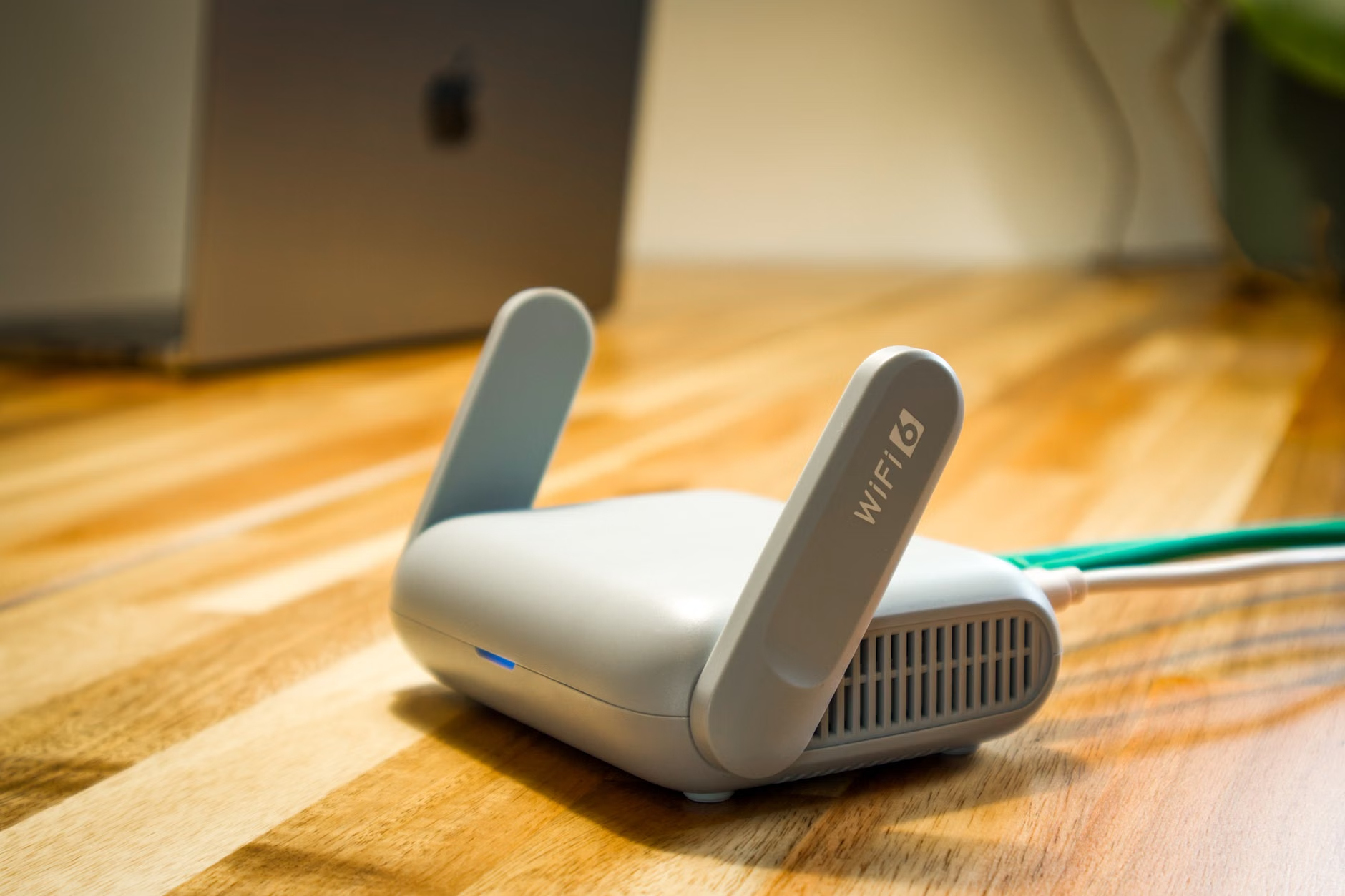
2. The “Guest Network” Strategy: Most modern routers allow you to create a “Guest Network.” Move all your smart home devices (cameras, lights, plugs) onto this isolated network. If one of your smart bulbs is compromised, it won’t have a direct path to your main computer or the devices where you do your online banking.
3. Regular Data Purges: Dive into the settings of your voice assistants (Alexa, Google Assistant, Siri). You will likely find a history of every voice command your family has ever given. Set these accounts to “Auto-Delete” every 3 or 18 months. This prevents the accumulation of long-term behavioral profiles that companies can use to build a psychological map of your household.
4. Disable “Personalized Ads”: Almost every smart device has a setting buried in the app that allows the company to share your usage patterns with “third-party partners.” Turn this off immediately. It is rarely necessary for the device to function, and it is almost always used to feed data brokers.
Common Misconceptions That Put Your Privacy at Risk
One of the biggest mistakes people make is assuming that “encrypted” means “private.” Encryption protects your data from hackers while it’s in transit, but it does not prevent the company that owns the server from reading it once it arrives. If a company uses “end-to-end encryption,” it means only you have the keys. If they use “encryption at rest,” they still have the keys, and they can see exactly what you are doing inside your home. Always look for “end-to-end” in the marketing materials, and be skeptical if the term is missing.
Another myth is that “free” smart devices are a bargain. When you pay $20 for a smart camera that costs $100 to manufacture, you are not getting a deal; you are the product. These devices are often subsidized by the data they harvest. If you want true sovereignty, consider investing in hardware from companies that have a business model based on selling the product, not your data. While the upfront cost is higher, the “hidden cost” of your privacy is significantly lower.
Finally, don’t ignore firmware updates. Manufacturers often release updates to patch security vulnerabilities that could allow unauthorized access to your data. A device that hasn’t been updated in two years is a massive liability, regardless of your privacy settings. Set a reminder on your calendar to check for firmware updates for your core smart home devices at least once every three months.
Creating a Sustainable Privacy Routine
Managing data sovereignty shouldn’t feel like a part-time job. The key is to build it into your routine. Just as you check the smoke alarm batteries or update your passwords annually, make “Privacy Check-up Day” a thing in your house. Once a year, log into the websites of your major smart home providers, navigate to the “Privacy” or “Data” section, and review what is being stored.
If you have children, this is also a great time to teach them about digital boundaries. Explain that smart devices are tools, not family members, and that they shouldn’t share sensitive information with a speaker or a camera. By normalizing this conversation, you are teaching your children to be savvy, protected digital citizens rather than passive consumers.
Ultimately, data sovereignty is about agency. It is about deciding that your home is a private space where your family can grow, talk, and live without being analyzed by algorithms. You don’t have to be a tech expert to achieve this; you just need to be intentional about the choices you make when you bring a new device into your home. The next time you buy a smart device, ask yourself: “Does this need to talk to the cloud to function?” If the answer is no, look for a version that doesn’t.
Frequently Asked Questions
1. Can I really delete all my smart home data?
Yes, under many jurisdictions, you can request the deletion of your data. However, be aware that deleting your data may cause some “smart” features to stop working, as these features often rely on the historical data stored in the cloud to provide personalized recommendations or automations. You are essentially trading convenience for privacy.
2. Does using a VPN help with smart home privacy?
A VPN (Virtual Private Network) protects your internet traffic from your ISP (Internet Service Provider) and masks your location, but it does not prevent the smart device manufacturer from collecting data on your usage *inside* their app or cloud. A VPN is a great tool for general security, but it is not a complete solution for data sovereignty at the device level.
3. What is the most “private” brand for smart home devices?
There isn’t one “perfect” brand, but companies that prioritize hardware sales over advertising revenue generally have better privacy track records. Brands like Apple (with their focus on HomeKit and local processing) are often cited as more privacy-conscious than companies whose primary business model is built on digital advertising and data collection. Always prioritize brands that explicitly state they do not sell your user data to third parties.
For more detailed information on your rights, you can check the official documentation from the EU GDPR portal or the California Attorney General’s CCPA resources. Staying informed is your best defense in an increasingly connected world.