Inclusive playground design is not just about wheelchair ramps; it is a fundamental shift in how we build environments that teach children empathy, conflict resolution, and self-regulation—the core pillars of social-emotional learning (SEL).
- Equitable Play: Inclusive design removes physical barriers, allowing children of all abilities to interact at eye level, which is critical for natural social skill development.
- Sensory Regulation: High-quality inclusive playgrounds include “quiet zones” that prevent sensory overload, helping children learn to identify their own need for a break.
- Social Engineering: Strategic design choices—like collaborative equipment—force children to communicate, wait their turn, and negotiate, turning play into a practical lab for emotional intelligence.
If you have ever stood at the edge of a playground watching your child navigate the complex social dance of the monkey bars, you know it is never just about climbing. It is about the kid who won’t share, the one who is scared to jump, and the subtle negotiations happening over who gets to go down the slide next. We often view the playground as a place to burn off energy, but it is actually one of the most sophisticated social-emotional learning (SEL) environments a child will ever encounter.
When we talk about “inclusive” design, the conversation often centers on compliance—meeting ADA (Americans with Disabilities Act) standards or local accessibility codes. But for a parent in their 30s or 40s, the real value of inclusive design is how it levels the playing field for every child, regardless of whether they have a physical disability, a neurodivergent profile, or are simply shy and struggling to find their voice.
Why Physical Accessibility is the Gateway to Social Growth
The most immediate impact of inclusive design is the removal of physical barriers. When a playground is designed with universal access—wide, smooth ramps, transfer stations, and ground-level sensory panels—it changes the social dynamics of the space. In a traditional playground, a child who cannot climb a ladder is often relegated to the sidelines, watching from below. This creates a literal and figurative hierarchy of play.
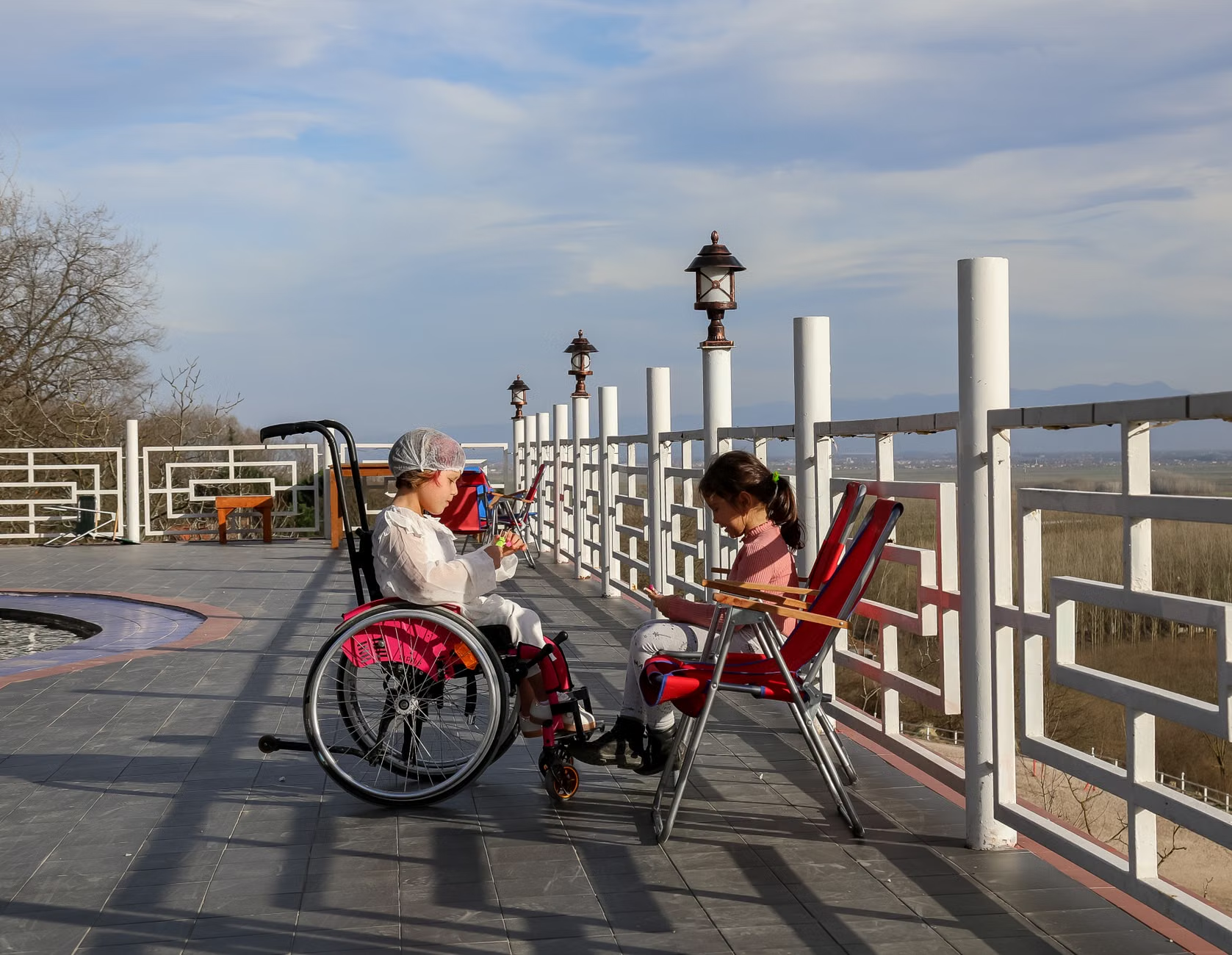
When everyone can access the highest point of the structure, the power dynamic shifts. Children are suddenly playing at the same level. This eye-level interaction is where social-emotional learning happens. It is much easier to resolve a conflict or start a collaborative game when you are face-to-face, rather than looking up at a peer who is physically out of reach. For the neurotypical child, this is a lesson in realizing that play is not about who is fastest or strongest, but about who is present.
Consider this scenario: A standard play structure has a single ladder. A child with mobility challenges waits at the bottom. The other children move on to the slide. The social connection is severed. In an inclusive design, a ramp allows the child with mobility challenges to reach the deck. The same children are now standing next to each other. They have to decide, in real-time, how to navigate the space together. That moment of decision—”Can I move over so you can pass?” or “Do you want to go down together?”—is an essential exercise in executive function and social awareness.
The Role of Sensory Design in Self-Regulation
One of the most overlooked aspects of playground design is sensory feedback. We often equate “fun” with high-stimulation: loud, fast, and chaotic. However, for many children, this environment is a recipe for a meltdown. Inclusive playgrounds now integrate “sensory-rich” but “sensory-safe” elements. This is the practical application of self-regulation.
When a playground includes tactile walls, musical chimes, or enclosed “pod” structures, it provides a sanctuary for a child who is feeling overwhelmed. The child learns to recognize their internal state—“I am feeling too much right now, I need to go to the quiet corner”—and then takes the agency to move to that space. This is a high-level social-emotional skill: self-regulation.
Parents often mistakenly think that a “quiet zone” is just a place to hide. In reality, it is a teaching tool. If your child is prone to overstimulation, visiting a park with these features allows you to guide them through the process of taking a break. You are teaching them that it is okay to step away from the crowd, calm their nervous system, and then rejoin the play. This is a life skill that translates directly to the classroom and the workplace.

Collaborative Equipment and the Art of Negotiation
In the world of playground equipment, there is a massive difference between “parallel play” equipment and “collaborative” equipment. A standard swing set is essentially parallel play; you swing next to someone, but you aren’t really interacting. Conversely, a large, multi-user spinner or a complex, interconnected climbing web requires cooperation.
Inclusive designers are increasingly prioritizing equipment that requires more than one person to operate. Take a multi-user, accessible merry-go-round. It requires balance, communication, and rhythm. If one child pushes too hard, the others struggle. If they don’t coordinate, it doesn’t spin. This is a natural laboratory for conflict resolution.
What to look for in your local park:
| Equipment Type | Social-Emotional Benefit | Parental Strategy |
|---|---|---|
| Multi-user spinners | Coordination and turn-taking | Encourage kids to set a “team” pace. |
| Accessible sand/water tables | Shared resources and negotiation | Ask, “How can we build this together?” |
| Quiet pods/nooks | Self-regulation and boundaries | Validate the need for personal space. |
When you see your child struggling to cooperate on a piece of collaborative equipment, do not immediately intervene to “fix” it. Instead, observe the negotiation. If they are fighting, ask a question: “It seems like you both want to spin at different speeds. How can you agree on one speed?” This prompts them to use their words rather than their impulses.
The Hidden Curriculum of Inclusive Play
Beyond the physical equipment, there is a “hidden curriculum” in inclusive playgrounds. This is the set of social norms that are implicitly taught when a space is designed for everyone. When a child sees a peer using a communication board (a sign with symbols used by non-verbal children) to interact, they are learning about different modes of communication. They are learning that not everyone expresses themselves the same way.
This exposure is the bedrock of empathy. In a society that is increasingly polarized, the ability to recognize, respect, and engage with people who have different needs is a superpower. Inclusive playgrounds provide this exposure in a low-stakes, high-fun environment. It is not a lecture on diversity; it is an lived experience of it.
For parents in their 30s and 40s, this means that selecting a park is a deliberate parenting choice. If you have the option, choose the inclusive park over the generic one. Even if it is a slightly longer drive, the social lessons your child will absorb by simply being in a space that celebrates human variety are worth the extra time. You are effectively choosing an environment that mirrors the real world—a place where everyone belongs, but where everyone also has to learn how to exist alongside others.

It is important to be realistic. Just because a playground has an accessible ramp doesn’t mean it is a perfect utopia. There are common pitfalls. One major issue is “tokenism” in design—where a playground has one accessible piece of equipment shoved into a corner, but the rest of the park is inaccessible. This sends a message of “you are allowed, but you are not integrated.”
Another common mistake is the “surface problem.” A playground might have an accessible structure, but it is surrounded by loose wood chips or deep sand, which effectively traps anyone using a wheelchair or a walker. True inclusive design requires poured-in-place rubber or high-quality synthetic turf that allows for smooth, continuous movement.
If you find that your local park is “inclusive” in name only, do not despair. You can still use it as a teaching moment. Talk to your children about why some areas might be harder for others to access. Use these moments to discuss fairness and community planning. It is a great way to introduce your children to the concept of civic responsibility—the idea that we have a duty to build spaces that work for everyone.
Practical Steps to Advocate for Better Play
If your community park is lacking, you have more power than you think. Local governments often have a budget for park maintenance or upgrades, and they are frequently looking for public input. Start by checking your local municipal website or the Parks and Recreation department page. Many cities now publish their long-term master plans for public spaces.
When you provide feedback, don’t just say “we need a better playground.” Be specific. Use the language of inclusive design: “We need more ground-level play opportunities,” “The current surfacing is not accessible for mobility devices,” or “We need more sensory-neutral spaces for children who get overstimulated.”
Bringing this up at a town hall or via a formal email to your local representative is a concrete way to influence the environment your children grow up in. It also models for your children that they can be agents of change in their own community. That is, perhaps, the most profound social-emotional lesson of all.
Understanding the Research Behind the Play
The science backing this is robust. Research from organizations like the Center for Inclusive Design and various child development institutes consistently shows that children who play in mixed-ability environments demonstrate higher levels of social competence. They are better at perspective-taking—the ability to understand how someone else might be feeling or why they are acting a certain way.
This isn’t just about “being nice.” It is about neurobiology. When a child observes a peer struggling with a movement or a communication barrier and then sees them overcome it with the right support, the observing child’s brain is processing complex social information. They are learning to anticipate needs, adjust their own behavior, and show patience. These are the building blocks of emotional intelligence (EQ), which is arguably a better predictor of long-term success than IQ.
For the parent, the lesson is clear: don’t view the playground as “time off” from parenting. View it as a “co-coaching” opportunity. You are there to provide the scaffolding for these social interactions. When you see your child hesitate to interact with someone who is playing differently, a simple, non-judgmental prompt like, “I wonder how they are using that equipment? Should we go ask or watch for a minute?” can bridge the gap.
Integrating These Lessons Into Daily Life
The beauty of the playground is that it is a microcosm of the larger world. The lessons learned there—respect, patience, empathy, and self-advocacy—are universal. As your children age, the equipment will change, but the social-emotional challenges will remain. The kid who wouldn’t share the slide becomes the teenager who won’t share the group project. The child who learned to use a quiet zone to regulate their emotions becomes the adult who knows when to step away from a high-stress meeting.
Inclusive design is ultimately a philosophy of belonging. It says that every child has a right to be there, to play, and to be challenged. By choosing these environments and engaging with them intentionally, you are helping your child develop a “social-emotional toolkit” that will serve them for the rest of their lives. It is a long-term investment that pays dividends in the form of more resilient, empathetic, and socially aware human beings.
Next time you head to the park, take a moment to look at the layout. See if you can identify the “inclusive” elements. Watch how the children interact with them. You might be surprised at how much you learn about your own child’s social-emotional development just by observing the way they navigate a space that is built for everyone.
Frequently Asked Questions
1. What is the difference between an ‘accessible’ and an ‘inclusive’ playground?
Accessibility usually refers to meeting the bare minimum legal requirements, such as a ramp to get onto the structure. Inclusivity goes much further, focusing on the quality of the experience. An inclusive playground ensures that children of all abilities can play together, not just side-by-side, and includes sensory-rich environments that cater to diverse neurological needs.
2. My child doesn’t have a disability. Should I still prioritize inclusive playgrounds?
Absolutely. Inclusive playgrounds offer a much wider range of play experiences, from sensory-focused stations to collaborative equipment that isn’t found in standard parks. Furthermore, exposing your child to a diverse environment fosters empathy and teaches them how to navigate social situations with peers who have different needs, which is a vital skill for success in school and beyond.
3. How can I tell if a playground is truly inclusive before I go?
Look for photos on the park’s website or Google Maps reviews. Key markers of true inclusivity include: poured-in-place rubber or synthetic turf surfacing (not wood chips), ground-level play panels, a variety of swing types (including high-back bucket seats), and clear paths that connect all major play structures. If the park is described as “universally designed,” that is a strong indicator of a high-quality, inclusive space.
For further information on universal design principles in public spaces, you can refer to the ADA standards for playground accessibility provided by the U.S. Department of Justice, or explore the resources provided by the Inclusive Play international design guidelines for creating equitable environments.