Emotional-vocabulary cards are not just educational toys; they are functional communication tools that bypass the “fight-or-flight” response by forcing the brain to transition from reactive emotional distress to analytical labeling.
- Affect Labeling: Putting a specific name to an emotion reduces amygdala activity, effectively lowering the intensity of a conflict in real-time.
- Beyond “Mad” and “Sad”: Expanding your vocabulary beyond basic descriptors prevents the “emotional bottleneck” where you feel misunderstood because you lack the words to explain your state.
- Structural De-escalation: Using cards as a physical third party in an argument removes the “me vs. you” dynamic, turning the conversation into a collaborative effort to identify the root issue.
We have all been there. It is 7:00 PM on a Tuesday. The laundry is piling up, the kids are refusing to eat their vegetables, and your partner just asked, “Why are you so upset?” In that moment, your heart rate is elevated, your cortisol is spiking, and your brain is essentially offline. You snap back, “I’m not upset, I’m just tired,” or you shut down entirely. This is the “emotional bottleneck.” You are experiencing a complex mix of frustration, exhaustion, and perhaps a touch of resentment, but your brain only has access to the most basic labels.
This is where emotional-vocabulary cards come in. They aren’t just for children in a classroom; they are a practical, structural intervention for adults in their 30s and 40s who are trying to balance the immense cognitive load of modern life. When you use these cards—or the framework they represent—you are essentially upgrading your internal operating system to handle stress more efficiently.
How Affect Labeling Physically Changes Your Brain
It sounds like a therapeutic buzzword, but “affect labeling” is a well-documented psychological phenomenon. Research from the University of California, Los Angeles (UCLA) has shown that when people put feelings into words, they exhibit reduced activity in the amygdala—the part of the brain responsible for the fight-or-flight response—and increased activity in the prefrontal cortex, which is responsible for reasoning and impulse control.
Think of the amygdala as your brain’s alarm system. When it goes off, you lose access to your “higher brain” functions. You stop being a rational partner or parent and start being a reactive animal. By using a card to label your emotion—say, shifting from “I’m angry” to “I feel overwhelmed and unsupported”—you are literally shifting the electrical activity in your brain from the emotional center to the thinking center.
The practical application: Next time you feel that familiar heat rising in your chest during a disagreement, reach for a card or a list of emotions. Don’t try to solve the problem yet. Just identify the feeling. If you are frustrated, ask yourself: Is it frustration, or is it actually feeling “inadequate” or “overlooked”? The difference in the label changes the trajectory of the conversation entirely.
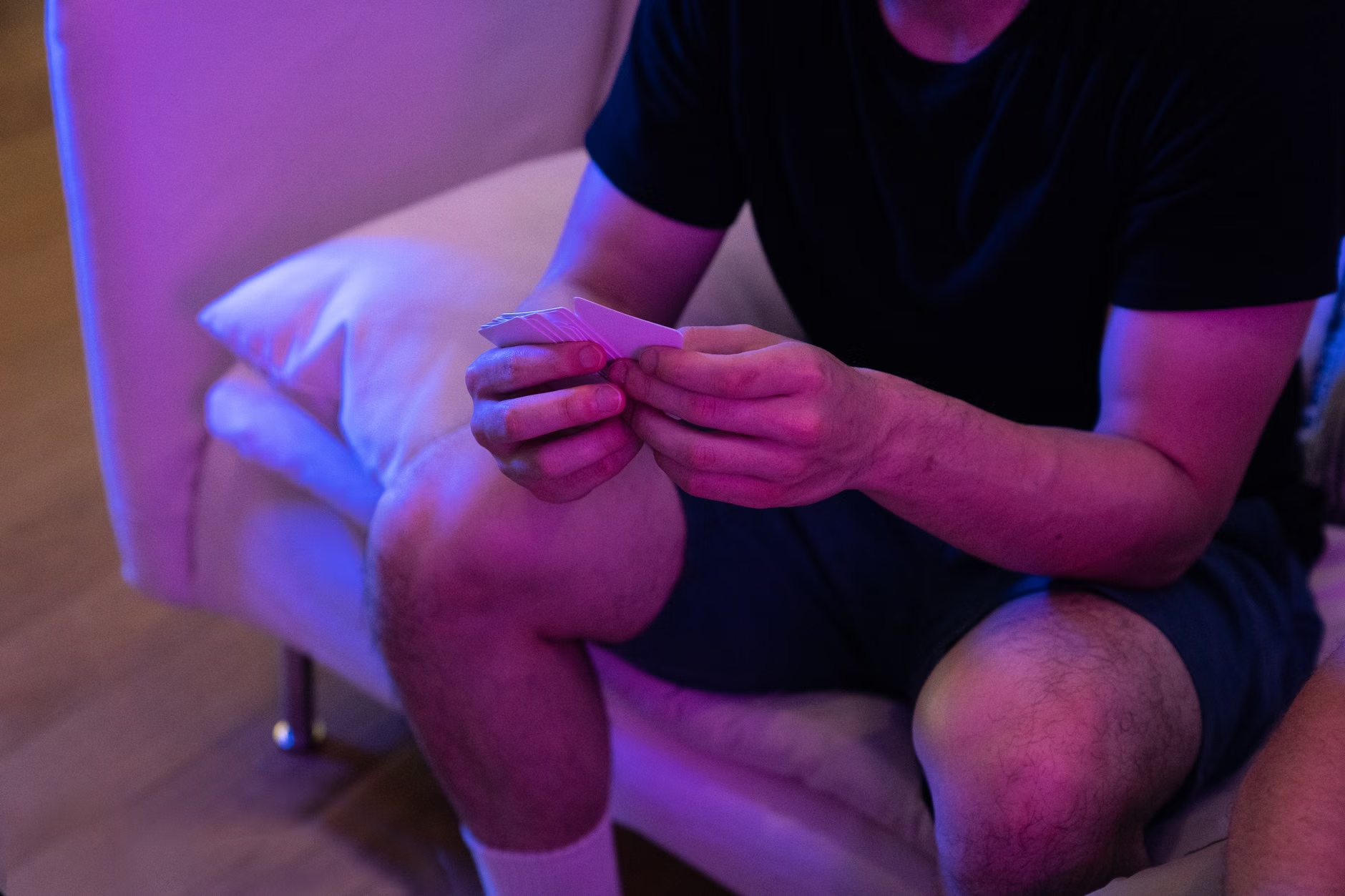
Moving Beyond the “Mad, Sad, Glad” Trap
Most of us were raised with a very limited emotional vocabulary. We were taught to categorize things into a handful of buckets. But the nuance of adult life requires a more sophisticated toolkit. If you only have three colors to paint with, your picture will be a smudge. If you have a full palette, you can create a masterpiece—or at least, a clear representation of your reality.
When you use emotional-vocabulary cards, you are expanding your “emotional granularity.” This is the ability to distinguish between closely related emotional states. Being “angry” feels very different from being “disappointed,” “frustrated,” “betrayed,” or “annoyed.” Each of these requires a different kind of resolution.
| The Vague Label | The Granular Alternative | Practical Resolution |
|---|---|---|
| “I’m angry.” | “I feel disrespected.” | Discuss specific boundaries that were crossed. |
| “I’m stressed.” | “I feel overwhelmed/incompetent.” | Identify a specific task to delegate or drop. |
| “I’m sad.” | “I feel lonely/unseen.” | Request specific quality time or connection. |
The table above illustrates a common mistake: assuming that “anger” is the end of the line. It isn’t. Anger is usually a secondary emotion—a protective shell for something more vulnerable underneath. By using cards, you give yourself the time to dig into that vulnerability without the immediate pressure of having to articulate it perfectly in the heat of the moment.
Using Cards as a “Third Party” to De-escalate Conflict
One of the biggest hurdles in conflict resolution is the defensive posture. If I say, “You never help with the dishes,” you hear an attack, and you immediately prepare to counter-attack. The conversation becomes a zero-sum game: I win, you lose, or vice versa.
Emotional-vocabulary cards act as a “third party” or a neutral mediator. When you place a card on the table that says “Overwhelmed,” you are no longer accusing the other person of being lazy. You are presenting an objective fact about your internal state. It is much harder to argue with a feeling than it is to argue with an accusation.
Step-by-step implementation:
- The Pause: When tension rises, call a “time-out.” This is non-negotiable. If you don’t step away, you cannot use your tools.
- The Selection: Each person takes the deck of cards and picks 2-3 words that best describe their current state.
- The Reveal: Place the cards face up. Do not explain them yet. Just look at the words.
- The Inquiry: Ask, “What triggered this feeling?” instead of “Why are you doing this to me?”

This method works remarkably well with children, too. Children often act out because they lack the linguistic capacity to express complex frustrations. By giving them a visual tool, you are teaching them that their emotions are manageable data points, not uncontrollable forces that dictate their behavior.
Common Misconceptions and Hidden Trade-offs
There is a common misconception that using these tools makes one “weak” or “overly sensitive.” In reality, the opposite is true. It takes significant emotional strength to stop a conflict, admit you are struggling, and use a tool to bridge the gap. The hidden cost of *not* doing this is the accumulation of “micro-resentments.” These are the small, unresolved feelings that build up over years and eventually lead to major relationship fractures.
Another thing to watch out for is the “weaponization” of these tools. If you use the cards to diagnose your partner—”Oh, you’re just feeling ‘insecure’ because you’re projecting”—you have immediately destroyed the utility of the tool. The cards are for you to express your feelings, not for you to label the other person. If you find yourself using these tools to control or “fix” someone else, stop immediately. That is a misuse of the process.
Furthermore, don’t feel like you need a “professional” set of cards. While there are many beautifully designed decks on the market, you can easily make your own with index cards and a sharpie. The value is not in the design; it is in the act of stopping, selecting, and speaking.
The Evolution of Your Emotional Intelligence
As you incorporate this into your routine, you will notice that you need the physical cards less and less. You are essentially training your brain to recognize these nuances automatically. This is the goal of emotional intelligence: to have such a rich, ready-to-hand vocabulary that you can identify your internal state before it manifests as an outward explosion.
It is important to remember that this is a skill, not a magic pill. There will be days when you are too tired to use the cards, or when the conflict is too intense for a “time-out.” That is okay. The goal is consistency, not perfection. When you do fail—and you will—the best thing you can do is come back to the cards later and say, “I realized I was feeling ‘defensive’ earlier, and I didn’t have the tools to say it. Can we re-evaluate?”

This act of “repair” is arguably more important than the initial conflict resolution. It models for your children (and reinforces for your partner) that relationships are not about being right; they are about being understood and understanding in return. It shifts the entire foundation of your household from reactive chaos to intentional connection.
Practical Tips for Success
To get the most out of this, keep the cards in a place where they are easily accessible—the kitchen counter or the coffee table. If they are tucked away in a drawer, they will never be used. Think of them like a fire extinguisher; you hope you don’t have to use them, but if a fire starts, you need them within arm’s reach.
Also, consider setting a “low-stakes” practice time. Don’t wait for a huge fight to pull them out for the first time. Try using them during a calm moment. Ask your partner, “How are you feeling about our schedule this week?” and use the cards to identify the feelings. This builds the muscle memory so that when the high-stakes moment arrives, using the cards feels natural rather than awkward or forced.
Finally, be prepared for the “this is silly” phase. If you are starting this with a partner who is skeptical, acknowledge it. Say, “I know this feels a bit weird, but I’m finding that I’m getting overwhelmed and I’m not communicating well. I want to try this to see if it helps us understand each other better.” That level of honesty is disarming and often invites the other person to participate, even if they initially think it’s a bit unconventional.
Addressing Common Questions
Is it really necessary to use physical cards, or can I just talk about my feelings?
While talking is obviously the end goal, the physical act of holding a card serves as a “circuit breaker” for your brain. In the middle of an emotional spike, your verbal processing is often impaired. The visual and tactile nature of the card provides a grounding anchor that helps you bypass the “brain fog” of a conflict, making it much easier to articulate what you are feeling than if you were relying solely on your memory or verbal recall.
What if my partner refuses to participate?
You cannot force someone else to use a tool, but you can lead by example. Start using the cards for your own self-reflection. When you are feeling something, pick up a card and say, “I’m feeling really ‘overwhelmed’ right now, so I’m going to take a moment to reset.” By modeling the behavior, you remove the pressure from them and demonstrate the benefits. Often, once they see how much more effectively you are communicating, they will become curious and want to join in.
Can this help with children who are too young to read?
Absolutely. For younger children, use cards that feature illustrations of facial expressions alongside the words. You can work with them to identify the face that matches how they feel. This is a crucial developmental milestone. By helping them connect the physical sensation of an emotion to a name and a visual representation, you are giving them the foundation for emotional regulation that will serve them for the rest of their lives.
Ultimately, the goal of using emotional-vocabulary cards is to create a home environment where feelings are treated as information rather than threats. It is a small, practical shift that can lead to profound changes in how you relate to those you love most. Start small, be patient with yourself, and remember that every time you use a card, you are choosing connection over conflict.
For further reading on the science of affect labeling and emotional regulation, you may find the resources from the UCLA Health and the Gottman Institute particularly useful for understanding the mechanics of communication in relationships.