If a family flight is cancelled or badly delayed, the most useful first move is to choose one goal—travel on the best workable alternative or take the refund—then preserve every message, receipt and baggage report before the paper trail disappears.
1. Know which country’s rules apply, because a refund, rerouting, care and compensation are different rights.
2. Keep medicines, documents, chargers and one change of clothes in hand baggage, and record disruption evidence in real time.
3. Treat the EU’s July 2026 passenger-rights update as a coming change, not an excuse to claim rules that are not yet in force.
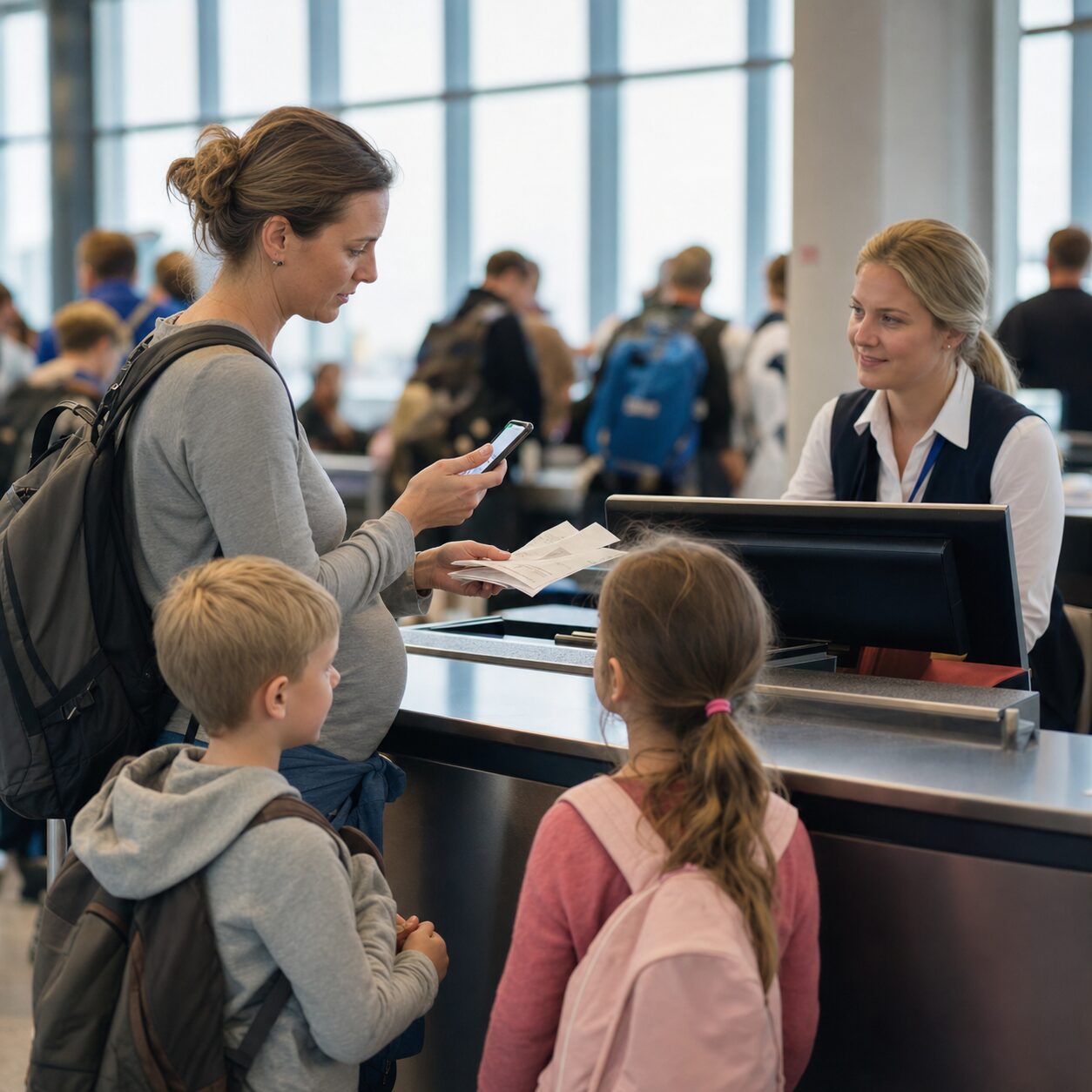
A departure board turns red. One child is hungry, another needs a bathroom, and three adults in the group have opened three different airline chats. This is exactly when families accept a poor option simply to make the problem stop.
There is a calmer method. Prepare before departure, separate immediate care from later compensation, and ask for a specific remedy. This guide uses current official US and European sources, but it is not legal advice. Rules depend on the itinerary, operating carrier, booking, cause and jurisdiction.
The timing matters. In July 2026, European institutions approved stronger air-passenger rules, including clearer claims, child seating and fare transparency. Official EU material says the update will take effect only after publication and its stated transition period. Until then, travellers should check the rules actually in force on the travel date.
Why “the airline owes me” is too vague to help
Four remedies are often mixed together. A refund returns money when you choose not to take an eligible changed journey. Rerouting or rebooking gets you to the destination. Care can mean meals, communication or accommodation during a qualifying wait. Compensation is an additional payment available only under particular rules and circumstances.
You may be entitled to one without another. Bad weather may remove a compensation claim in some systems while leaving assistance or rerouting rights intact. A voluntary voucher can also carry different conditions from a cash refund. Before tapping “accept,” read whether the offer settles or changes another claim.
| Need | What to ask | Evidence |
|---|---|---|
| Still travel | Earliest reasonable rerouting to final destination | Original itinerary and offered alternatives |
| Stop travelling | Refund to original payment method | Cancellation or significant-change notice |
| Wait safely | Meals, hotel, transport or reimbursement policy | Delay timeline and itemised receipts |
| Recover loss | Baggage report, expenses and formal claim route | Bag tag, report number and receipts |
Which rules may cover an international family?
Start with the route and operating airline, not citizenship. EU passenger protections generally cover flights within the EU, departures from the EU, and arrivals into the EU on an EU airline. US refund rules cover qualifying flights to, from or within the United States. Other countries have their own regimes.
A codeshare complicates the label on the booking. The airline that sold the ticket may differ from the airline operating the aircraft. Save both names and flight numbers. If a travel agent or online booking platform took payment, it may also control part of the refund process.
Do not assume travel insurance replaces airline duties. Insurance is a separate contract with definitions, exclusions, limits and deadlines. Likewise, a credit-card benefit may cover a hotel or delayed bag but require that the trip was paid with that card.
Build the disruption kit before anyone leaves home
A good kit is boring, light and exceptionally useful. Put passports, visas, consent documents, insurance details, essential medication, prescription information, chargers, a power bank and key contact numbers in hand baggage. Add one practical clothing layer and basic toiletries for each traveller within security rules.
Children need their own continuity items: snacks, an empty refillable bottle, a quiet activity, headphones, comfort item and any accessibility support. Never check irreplaceable medicine, keys or the only copy of a required document.
Save the itinerary offline. Include booking references, ticket numbers, operating carriers, baggage-tag photos, seat purchases and assistance requests. Take screenshots because an app can replace the original schedule after a change.

Make one adult the evidence keeper
During disruption, assign roles. One adult handles the airline. Another looks after children, food and rest. A third, if present, checks insurance and ground alternatives. The evidence keeper notes times, announcements, names or agent IDs, offers made and expenses.
Create one shared note headed with the date and booking reference. Photograph receipts immediately. Thermal paper has a mischievous habit of fading exactly when a claim form asks for it.
The first 15 minutes after a cancellation
1. Confirm the operating status
Check the airline app, airport board and official notification. Save screenshots showing the original and changed times. Record whether the flight was cancelled, delayed, diverted or renumbered; these labels can matter.
2. Decide the family’s priority
Ask: must we reach the destination, can we travel later, or should we abandon the trip? A family attending a wedding tomorrow makes a different choice from one starting a flexible holiday. Do not accept a refund if you still expect the airline to carry you on that ticket.
3. Queue in more than one sensible channel
Join the service-desk line while one adult uses the official app or phone. Avoid unsolicited social-media accounts asking for payment or booking details. Scammers know that stranded travellers are tired and public.
4. Ask for a concrete outcome
Try: “Please reroute all four passengers together to our final ticketed destination on the earliest reasonable option.” Or: “We will not travel on the significantly changed itinerary and request the eligible refund to the original payment method.” Specific language reduces circular conversation.
5. Protect care needs immediately
Tell staff about disability assistance, medication timing, pregnancy, an unaccompanied minor or a child who cannot safely tolerate a long queue. Ask where to obtain meal or hotel authorisation. If urgent health needs arise, use airport medical help or local emergency services rather than waiting for a booking agent.
US refunds: what the current official page says
The US Department of Transportation states that a passenger is entitled to a refund when an airline cancels a flight and the passenger chooses not to travel or accept the alternatives offered. It also defines significant changes for refund purposes and requires notification of the refund right.
Its current consumer page says automatic refunds are generally due within seven business days for credit-card purchases and twenty business days for other payment methods after the carrier knows the passenger did not accept the alternative. Check the latest page because enforcement details can change.
The same page explains refunds for paid ancillary services not provided and certain significantly delayed or lost checked bags. It also notes that most airlines declare a bag lost within their own period, often between five and fourteen days.
Do not confuse the US refund right with a universal right to cash compensation for inconvenience. Airlines’ customer-service commitments vary. The DOT dashboard and the carrier’s plan are useful places to check promised meals, hotels and family seating.
EU rights: assistance, rerouting and compensation
Under the EU system currently described by Your Europe, a cancelled flight generally gives passengers a choice among reimbursement, rerouting at the earliest opportunity, or rerouting later under comparable conditions, subject to the rules. Long waits can trigger assistance.
Compensation depends on notice, arrival delay, route distance, alternatives and extraordinary circumstances. Weather, security and air-traffic decisions may qualify as extraordinary, but the carrier must show the connection and that reasonable measures could not have avoided the disruption.
If you are offered rerouting, ask whether checked bags transfer automatically, whether the whole family remains on one booking, and which airport is involved. A flight to a different airport can create an expensive ground-transport puzzle.
What changed politically in July 2026?
EU institutions announced a strengthened framework with clearer claims and new protections. Official summaries mention fee-free seating of an accompanying adult next to a child under twelve, clearer fare presentation including hand baggage, and protection against cancelling a return solely because the outbound was missed.
However, approval is not the same as immediate applicability. The Council’s official announcement describes a delayed entry into force after publication. Travellers should verify the Official Journal status and effective date rather than quoting a headline at the desk.
When the airline offers a voucher
A voucher may be useful when its value exceeds the refund and the family expects to use it. Before accepting, check expiry, transferability, blackout dates, route restrictions, currency, residual value and whether acceptance waives a cash option.
Take a screenshot of the full terms. A large headline credit can shrink after four family fares, school-holiday pricing and a short validity window enter the room.
If you booked through an agent, ask who holds the money and who issued the ticket. Keep correspondence with both parties, but avoid cancelling in one channel while another is processing a rebooking.
How to manage an overnight disruption with children
First establish the next confirmed travel point: flight, terminal, reporting time and transport. Then solve sleep and food. Ask the airline what it will provide before booking independently, unless safety or health makes waiting unreasonable.
If you pay, choose proportionate essentials and keep itemised receipts. Alcohol, luxury rooms and elaborate meals are difficult claims. Note why the purchase was necessary and why an offered option was unavailable or unsuitable.
Keep children informed in short facts: “The plane is not going tonight. We are finding a safe place to sleep. Our next update is in twenty minutes.” Avoid promising a departure the airline has not confirmed.
Delayed baggage: report first, shop second
Report a missing bag before leaving the airport where possible. Obtain a Property Irregularity Report or equivalent reference, confirm the delivery address and save the baggage tag. The initial report may not be the final written claim.
Ask what reasonable interim expenses are covered and whether daily limits apply. Buy necessities appropriate to the delay and destination. Keep receipts. A winter coat may be reasonable on arrival in a cold climate; a replacement designer wardrobe is a more ambitious conversation.
EU guidance says written claims for damaged baggage should generally be made within seven days, and delayed-baggage claims within twenty-one days after the bag is received. International carriage may also involve the Montreal Convention. Deadlines and liability limits require current checking.
US DOT guidance says a paid checked-bag fee can be refundable when a bag is declared lost or significantly delayed under the applicable rule. This is separate from reimbursement for reasonable contents or expenses.
Photograph before and after
Before check-in, photograph the bag, its distinctive features and contents at a sensible overview level. Do not expose document numbers. After damage, photograph the condition before repair and retain estimates or written confirmation that repair is impossible.

Missed connections on one ticket versus separate tickets
A protected through-booking usually places more responsibility on the carrier to reroute to the final ticketed destination. Separate tickets can leave the second airline treating you as a no-show even though the first flight caused the miss.
If using separate tickets, build a large buffer, understand entry and baggage-recheck requirements, and buy insurance that explicitly addresses self-transfer. Cheap connections can become expensive geography lessons.
When disruption occurs, tell the first carrier about the final destination but recognise what it actually ticketed. Contact the second carrier before departure closes and record the response.
Family seating and accessibility need separate attention
Never assume a new itinerary preserves seats. Recheck every segment. Tell the airline the children’s ages and request adjacent seating. Save proof of paid seat assignments if they disappear.
For disability or reduced mobility assistance, confirm the request with the operating airline and airport after rebooking. Check mobility equipment tags, battery details and handover arrangements. Photograph equipment condition without obstructing staff.
The approved EU update includes stronger family-seating and reduced-mobility provisions, but again, confirm when each provision legally applies. In the US, consult the DOT family-seating dashboard and the carrier’s current policy.
A claim file that an exhausted reviewer can understand
Submit a short chronological claim with attachments labelled clearly. State the remedy requested and the basis without writing a travel memoir. Include passenger names, booking reference, ticket numbers, flight details, disruption notices, offers, actual arrival time, receipts and prior case numbers.
| Folder | Contents |
|---|---|
| 01 Booking | Original itinerary, payment and passenger list |
| 02 Disruption | Notices, screenshots and timeline |
| 03 Alternatives | Offers accepted or declined and reasons |
| 04 Expenses | Numbered itemised receipts |
| 05 Claim | Submitted form, confirmation and replies |
Use the airline’s official claim route first. If unresolved, follow the relevant national enforcement, alternative dispute or court route. Claims companies charge fees and may require authority to act; read their terms before handing over the file.
Common mistakes that weaken a good claim
Accepting without reading. A voucher or alternative may alter the refund path. Save terms before clicking.
Buying before asking. When practical, request airline authorisation for hotel or transport and record refusal or unavailability.
Losing the timeline. Screens update. Capture original schedule, notification time and actual arrival.
Claiming every possible right at once. Ask for the remedy that matches the facts. Separate refund, expenses, baggage and compensation if the forms do.
Quoting a future rule as current law. July 2026 EU headlines are important, but effective dates matter.
Letting the family split accidentally. Confirm every passenger and segment before accepting a rebooking.
A worked family scenario from cancellation to claim
Imagine two parents and two children travelling on one booking from a European airport to a non-EU destination with a connection. The first flight is cancelled at 6 p.m. The airline app offers a departure two days later, while the service desk mentions a route the following morning on different flights.
The family first saves the cancellation notice, original itinerary and both alternatives. They decide the trip is still worthwhile, so they do not select the refund button. One parent asks for rerouting to the final ticketed destination at the earliest opportunity and confirms that all four passengers will remain together. The other parent buys water and a simple meal after checking the airline’s assistance instructions.
The desk provides a hotel voucher but the shuttle is inaccessible for one family member. The evidence keeper asks staff for an accessible alternative, notes the response and keeps the taxi receipt when no suitable transport is provided. At the hotel, the family photographs the vouchers and checks the new boarding passes, seats, baggage status, terminal and assistance request.
The next flight arrives more than three hours late at the final destination. The family does not decide at the baggage belt that compensation is guaranteed. They first identify the governing rules, notice period and reason given by the airline. They submit care expenses separately from any compensation request and attach a short timeline.
This example shows why tidy categories matter. Rerouting solved transport. The hotel, meals and accessible taxi concerned care. Any later compensation analysis concerns the cause and arrival delay. If a bag had failed to arrive, that would require a baggage report and its own receipts.
What to check again 48 hours before departure
Open the booking on the operating airline’s site, not only the agent’s itinerary. Confirm flight numbers, airports, terminals, times, passenger names, seats, baggage allowances and special assistance. Check passport and entry requirements through official government sources.
Review weather and transport alerts without trying to predict every disruption. Download the airline app, enable useful notifications and make sure the contact email and phone number are correct. Store the airline’s international contact number offline.
Check the cards and insurance used for booking. Know the insurer’s notification deadline and emergency-assistance number. If the policy requires approval before a hotel purchase, discovering that rule at home is considerably nicer than discovering it at 1 a.m.
Repack essentials into hand baggage and confirm battery rules. Charge devices and power banks. Give older children a paper card with adult names, phone numbers, hotel address and meeting instructions, but avoid displaying unnecessary personal data.
Finally, agree on the family meeting point if people become separated at the airport. Children should know not to leave the secure area or follow a stranger claiming to help. Airport or airline staff at an identified desk are safer sources of assistance.
When self-booking an alternative may be reasonable
Buying replacement travel can sometimes be necessary, but it creates financial risk. First give the airline a reasonable opportunity to offer rerouting where the law requires it. Record what was requested, what was offered, why it failed the family’s needs and any urgency.
Compare like with like. A train to the same city may be practical; a premium cabin on another airline may be harder to justify when economy was available. Consider ground transport, baggage collection, visas, airport changes and whether cancelling one segment automatically cancels later segments.
Ask for written confirmation if the airline instructs you to book and claim later. If staff refuse to write it, record the time, channel and exact guidance. Check insurance before purchasing. Never abandon children, essential medication or accessibility needs simply to chase the cheapest theoretical route.
When safety is involved, act reasonably first and document why. Consumer rules are not meant to require a family to remain in an unsafe place. They also do not make every convenient upgrade reimbursable. Proportion and evidence are the useful middle ground.
Official sources to bookmark
These official pages were checked in July 2026. Recheck them on the date of travel.
- US Department of Transportation, Refunds: https://www.transportation.gov/individuals/aviation-consumer-protection/refunds
- US Department of Transportation, Aviation Consumer Protection: https://www.transportation.gov/airconsumer
- Your Europe, Air passenger rights: https://europa.eu/youreurope/citizens/travel/passenger-rights/air/index_en.htm
- European Commission, Air passenger rights: https://transport.ec.europa.eu/transport-themes/passenger-rights/air_en
- Council of the EU, July 2026 stronger air-passenger-rights announcement: https://www.consilium.europa.eu/en/press/press-releases/2026/07/13/council-gives-final-clearance-for-stronger-air-passenger-rights/
Frequently asked questions
If the airline cancels, should a family take the refund immediately?
Only if the family no longer wants the airline to transport them under that ticket. If reaching the destination remains the priority, first request suitable rerouting and understand the offered itinerary. A refund can end the original carriage contract and leave the family buying costly replacement tickets.
Can we claim a hotel and meals when weather caused the cancellation?
It depends on the governing rules and carrier commitments. In the EU, duties of care can apply even when extraordinary circumstances affect compensation. US airline commitments vary. Ask the carrier, keep proportionate itemised receipts, and check the current official rule for the itinerary.
Do the July 2026 EU passenger-rights changes apply to a flight today?
Not necessarily. Political approval and publication do not mean every provision is immediately applicable. The official Council announcement describes an entry-into-force timetable. Check the Official Journal, the travel date and current Your Europe guidance before relying on a new protection.
The calm plan to remember at the gate
Choose travel or refund. Ask specifically. Protect children and essential needs. Photograph the evidence. Keep reasonable receipts. Confirm every passenger, seat, bag and connection before leaving the desk.
Families cannot control weather, aircraft rotations or crowded airports. They can control the kit, the decision process and the claim file. That modest preparation turns a chaotic announcement into a sequence of manageable jobs—and leaves more energy for the people who matter than for arguing with a blinking departure board.