The safest first move in any holiday rental is a five-minute arrival check: confirm working smoke and carbon monoxide alarms, identify two ways out, and leave immediately if an alarm sounds or several people develop the same unexplained headache or nausea.
- Carbon monoxide, or CO, has no smell, colour or irritating warning; symptoms can look like travel fatigue, food poisoning or a bad first night.
- A listing photo or host message is not a functional test. Check alarms after arrival, keep exits clear, and know the local emergency number.
- If a CO alarm sounds or poisoning is possible, get everyone into fresh air, call emergency services, seek medical advice and do not re-enter until professionals say it is safe.
You have finally reached the rental. One child wants the Wi-Fi password, another has opened every kitchen cupboard, and the adults are negotiating who gets the room with the less theatrical mattress. Is this really the moment to inspect an alarm?
Yes. Not because holidays should begin with a risk assessment worthy of an airport, but because unfamiliar buildings remove the little safety advantages we have at home. We do not know the boiler, heater, fireplace, generator, staircase, locks or escape routes. We may not even know which number reaches emergency services.
This matters in 2026 as short-term accommodation continues to range from regulated hotels to cottages, apartments, boats, cabins, caravans and converted outbuildings. Rules differ sharply by country and property type. A new UK government guide for self-catering holiday homes in England, published in March 2026, specifically directs hosts to fire, gas and carbon monoxide duties. That is useful progress, but travellers still need a portable routine that works across borders.
This guide is for ordinary families, not safety engineers. It explains what to ask before booking, what to test on arrival, how to recognise CO exposure, and what to do without wasting precious minutes. It also separates reasonable preparation from gadgets and rituals that only create a comforting illusion.
Why carbon monoxide can hide inside an ordinary “travel headache”
Carbon monoxide is produced when carbon-based fuels do not burn completely. Possible sources include gas or oil boilers, wood stoves, fireplaces, portable fuel heaters, charcoal grills, camp stoves, generators and vehicle engines. A faulty appliance, blocked flue or poor ventilation can allow the gas to accumulate indoors.
The inconvenient fact is that human senses are bad CO detectors. The gas is colourless, odourless and non-irritating. You cannot rely on a strange smell, visible haze or stinging eyes. A room can look perfectly normal while exposure is occurring.
The US Centers for Disease Control and Prevention lists common symptoms including headache, dizziness, weakness, nausea, vomiting, chest pain and altered mental state. Breathlessness, collapse, loss of consciousness and death can occur with severe exposure. Symptoms can be nonspecific, which means they resemble jet lag, dehydration, a virus, alcohol after-effects or food poisoning.
A useful warning pattern is several people becoming unwell in the same place, with symptoms improving outdoors. Children and small pets may show effects earlier because of their physiology and breathing rates. Pregnant people, babies, older relatives and people with heart or respiratory conditions can also be especially vulnerable. None of this allows a traveller to diagnose CO poisoning at the kitchen table; it tells us when to stop debating and move outside.
| Clue | Why it matters | Safe response |
|---|---|---|
| CO alarm sounds | Treat the alarm as real even if nobody feels ill | Move everyone outside, call local emergency services, follow professional instructions |
| Several guests have headache, dizziness or nausea | A shared environmental exposure is possible | Get fresh air and seek urgent medical advice; mention suspected CO |
| Symptoms ease outdoors and return indoors | The building may be the source | Stay outside and do not re-enter to investigate |
| Only one person feels ill | CO still cannot be ruled out | Use symptoms and context; leave and get medical help if concerned |
| A faint smell is present | CO itself has no smell, but another fuel or combustion problem may exist | Leave, avoid switches or flames if gas is suspected, and call professionals |
Do not use a consumer CO alarm to “clear” a symptomatic person or prove a building is safe. Alarms are essential warning devices, but a silent device does not replace medical assessment, qualified inspection or emergency advice. Exposure level, duration, alarm placement, battery condition and device specifications all matter.
The booking-page questions that are worth asking before you pay
A glossy listing can show the coffee machine from four angles while saying nothing about alarms. Before booking, scan the amenities and safety sections for smoke alarms and carbon monoxide alarms. If the property has any fuel-burning appliance, attached garage, fireplace, wood stove or generator, ask the host directly what is installed and when it was last tested.
Keep the message short and specific: “Please confirm whether there are working smoke and carbon monoxide alarms near the sleeping areas and on each relevant level, and whether guests can test them on arrival.” A serious host should understand the question. Vague replies such as “the property meets all requirements” may be legally meaningful in one place and nearly meaningless in another.
Also ask about heating and hot water if the listing shows an indoor gas water heater, portable fuel heater, open fire or wood burner. Ask whether combustion appliances have been serviced by a qualified local professional. You do not need a stack of certificates for a weekend stay, but you do need enough information to spot a host who treats safety as somebody else’s hobby.
For a multistorey property, confirm that stairs have usable rails and that bedroom doors and final exits can be opened easily without searching for an unfamiliar key. For a remote cabin, learn how far help is and whether phone coverage is reliable. For a boat, caravan, tent or glamping pod, pay particular attention to heaters, cooking equipment and ventilation.
| Ask before booking | A reassuring answer includes | Consider another property when |
|---|---|---|
| Are smoke and CO alarms installed? | Clear locations, recent testing and a yes for relevant sleeping levels | The host says an alarm is unnecessary despite fuel-burning equipment |
| How are heating appliances maintained? | Qualified servicing and guest instructions | Portable fuel heaters are presented as casual indoor extras |
| How do guests exit? | Simple doors, clear routes and backup exits | Bedrooms appear dependent on one complex or locked route |
| Who handles an emergency? | Local contact, emergency number and property address | No one can explain whom to call after hours |
Local law is a floor, not a universal guarantee. Requirements can differ between long-term rentals and holiday lets, between hotels and private homes, and between neighbouring regions. A device that is mandatory in England may be placed differently elsewhere. Travellers should not attempt to become cross-border building inspectors, but they can choose listings that answer basic questions plainly.
What belongs in a small family travel safety kit?
A compact audible CO alarm can be a sensible travel item, especially for stays with fuel-burning appliances, remote cabins or destinations with uneven enforcement. The CDC Yellow Book notes that travellers may want to bring a personal CO detector. London Fire Brigade also advises taking a free-standing alarm on holiday.
Choose a device certified to a recognised standard in the market where it is sold, from a reputable supplier. Follow its manual for activation, placement, temperature limits, replacement date and transport. Some alarms have sealed batteries; others require batteries to be installed. A test button confirms parts of the alarm circuit and audible warning, not the air quality of an entire building.
Do not pack a mystery detector bought solely because its online listing used twelve exclamation marks. Keep the manual as a PDF available offline. Note the alarm’s end-of-life signal so you do not confuse it with a CO warning at 2 a.m. If travelling by air, check airline rules for the battery type.
A modest kit can include a small torch, portable CO alarm, phone power bank packed according to airline rules, a paper card with local emergency numbers and accommodation address, and any essential medicines. The point is resilience, not turning hand luggage into a hardware shop.
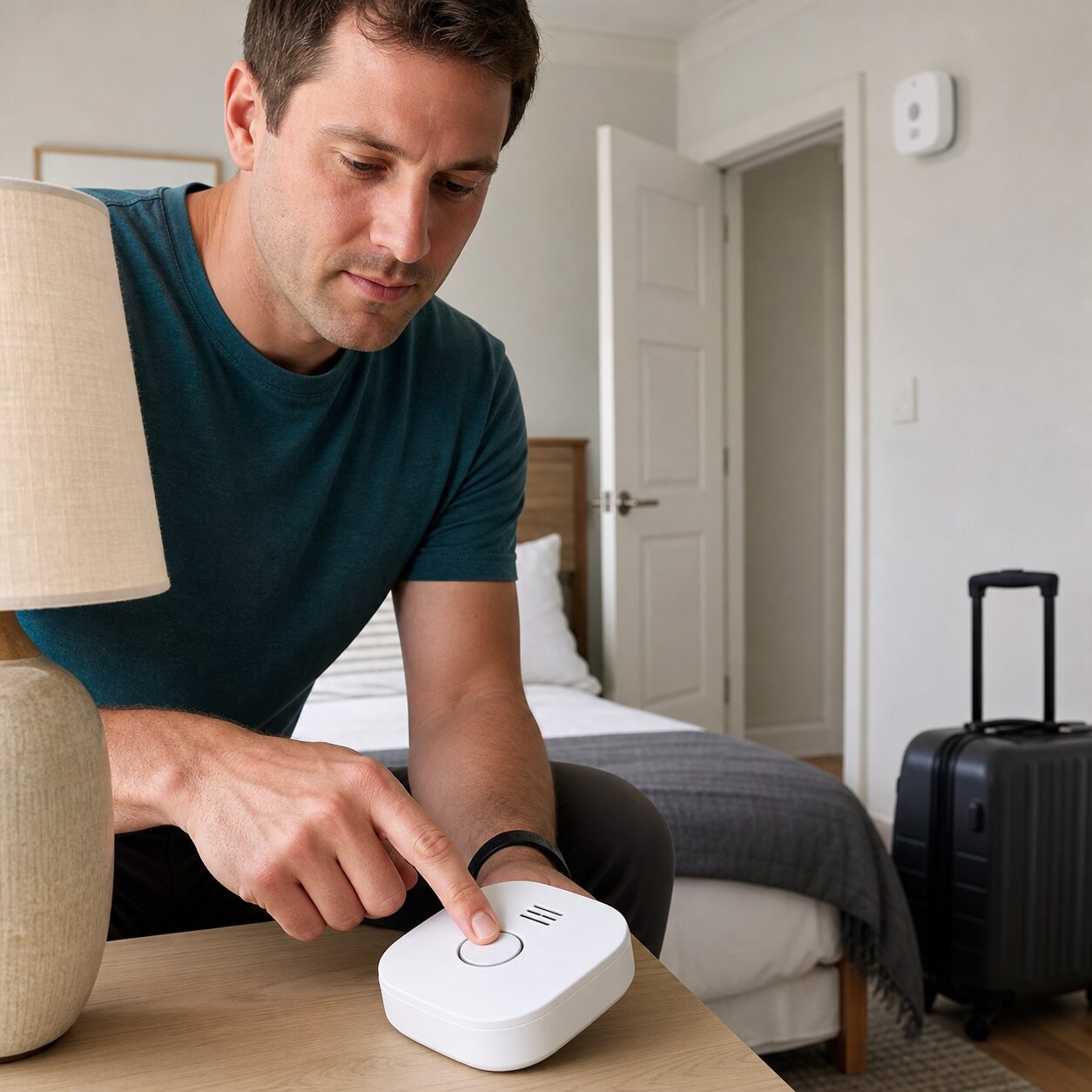
The five-minute arrival check that protects the whole stay
Do the check before luggage spreads across the floor and before tired children disappear behind closed doors. One adult can inspect while the other keeps arrival chaos moving. If travelling alone with children, make it a simple game: find the exits, the alarms and the outdoor meeting point.
1. Confirm the exact address and emergency number
Save the full local address, including apartment, gate or unit details. Drop a map pin and take a screenshot for offline use. Learn the local emergency number; 112 works in the European Union and in some other countries, while 911, 999, 000 and other numbers apply elsewhere. Do not assume your home-country number will redirect.
Look for host or manager contact details, but understand the hierarchy: an emergency service comes before a booking-platform message when life or health may be at risk. A host can arrange repairs. A host is not a substitute for fire, ambulance or gas emergency professionals.
2. Locate smoke and carbon monoxide alarms
Look on ceilings and walls near sleeping areas, on each occupied level, and near relevant fuel-burning appliances as local guidance requires. Smoke and CO alarms are not interchangeable. Combination units exist, but a traveller should not guess based on casing shape. Check labels if readable and consult guest information.
Press the test button according to the host’s instructions and device manual. Warn the family first because the sound may be loud. If an alarm does not respond, contact the host immediately and do not simply borrow a battery from the television remote. A failed device needs a proper remedy.
3. Inspect escape routes from every sleeping room
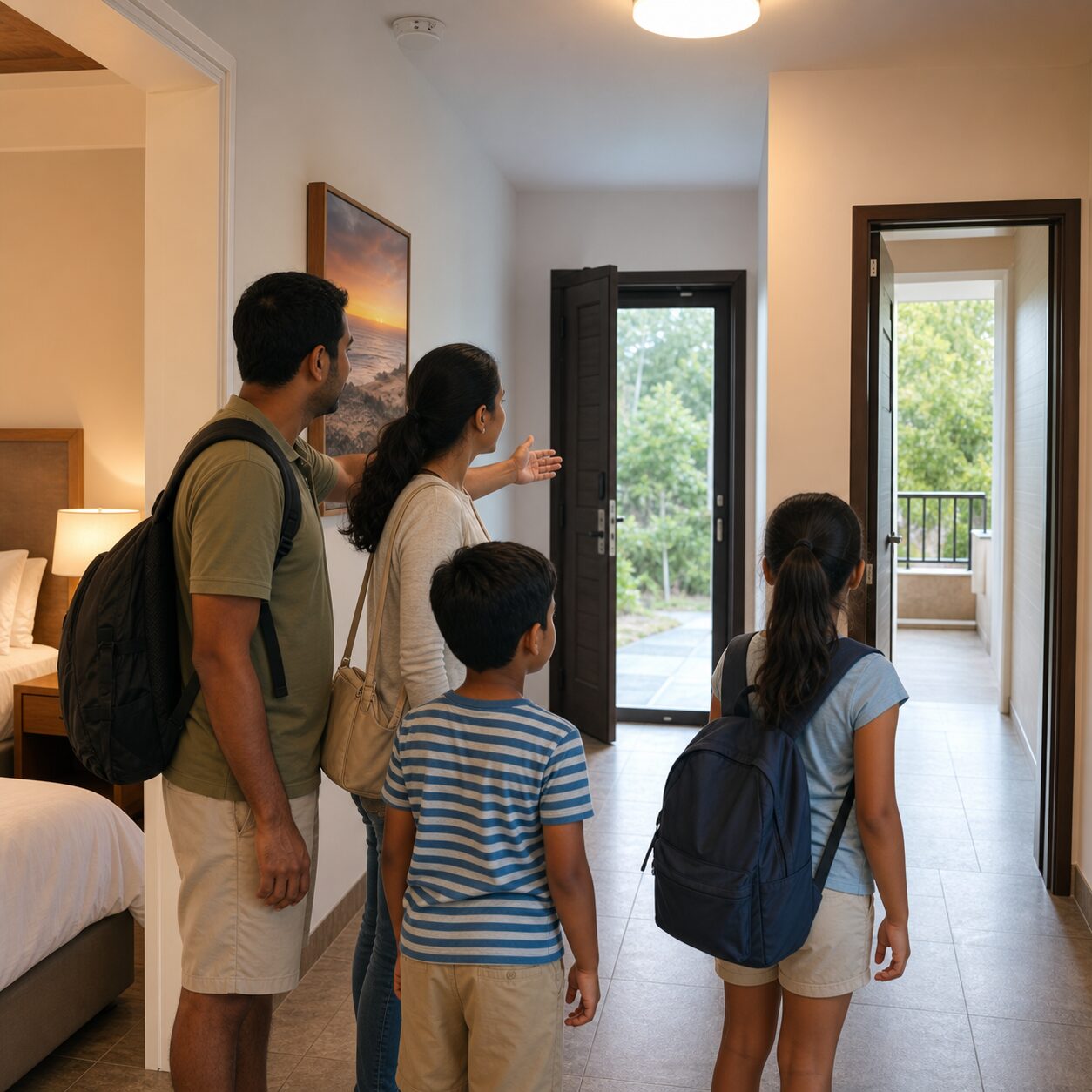
Walk from each bedroom to the main exit. Then identify a second route where the building design allows one. Check whether doors open from the inside, stairs are lit and corridors are clear. Move your own bags out of routes. Never block a door with a stroller because it feels conveniently close.
Windows may be part of an escape plan in some low-rise buildings, but height, locks, screens and child safety devices matter. Do not assume a high window is usable. In a hotel, count doors between your room and the stairwell so you can navigate in smoke, and identify an alternative stairway. Avoid lifts during a fire.
4. Scan combustion and cooking hazards
Never use charcoal grills, generators, camp stoves or fuel-burning outdoor appliances inside a home, garage, basement, tent, camper or near an open window. An extinguished barbecue can continue producing CO. Moving it indoors because rain has arrived turns a disappointing dinner into a potentially lethal decision.
Do not use a gas oven or stove to heat the accommodation. Check that vents are not intentionally covered and that a fireplace or wood stove has clear guest instructions. If you see heavy soot, damaged appliances, a disconnected flue, scorch marks or improvised repairs, stop using the equipment and contact the host.
5. Agree on one outdoor meeting point
Choose something obvious and safely away from the building: a gate, large tree, parking sign or neighbour-facing corner. Children should understand that an alarm means go outside, stay together and never return for a toy, coat or tablet.
Assign age-appropriate roles. One adult leads children out; another checks only the immediate path while leaving, if safe, without searching the entire property. Nobody re-enters. If a family member has mobility, hearing or sensory needs, plan how alarms will be noticed and how stairs or unfamiliar locks will be managed.
What to do when a carbon monoxide alarm sounds
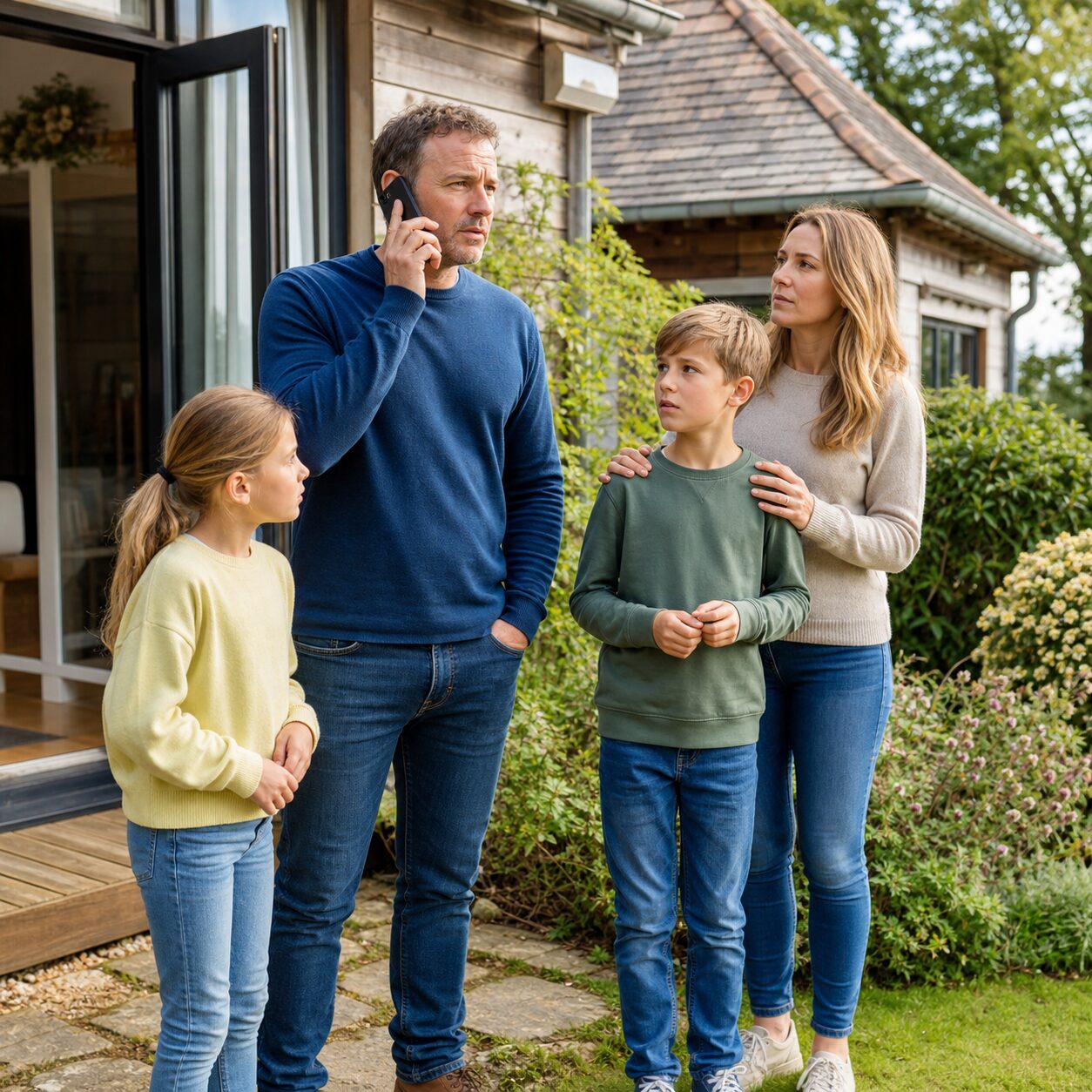
Move everyone into fresh air immediately. Do not spend time opening every window, locating the appliance or filming the alarm for customer support. Leave by the quickest safe route. Help children and anyone with limited mobility. Take a phone only if it is already with you.
Once outside, call the local emergency number and say that a carbon monoxide alarm has activated or that CO exposure is suspected. Give the exact address and describe symptoms. Follow the dispatcher’s instructions. Seek urgent medical evaluation when anyone has symptoms, is pregnant, has lost consciousness, has chest pain or breathing difficulty, or when emergency services advise it.
Tell clinicians that CO is suspected. This matters because the symptoms are nonspecific and because testing and treatment decisions depend on timing and clinical assessment. Do not rely on a normal fingertip pulse oximeter reading; ordinary pulse oximeters cannot reliably distinguish oxygen-carrying haemoglobin from carboxyhaemoglobin in the way a worried traveller might assume.
Do not re-enter until the fire service, gas emergency service or another qualified authority says the property is safe. Do not accept “it was probably a low battery” from an unqualified person as permission. Low-battery chirps and CO alarm patterns differ, but a traveller standing outside does not need to solve the sound like a quiz.
| Do now | Do not do |
|---|---|
| Get everyone outdoors into fresh air | Search room by room for the source |
| Call emergency services from outside | Rely only on a host or booking platform |
| Report symptoms and suspected CO | Assume nausea is food poisoning |
| Wait for professional clearance | Re-enter for luggage or to silence the alarm |
| Arrange alternative accommodation | Sleep there after merely opening windows |
When symptoms appear but no alarm is sounding
An alarm may be absent, poorly placed, expired, disabled or outside its response threshold. If several people develop unexplained headache, dizziness, weakness, nausea, confusion or breathlessness, especially while a heater, boiler, fireplace or generator is operating, move outside and get help.
Notice whether symptoms improve in fresh air, but do not use improvement as a reason to return. Call emergency services or a poison centre where available. If someone is unconscious, difficult to wake, confused, having chest pain, struggling to breathe or seizing, treat it as an emergency.
If you smell gas, avoid flames and actions that could create a spark, including operating switches, when local emergency guidance tells you to do so. Leave and call the gas emergency service from outside. Remember that the smell added to fuel gas is not the smell of carbon monoxide; either situation deserves professional attention.
Fire safety deserves the same arrival routine
CO and fire preparation overlap but are not identical. Smoke alarms warn of combustion particles; CO alarms warn of carbon monoxide. A property should have appropriate detection for its hazards and local rules. Families also need a workable exit plan.
The US Consumer Product Safety Commission advises vacation-rental guests to check smoke alarms, CO alarms and fire extinguishers, and to plan two ways out. The CDC Yellow Book warns that fire-safety standards and emergency response can vary internationally. This is not an argument against travel. It is an argument for looking up from the welcome basket.
Keep cooking attended. Turn pan handles away from edges, keep children out of the cooking zone and do not improvise with unfamiliar appliances. Place charging devices on hard, ventilated surfaces rather than under bedding. Use travel adaptors suitable for the destination and appliance; an adaptor changes plug shape, not necessarily voltage.
Know where a fire extinguisher or fire blanket is, but escape comes first. Only attempt to control a very small fire if you are trained, have the correct equipment, have a clear exit behind you and emergency services have been called. Closing a door while leaving can slow smoke and fire spread. Never hide during a fire alarm because the corridor seems inconvenient.
Special cases: cabins, caravans, boats and power cuts
Alternative accommodation often creates memorable trips and unusual combustion risks. Cabins may use wood stoves. Caravans and boats may have compact gas appliances. Remote properties may rely on generators during outages. Tents and glamping pods may tempt guests to bring cooking or heating equipment inside.
CDC guidance is unequivocal about generators, grills, camp stoves and similar fuel-burning equipment: never use them inside a home, basement, garage or camper, or outside near an open window or air intake. Generator placement distances and operating rules should follow the manufacturer and local authorities. Guests should not move or modify host equipment.
A barbecue that appears extinguished can still release CO for hours. Keep it outdoors and away from enclosed spaces. Do not bring it into a tent, porch, conservatory or cabin for warmth. Do not sleep with a running vehicle nearby or idle an engine in an attached garage.
On boats, engine exhaust can collect in unexpected areas. The CDC warns travellers to avoid swimming or lingering near stern exhaust outlets. Follow the operator’s safety briefing, check onboard alarms, and keep children within the designated safe areas.
How to handle a missing or failed alarm without starting a holiday argument
Photograph the missing location or failed test only after immediate safety is addressed. Message the host through the booking platform so there is a time-stamped record. State the problem, what fuel-burning appliances are present, and the remedy you require. Keep the language factual.
If there is no working CO alarm in a property with relevant combustion risk, or no working smoke alarm near sleeping areas, ask for immediate installation by a competent person or move to alternative accommodation. A portable alarm you brought can add protection, but it does not repair a defective appliance or necessarily satisfy local placement requirements.
Contact the booking platform’s safety team if the host does not respond. In an immediate hazard, call local authorities first. Save receipts for alternative accommodation and transport. Consumer remedies depend on jurisdiction and platform terms, so avoid promising yourself a particular refund while still inside a questionable building.
The family discussion can be simple: “The alarm did not work, so we are moving while it is fixed.” Children do not need an anxious lecture. Adults do need to resist sunk-cost thinking. A prepaid night is not a reason to gamble with an invisible gas.
A practical checkout note can protect the next guests
Report safety defects privately and promptly, even if the host solved them. Include dates, device location and what happened. If a review is appropriate, describe verifiable facts rather than speculating about cause. “The bedroom CO alarm did not sound during the test; the manager replaced it that afternoon” is more useful than a dramatic accusation.
If an alarm activated or anyone became ill, preserve booking messages, medical records and incident numbers. Follow local public-health or fire-service advice. Do not take or dismantle installed devices. If authorities identify a hazard, ask the platform to prevent rebooking until remediation is confirmed.
The 60-second family script to rehearse tonight
A plan works best when it is short enough to remember while half asleep. Try this: “If an alarm sounds, put on no shoes, collect no bags and follow the nearest safe exit. Meet at the front gate. Stay outside. One adult calls emergency services. Nobody goes back in.”
For younger children, point to the alarm and let them hear a planned test while covering sensitive ears as needed. Explain that the sound means find the adult and go outside. For teenagers, assign practical responsibility without making them responsible for younger siblings beyond their capacity.
For a deaf or hard-of-hearing traveller, ask in advance about vibrating pads, visual alarms or accessible rooms. For mobility limitations, choose a suitable floor and inspect the route before bedtime. A beautiful loft is less charming when the only exit is a narrow spiral staircase.
FAQ
Should every family carry a portable carbon monoxide alarm?
It is a reasonable extra layer for travel involving rentals, cabins, caravans, boats or fuel-burning appliances, and official travel guidance says travellers may want one. Buy a certified audible model from a reputable source and follow its manual. It cannot replace installed alarms, proper appliance maintenance or professional clearance after an incident.
Can I stay if the host replaces the battery and the alarm passes a test?
That depends on why the device failed and whether any exposure or appliance defect is suspected. A battery replacement may resolve a simple maintenance issue, but it does not prove fuel-burning equipment is safe. If an alarm activated, anyone had symptoms, or there are signs of combustion trouble, stay outside until qualified professionals clear the property.
What if everyone feels better a few minutes after going outdoors?
Improvement in fresh air can be consistent with CO exposure and is not permission to re-enter. Call emergency services or a poison centre and describe the location, alarm status and symptoms. Seek medical assessment as advised, particularly for children, pregnant people, older adults, people with heart or lung conditions, or anyone with neurological, chest or breathing symptoms.
Official sources and current guidance
- UK Department for Business and Trade: self-catering holiday home rules and regulations, published 25 March 2026
- CDC Yellow Book: poisonings and toxic exposures during travel
- CDC Yellow Book: injury and death during travel
- CDC: clinical guidance for carbon monoxide poisoning
- US Consumer Product Safety Commission: vacation rental safety hazards
- London Fire Brigade: carbon monoxide safety
The calm conclusion to take on your next trip
Holiday-rental safety is not about distrusting every host or inspecting pipes with a torch. It is about a short, repeatable routine that catches obvious failures before the family goes to sleep.
Confirm alarms, test them correctly, map exits, keep fuel-burning equipment outdoors where required, save the address and emergency number, and leave first if CO is possible. Five minutes at arrival buys something more useful than reassurance: a plan everyone can follow when thinking clearly is suddenly difficult.
Then unpack, find the Wi-Fi password, negotiate the mattress and enjoy the trip. Preparedness has done its job when it becomes a quiet background habit rather than the main event.