The most effective way to end morning chaos is to stop making “decisions” and start following a pre-set architecture that removes the need for active thought before your first cup of coffee.
- Cognitive Load Reduction: By treating lunch packing as a structural system rather than a creative culinary task, you preserve your executive function for work and parenting.
- The 4-Component Rule: Every lunch must follow a fixed ratio—Protein, Fiber, Complex Carb, and “Wildcard” (treat)—to eliminate decision paralysis.
- Batch-Prep vs. Daily-Prep: You shouldn’t be cutting vegetables in the morning; the system relies on “assembly,” not “preparation,” during the morning rush.
If you have ever stared into the refrigerator at 7:00 AM, holding a half-eaten bag of baby carrots and wondering if you have enough protein for the day, you have experienced a failure of executive function. It isn’t that you aren’t capable; it’s that you are asking your brain to solve complex logistical problems—balancing nutrition, preferences, and inventory—at a time when your brain is still essentially buffering.
Why Your Brain Crashes During Morning Prep
Executive function refers to the mental skills that include working memory, flexible thinking, and self-control. In your 30s and 40s, these resources are already spread thin by work projects, household management, and the general “mental load” of modern life. When you add the variable of “what should I put in this lunchbox today?” you are triggering decision fatigue.
Decision fatigue is the psychological phenomenon where the quality of your decisions deteriorates after a long session of decision-making. By the time you are packing lunch, you’ve already decided what to wear, checked your email, and negotiated with your children about brushing their teeth. The lunchbox is often the final straw that leads to the “I’ll just buy them something at school” compromise, which is expensive and often less nutritious.
The solution is to turn the lunchbox into a system. A system is a set of rules that governs your behavior so that you don’t have to think. If the rules are rigid, the system works. If you leave room for “inspiration,” the system breaks.
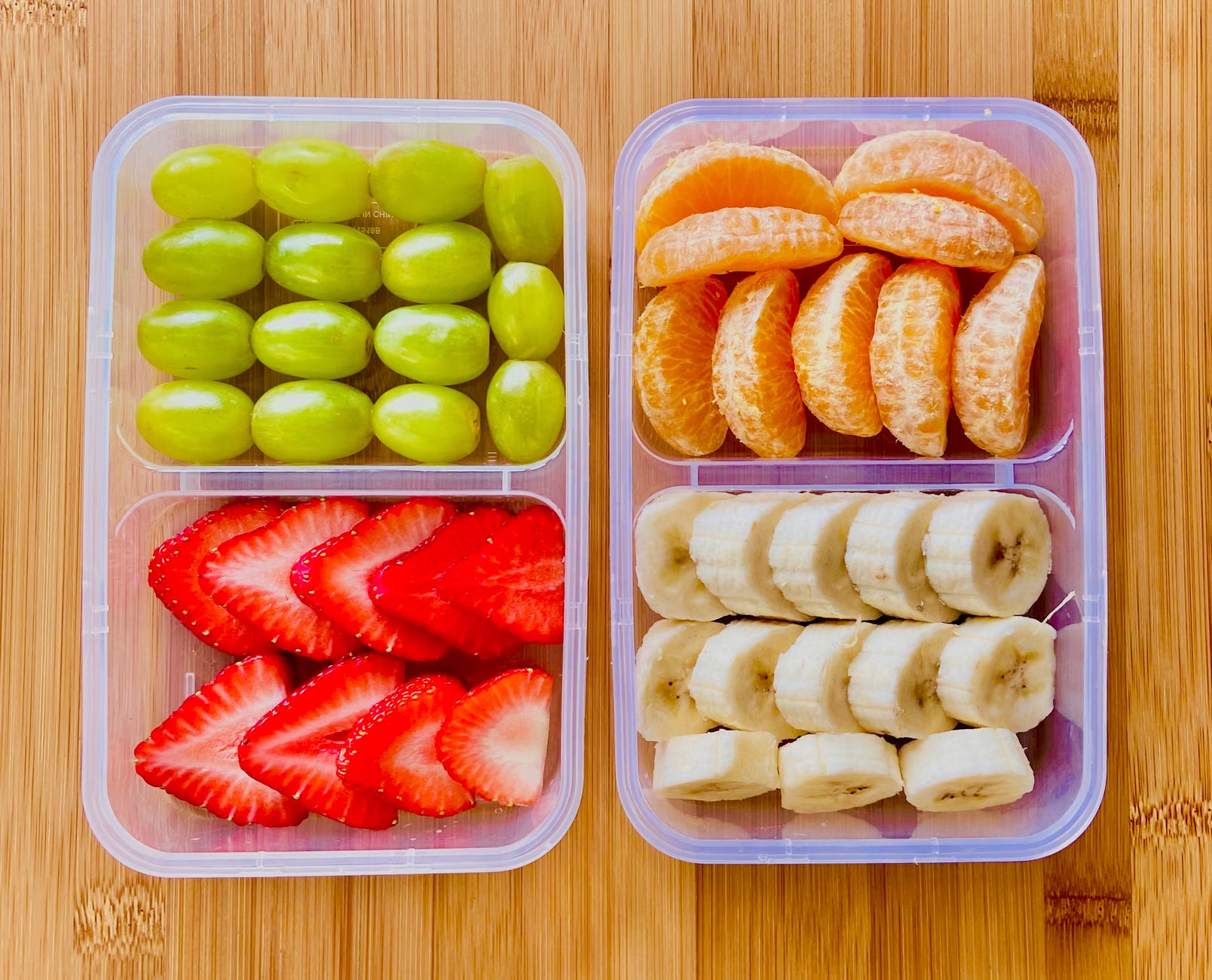
The 4-Component Architectural Framework
To stop the morning drain, you must standardize your inputs. Do not look for recipes. Look for components. Every lunchbox you pack should be a variation of the same four-slot architecture. This is not about being a gourmet chef; it is about being an assembly line manager.
Your lunchbox should have at least four distinct compartments. If it doesn’t, you are losing time trying to arrange items that don’t fit. The four components are:
- The Anchor Protein: This is the most calorie-dense item. Examples: Hard-boiled eggs, deli-sliced turkey, cubed tofu, or canned chickpeas.
- The Fiber Foundation: This is your volume filler. Examples: Cucumber slices, cherry tomatoes, snap peas, or apple wedges.
- The Sustained Energy Carb: This keeps them full. Examples: Whole-grain crackers, quinoa, brown rice, or a slice of hearty sourdough.
- The Wildcard: This is the “treat” or “surprise” that ensures they actually eat the rest of the box. Examples: A few dark chocolate chips, a handful of dried cranberries, or a small piece of cheese.
The Decision Rule: If you are missing one of these, you are not allowed to “improvise” a replacement. You simply skip that slot or use a standby “emergency” item (like a shelf-stable granola bar or a pouch of applesauce). By removing the need to find a “perfect” match, you reduce the time spent in the kitchen from 15 minutes to 3 minutes.
Building Your Assembly Station
The most common mistake parents make is storing lunch supplies in the same place they store “dinner” supplies. If you have to move a heavy cast-iron skillet to reach the crackers, you are creating friction. Friction is the enemy of a system.
Create a “Lunch Assembly Zone” in your kitchen. This should be a specific drawer or a section of your pantry that contains only lunch-related items: silicone cupcake liners (for separating foods), bento-style boxes, and non-perishable snack items.
| Task | The “Old” Way (Chaos) | The “System” Way (Executive Function) |
|---|---|---|
| Inventory | Check fridge, pantry, and freezer daily. | Weekly Sunday grocery “reset” using a standard list. |
| Preparation | Chopping and cooking during the morning rush. | Batch-prep on Sunday (e.g., boil eggs, wash berries). |
| Choice | “What do they want to eat today?” | “It is Tuesday; Tuesday is Turkey/Cheese/Apple day.” |
Notice the difference: The System removes the question “What?” and replaces it with “When?” and “How?”

The “Sunday Reset” vs. The “Morning Assembly”
The success of the executive-function lunchbox hinges entirely on the Sunday Reset. If you try to do the heavy lifting in the morning, the system will fail. The Sunday Reset is the time where you transfer cognitive load from your future, tired self to your present, rested self.
Step 1: The Container Audit
Ensure all lunchboxes are washed and dried on Sunday. If you have to wash a container in the morning, you have already lost. Have a minimum of three sets of containers per person so you are never caught without a clean one.
Step 2: The Bulk Prep
Wash all fruit and vegetables. If you buy a bag of grapes, wash them and put them into a clear container. If you buy a block of cheese, cube it. Do not leave items in their original plastic packaging; the packaging is a barrier to entry. When you open the fridge on Wednesday morning, you should see ready-to-grab components, not raw ingredients.
Step 3: The “Assembly” Logic
On Tuesday morning, your goal is to assemble, not to create. You open the fridge, grab the pre-washed berries, the pre-cubed cheese, and the pre-cooked protein. You place them into the four slots. You close the lid. You are done.
Addressing Common Hurdles and Edge Cases
Inevitably, someone will complain. “I don’t like grapes!” or “We ran out of crackers.” This is where the Rigidity Protocol comes in. If you allow the system to be flexible, it ceases to be a system. If the child doesn’t like grapes, they don’t get the Fiber component for that day—or they get the “Emergency Fiber” (e.g., a simple carrot stick). You do not start a negotiation at 7:15 AM.
Another hurdle is the “food waste” guilt. We often feel that if we don’t pack a “perfect, balanced, varied” meal, we are failing. Research from the USDA MyPlate guidelines suggests that nutritional balance is a long-term goal, not a per-meal requirement. A lunchbox that is simple, consistent, and actually eaten is infinitely better than a “perfectly balanced” lunch that comes home uneaten because it was too complicated or unappealing.
The Hidden Variable: Temperature and Texture. Many parents fail because they pack items that get soggy. If you pack a sandwich, put the condiments in a tiny separate container or use a “barrier” ingredient like a leaf of lettuce between the bread and the meat. This small, 5-second action prevents the entire lunch from being discarded at school, which saves you the stress of a hungry child coming home.

The Psychological Shift: From “Caregiver” to “Operations Manager”
There is a lingering societal pressure for parents to express love through the labor of lunch preparation. We equate “time spent” with “care provided.” This is a trap. Your child does not derive their sense of being loved from the fact that you spent 20 minutes meticulously cutting their sandwich into the shape of a star at 7:00 AM.
In fact, the stress you project during that morning rush is far more detrimental to the family dynamic than a simpler, more efficient lunch. By adopting an “operations manager” mindset, you are modeling a crucial life skill for your children: systematic thinking. You are showing them that life is manageable when it is organized, and that preparation is a form of self-care.
When you stop viewing the lunchbox as a daily performance piece, you reclaim your mental bandwidth. That energy can then be redirected toward things that actually matter—like having a conversation with your child in the car, or simply enjoying your own breakfast without the looming shadow of the “lunchbox task.”
Maintaining the System Long-Term
Even the best systems require maintenance. Every month, conduct a “System Audit.” Ask yourself: Which components are consistently coming back uneaten? If the crackers are always returned, stop buying them. If the hard-boiled eggs are a hit, increase that rotation. The system should evolve based on data, not on your personal ambition.
If you find yourself slipping back into morning chaos, it’s usually because you’ve skipped the Sunday Reset. If you find yourself in that position, do not try to “catch up” by being a hero on Monday morning. Accept the “low-effort” lunch—a piece of fruit, a cheese stick, and a granola bar—and move on. The goal is consistency, not perfection.
Frequently Asked Questions
What if my children are picky eaters and refuse to eat the “components” I pack?
The “Executive-Function Lunchbox” relies on the Exposure Principle. By including a small amount of a “safe” food (the Wildcard) alongside the components, you remove the pressure. If they don’t eat the protein, it’s not a failure; it’s data. Note it, and swap the protein for a different one next week. The goal is to provide the option, not to force the consumption.
Is this system expensive to implement?
It can be, if you buy specialized, high-end bento boxes. However, the system works perfectly with simple, reusable plastic containers or even glass jars. The “cost” is not in the equipment; it is in the time spent organizing. You will likely save money in the long run because you will stop buying pre-packaged, single-serving snacks, which are almost always more expensive per ounce than buying in bulk and portioning yourself.
How do I handle food safety with the “Sunday Prep” method?
Food safety is paramount. When batch-prepping (e.g., cooking grains or proteins), ensure they are cooled completely before being placed in airtight containers in the refrigerator. Use an insulated lunch bag with a dedicated ice pack. If you are worried about perishables like deli meat, keep them in the coldest part of the fridge and assemble the box the night before, keeping it refrigerated until the moment of departure.
Ultimately, the goal is to make your morning routine feel like a “launch” rather than a “scramble.” By pre-loading your brain’s decision-making capacity on the weekend, you ensure that your morning energy is spent on your family, not on the logistics of a ham sandwich. Start small: pick one day next week, set your four components, and watch how much lighter your morning feels.
For further reading on managing the mental load and household systems, visit the American Psychological Association resources on stress and decision-making.