The most effective way to combat the burnout of modern urban life isn’t a week-long retreat to a remote destination, but the intentional practice of “Quiet Tourism” within your city’s own metropolitan park system.
- Accessibility Over Distance: Quiet tourism focuses on sensory regulation and mental detachment rather than travel distance, making local parks the most efficient tool for stress reduction.
- Strategic Timing: Visiting urban parks during “shoulder hours” (early morning or late weekday afternoons) is the single most important factor in transforming a crowded public space into a quiet sanctuary.
- The “Active Stillness” Framework: By engaging in low-dopamine activities like sketching, reading, or observing, you can achieve a restorative state that passive scrolling on a smartphone actively prevents.
If you are in your 30s or 40s, your life is likely a constant oscillation between professional deadlines and the logistical demands of parenting. The idea of “taking a break” often feels like just another item on a to-do list that requires hours of planning, expensive flights, and the inevitable stress of logistical coordination. This is exactly where the concept of Quiet Tourism becomes a game-changer.
Quiet tourism is not about visiting “quiet” places in the traditional sense; it is about adopting a specific mindset and behavior in spaces that are often overlooked. It rejects the “checklist” approach to travel and leisure, where the goal is to see as much as possible, and replaces it with the goal of hearing, feeling, and processing as little as possible. For the city dweller, the metropolitan park is the laboratory for this practice.
Understanding the Psychology of Urban Stillness
Why do we feel so drained even when we are “resting”? Psychologists often refer to “Attention Restoration Theory” (ART). In our daily lives—especially those of us managing households and careers—we rely heavily on “directed attention.” This is the type of focus required to manage a calendar, navigate traffic, or solve a work problem. It is a finite resource that, when depleted, leads to irritability and mental fatigue.
Metropolitan parks provide what is known as “soft fascination.” This is an environment that holds our attention without effort. Think of the way light filters through leaves, the movement of clouds, or the rhythmic sound of a distant fountain. These stimuli allow our directed attention to recover. You aren’t “doing” anything; you are letting your brain reboot.
However, the mistake most people make is trying to find this silence in a park on a Saturday afternoon when the playgrounds are at full capacity. If you go to a park during peak hours, you aren’t engaging in quiet tourism; you are engaging in crowd management. The success of this practice depends entirely on your ability to curate your environment.

The Logic of Off-Peak Scheduling
To practice quiet tourism effectively, you must treat your park visit like a high-value meeting. You wouldn’t schedule a critical project review during a noisy construction window, so why treat your mental health time as an afterthought? The best time to visit a major metropolitan park is between 7:00 AM and 9:00 AM on weekdays, or during the “golden hour” just before sunset on a Tuesday or Wednesday.
During these times, the demographic of the park changes. The commuters are at their desks, and the weekend crowds haven’t arrived. You are left with the “quiet cohort”—the early morning runners, the retired locals, and the few who have mastered the art of carving out time for themselves. This environment is essential for the “passive engagement” that defines quiet tourism.
Curating Your Sensory Environment
Even in a quiet park, the city is never truly silent. The hum of traffic or the distant siren can break your state of restoration. This is where personal technology, used intentionally, becomes a tool for silence rather than a source of distraction.
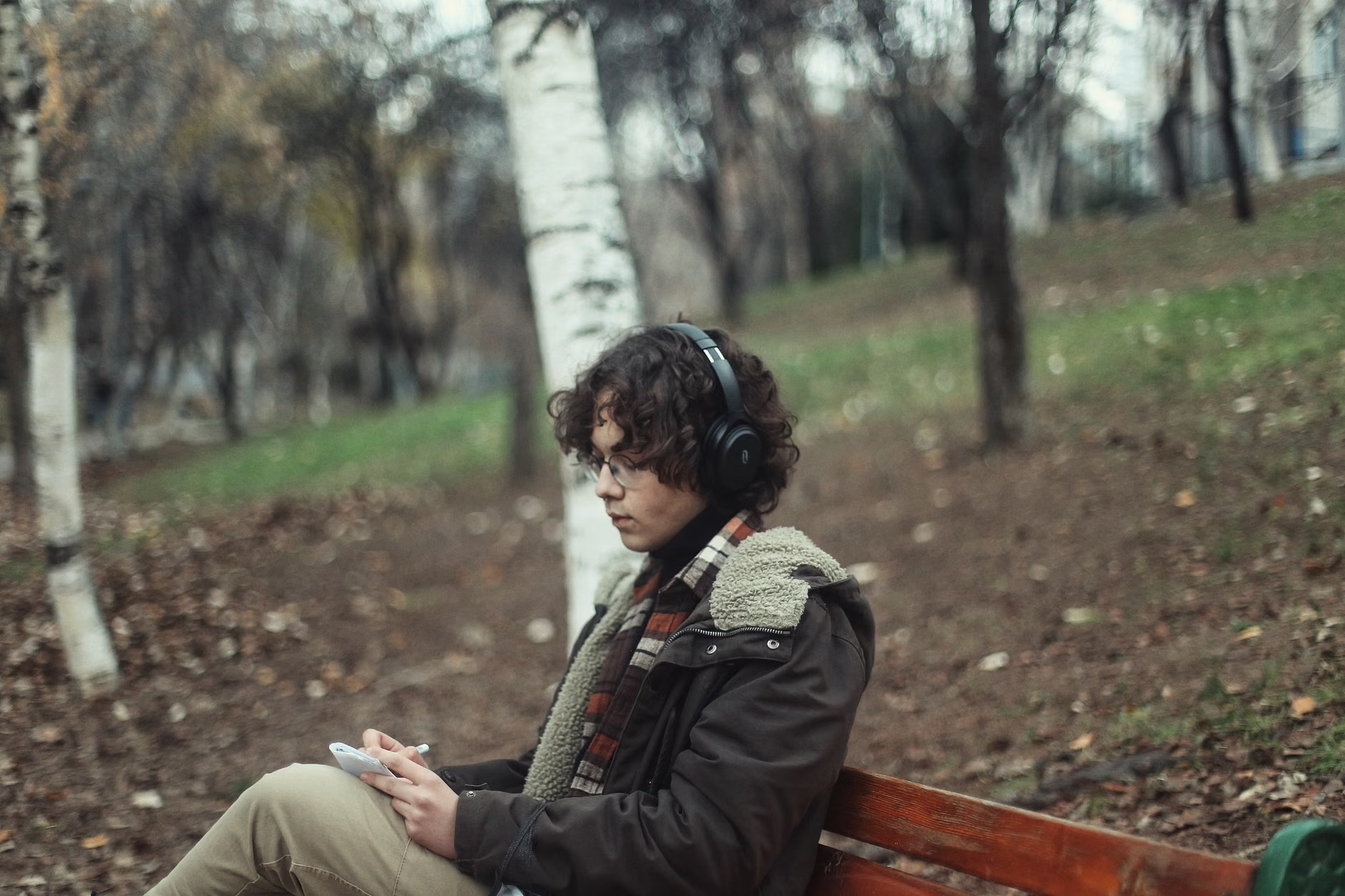
If you find that the ambient city noise is intrusive, use noise-canceling headphones, but do not listen to podcasts or high-energy music. Instead, use white noise, brown noise, or ambient nature sounds. The goal is to create a “sound bubble” that isolates your senses from the chaotic city input. This is not about escaping reality; it is about filtering the sensory overload so your nervous system can down-regulate.
Another common mistake is bringing your smartphone with the intention of “catching up.” If you are checking emails or scrolling through social media, you are not engaging in quiet tourism; you are simply changing the location of your work. The screen is a high-stimulus object that keeps your brain in a state of “directed attention.” To truly benefit from a park visit, your phone should be in “Do Not Disturb” mode, or better yet, kept in your bag.
The “Active Stillness” Toolkit
What should you actually *do* in the park? The answer is: as little as possible. However, humans often find “doing nothing” uncomfortable. To bridge this gap, engage in activities that require low cognitive load:
- Analog Observation: Carry a small notebook and a pen. Don’t write a journal entry; simply sketch the shape of a tree or write down five things you see, hear, or smell. This forces your brain to observe the present moment.
- The “One-Point” Focus: Choose one object—a flower, a rock, a ripple in the water—and look at it for three minutes. Do not try to analyze it. Just observe the details.
- Slow Walking: Walk at half your usual pace. Notice the sensation of your feet hitting the ground. This is a form of moving meditation that grounds you in your physical body, away from the abstract worries of your professional life.

If you have children, the concept of “quiet” can seem like a fantasy. However, quiet tourism is not just for the solo practitioner. It can be a powerful way to bond with your children without the pressure of “entertainment.”
The key is to change the narrative from “we are going to the park to play” (which implies high energy and supervision) to “we are going to the park to be quiet explorers.” You can turn it into a game: “Let’s see how many different types of birds we can find,” or “Let’s find a quiet spot and see who can hear the most distant sound.”
By modeling quiet behavior, you teach your children that they don’t always need to be stimulated. This is a vital skill for children growing up in a world of constant digital input. Even if the quiet only lasts for 15 minutes, the cumulative effect of these moments is significant for both you and your child’s emotional regulation.
Addressing the “Safety and Comfort” Factor
One barrier to quiet tourism is the perception of public parks as unsafe or uncomfortable. For parents and professionals, this is a valid concern. Before you go, perform a “site audit.” Most major cities have official park websites that provide maps, information on opening hours, and details about maintenance. Use these resources to pick a spot that has clear sightlines and is well-populated enough to feel safe, but secluded enough to feel private.
If you are worried about comfort, invest in a high-quality, portable, waterproof picnic blanket. If you are physically comfortable—not sitting on damp grass or a hard, cold bench—you are much more likely to stay and actually relax. Treat your park visit with the same level of preparation you would use for a trip to the gym or a commute.
| Factor | High-Stress Approach | Quiet Tourism Approach |
|---|---|---|
| Timing | Weekend mid-day peak | Weekday shoulder hours |
| Device Use | Constant checking/multitasking | Offline/Do Not Disturb |
| Objective | Exercise/Productivity | Sensory Regulation |
| Environment | Crowded/Noisy areas | Quiet/Solitary pockets |
Managing Expectations and Hidden Trade-offs
It is important to be realistic. Quiet tourism is not a magic cure for deep-seated anxiety or chronic burnout. If your stress levels are consistently high, a 30-minute walk in a park will not fix the underlying issues. It is, however, a critical maintenance strategy. Think of it like brushing your teeth; it doesn’t replace a dentist, but it prevents the decay that comes from daily neglect.
A common misconception is that you need “pristine nature” for this to work. You don’t. You can practice quiet tourism in a small neighborhood park or a concrete-heavy urban square. The “quiet” is internal. If you go in with the expectation that the park must be silent, you will be disappointed by the first airplane that flies overhead. If you go in with the expectation that you are a neutral observer of the city’s hum, you will find peace regardless of the ambient noise.
The Role of “Micro-Sabbaticals”
If you find that your life is too fragmented for long, intentional sessions, try the “micro-sabbatical” method. Every time you have a transition—say, between dropping the kids off at school and starting work—add a 10-minute “park buffer.” Don’t go straight home or to the office. Stop at the nearest green space, sit on a bench, and do nothing for 10 minutes. This creates a psychological boundary between your roles as a parent, a professional, and an individual.
This is where the “hidden cost” of the modern lifestyle becomes apparent. We have been conditioned to believe that every minute must be optimized for production. The act of sitting in a park for 10 minutes feels like “wasted time.” This is a cognitive trap. That 10 minutes of “wasted” time is actually an investment in your cognitive longevity. It prevents the mid-afternoon crash and the evening irritability that often plagues parents in their 30s and 40s.
Final Thoughts on Sustaining the Habit
The most successful quiet tourists are not those who make grand, sweeping changes to their lives, but those who integrate small, non-negotiable moments of stillness into their weekly rhythm. If you try to go to a park for two hours every day, you will fail, and then you will feel guilty, and then you will stop going altogether.
Instead, start with a “minimum viable dose”: 15 minutes, twice a week. Pick the same park, the same time, and the same bench. Consistency is more important than duration. By making it a routine, you remove the “decision fatigue” that keeps us from doing things that are good for us. You don’t have to decide where to go or when; the plan is already set.
Quiet tourism is essentially an act of rebellion against the constant noise of the digital age. It is a declaration that your nervous system is not a machine to be optimized, but a human system that requires rest to function. Start small, be intentional about your environment, and give yourself permission to be still. Your future self—the one who isn’t constantly on the verge of burnout—will thank you for it.
Frequently Asked Questions
Q: What if I live in a city with very few parks or green spaces?
A: Quiet tourism isn’t strictly limited to “nature.” If you don’t have a park, look for “quiet pockets” in the city: a public library courtyard, an empty church garden, or even a rooftop terrace during off-peak hours. The goal is a space where you can sit and observe without being part of the flow of traffic or commerce. The psychological benefit comes from the act of stepping out of the “do-mode” and into the “observe-mode,” regardless of whether you are surrounded by trees or architecture.
Q: Does “quiet tourism” mean I can’t talk to anyone?
A: Not at all. If you are with your family, the “quiet” refers to the sensory environment and the absence of high-stimulation activities like phones, loud toys, or rigid schedules. Quiet conversation is perfectly fine. The goal is to avoid the “noise” of the modern world—digital notifications, ambient city cacophony, and the internal noise of multitasking. It is about fostering a shared state of calm rather than silence in the absolute sense.
Q: How do I handle the feeling that I should be doing something more productive?
A: This is the most common hurdle for people in their 30s and 40s. Reframe the experience: you are currently “maintaining your hardware.” Just as you would charge your phone or service your car, your brain requires periods of low-stimulation to function at its peak. When you feel that urge to be “productive,” remind yourself that you are not wasting time; you are preventing future burnout, which is the most productive thing you can do for your career and your family.
For more information on the benefits of urban green spaces for mental health, you can visit the following resources: