Key Takeaways
- Process over Outcome: Praise the specific effort, strategy, and focus rather than intelligence or natural talent to foster long-term resilience.
- Reframing Mistakes: Use the “Not Yet” framework to transform failure from a dead-end into a data point for future improvement.
- Modeling Vulnerability: Parents must demonstrate their own struggle with new skills to show that growth is a universal, life-long process, not a destination.
The most effective way to help your pre-teen build resilience isn’t by telling them they are “smart” or “naturally gifted,” but by changing how they view the struggle itself. If you’ve ever watched your 11-year-old shut down over a math assignment or abandon a hobby the moment it required genuine effort, you’ve seen a “fixed mindset” in action. They believe their abilities are static, and therefore, a challenge feels like a threat to their identity.
For parents in their 30s and 40s, balancing the demands of work and household management, the temptation to offer quick, reassuring praise is high. However, research suggests that this often backfires. When we praise results, we inadvertently teach our children that they should only engage in tasks where they already excel. To build a growth mindset—the belief that intelligence and skills can be developed through dedication—we need a tactical shift in how we communicate, praise, and model behavior at home.

Moving Beyond the ‘You’re So Smart’ Trap
Most of us were raised on a steady diet of “You’re so clever” or “You’re a natural at this.” While intended to boost confidence, this creates a performance-based anxiety. If a child is “smart” because they succeeded easily, then failing at a new task implies they are no longer “smart.” This is the core of the fixed mindset.
The alternative is process-based praise. This involves identifying the specific effort, strategy, or focus a child applied to a task. Instead of saying “You got an A on this test, you’re a genius,” try: “I noticed how you broke down the study guide into smaller sections and spent extra time on the concepts that were confusing. That strategy really paid off.”
Why this matters: Process-based praise provides a roadmap for the future. If the child fails next time, they don’t have to question their innate intelligence; they simply have to adjust their strategy. It shifts the focus from an unchangeable trait to a controllable action.
The Four Pillars of Strategic Praise
To implement this effectively, categorize your feedback into these four buckets:
- Effort: Acknowledge the sheer work put into the task. “You stuck with that coding project for three hours despite the errors.”
- Strategy: Commend the method used to solve the problem. “I like how you tried a different approach when the first one didn’t work.”
- Focus: Note the concentration levels. “You were really locked into your practice session today; that level of focus is impressive.”
- Resilience: Recognize the ability to bounce back. “I saw you were frustrated with that level, but you took a break and came back to it. That’s a great way to handle stress.”
The ‘Not Yet’ Framework: Turning Failure into Data
The term “not yet” is perhaps the most powerful tool in the growth mindset arsenal. When a pre-teen says, “I can’t do this,” the immediate, natural parent response is often, “Yes you can!” But this feels dismissive to a child who is genuinely struggling. Replacing “I can’t” with “I can’t yet” creates a bridge between their current state and their potential.
In practice, this means normalizing the struggle. If they are struggling with learning a new instrument or a difficult sport, talk about the “learning curve” as a quantifiable measurement. Explain that the brain is like a muscle—it literally grows stronger when it encounters resistance. Without the struggle, there is no physical change in the neural pathways.

Common Mistake: Many parents try to shield their children from failure to protect their self-esteem. However, this creates a “fragile confidence.” True resilience is built by experiencing small, manageable failures and learning how to navigate them. If you solve every problem for your child, you rob them of the opportunity to develop the cognitive tools required to solve the next, harder problem.
Step-by-Step Implementation of the ‘Not Yet’ Strategy
| Scenario | Fixed Mindset Response | Growth Mindset Response |
|---|---|---|
| Failing a math quiz | “Math just isn’t your strength.” | “You haven’t mastered these concepts yet. What’s one part we can review tonight?” |
| Quitting a sport | “It’s okay, you’re just not athletic.” | “The skills required for this position take time to build. Let’s look at the drill you found hardest.” |
| Avoiding a project | “I’ll help you finish it so you don’t stress.” | “This project is challenging. Let’s break it into three small steps and start with the first one.” |
Modeling Vulnerability: Your Struggle is Their Lesson
As parents in our 30s and 40s, we often project an image of competence. We handle the bills, the home repairs, the career challenges, and the logistics. But if we never allow our children to see us struggle, we are failing to model the very growth mindset we want them to adopt.
When you are learning a new skill—perhaps a new software for work, a language, or a hobby—talk about it openly. Share the moments where you feel frustrated. Say things like, “I’m really struggling with this spreadsheet today. I keep getting an error message, but I’m going to look up a tutorial and try a different formula.”
The Hidden Variable: Children observe your reaction to your own failures far more than they listen to your advice. If you complain about a “stupid” customer or get angry at a household appliance that breaks, you are implicitly teaching them that the world is binary: things work, or they are broken. By staying calm and analytical during your own “not yet” moments, you provide a template for how they should handle their own obstacles.
Practical Ways to Model Growth
- The “Mistake Journal”: Keep a shared notebook where you and your child can write down one “mistake” you made during the week and what you learned from it. This de-stigmatizes failure.
- Visible Planning: When you have a difficult task, talk through your planning process out loud. Explain why you are choosing one strategy over another.
- Ask for Feedback: Ask your child, “What do you think I should do differently next time?” This invites them into the problem-solving process and values their perspective.
Designing a Resilience-Friendly Home Environment
Resilience isn’t just a mindset; it’s an environment. The physical and social space you create at home dictates how your child views challenges. A home that prizes “perfection” or “top grades” above all else will inevitably foster a fixed mindset.
To cultivate resilience, you need to audit the “hidden curriculum” of your home. Are you valuing speed or accuracy? Are you rewarding the person who finished first, or the person who worked the hardest to understand the material? These signals are picked up by pre-teens with remarkable speed.
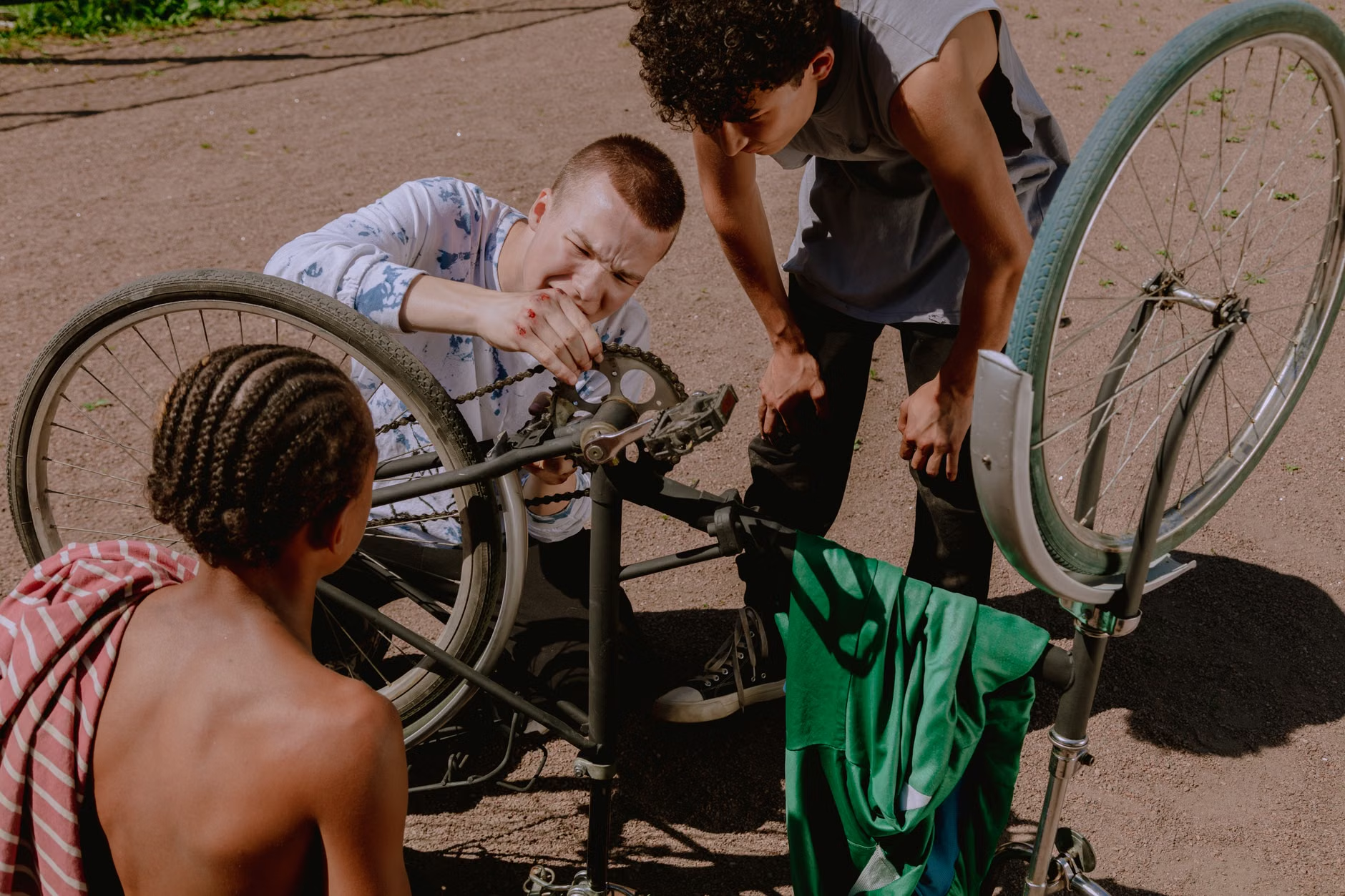
The “Challenge Hour”: Establish a time during the week—perhaps on a weekend morning—where the family engages in a “challenge activity.” This could be a complex board game, a DIY project, or learning a new skill together. The goal isn’t to win or produce a perfect result, but to navigate the frustration of the learning process as a unit.
Decision Criteria for Selecting Challenges
When selecting these activities, ensure they meet three criteria:
- Low Stakes: The outcome should not impact their grades or social standing.
- High Engagement: It should be something they are interested in, even if they aren’t good at it yet.
- Incremental Difficulty: The task should be slightly above their current ability level to force the use of new strategies.
Avoid activities that are purely competitive. Competition, while healthy in moderation, often triggers a fixed mindset because the focus shifts from “How can I get better?” to “How can I beat them?” In the early stages of building resilience, focus on mastery-oriented activities.
Addressing the ‘Hidden Costs’ of Resilience Training
There are, however, nuances to this approach that are often overlooked. One common misconception is that a growth mindset means “persistence at all costs.” There is a critical difference between persistent effort and “banging your head against a wall.”
If your child is stuck on a task for hours with no progress, the growth mindset approach is not just to “keep going.” It is to change the strategy. If they are failing to solve a problem after multiple attempts, encourage them to take a break, seek a new resource, or ask for help. Persistence is only valuable if it is coupled with reflection and adaptation.
Another trade-off is the time commitment. This approach requires you to be present and engaged in the process, which is difficult for busy parents. You cannot outsource this to a school or a tutor. It requires active listening and the patience to hold back from giving the answer, even when you know it. The “cost” is the time you spend waiting for your child to find the solution, but the “return on investment” is a child who is fundamentally more capable and less anxious.
When to Intervene
There is a fine line between supporting a child and enabling them. Use this rule: If the child is stuck because they lack a strategy, provide the strategy. If the child is stuck because they are frustrated, provide emotional support and encouragement. Never provide the answer itself.
Summary and Actionable Next Steps
Building a growth mindset in a pre-teen is not a one-time conversation; it is a fundamental shift in the culture of your home. It requires you to be conscious of your language, intentional with your praise, and vulnerable with your own struggles.
Start today by identifying one area where your child usually gives up. Next time they face a hurdle in that area, resist the urge to praise their innate ability or to solve the problem for them. Instead, ask questions that force them to analyze their strategy. Ask, “What have you tried so far?” or “What’s one thing you could try differently?”
The transition from a fixed to a growth mindset is gradual. There will be days when your child reverts to “I can’t,” and that is perfectly normal. Resilience is not the absence of frustration; it is the ability to navigate it. By reframing the struggle, you are giving them the most valuable tool they will ever possess: the understanding that they are in control of their own development.
Frequently Asked Questions
1. Does a growth mindset mean my child will never experience burnout or stress?
No. A growth mindset actually encourages children to push their boundaries, which can lead to stress. The difference is that a child with a growth mindset views stress as a sign of learning rather than a sign of failure. It changes their relationship with the pressure, making it a manageable component of growth rather than a signal to quit.
2. How do I handle a child who is naturally talented and used to everything coming easily?
This is a common challenge. These children are the most at risk for developing a fixed mindset because they haven’t had to develop persistence. The strategy here is to intentionally introduce them to tasks where they are not the best, or where they have to work significantly harder than their peers. Praise the struggle, not the talent. If they complain that something is “too hard,” frame that as the exact reason why they should be doing it.
3. Can this approach work for neurodivergent children who may experience frustration differently?
Yes, but the implementation requires adjustments. For children with ADHD or other learning differences, the “struggle” can be physically and emotionally overwhelming. In these cases, the focus should be on “micro-wins”—breaking tasks into even smaller, more manageable increments. The goal remains the same, but the pacing must be tailored to ensure the child doesn’t enter a state of total emotional shutdown. Always consult with your child’s educators or therapists to ensure your strategies align with their individual needs.
Further Reading and Research:
For more on the science of mindsets, visit the Mindset Works research portal, which provides evidence-based resources on how brain plasticity supports these concepts.