Key Takeaways
- The “Ownership Trap”: Research suggests that children actually play more creatively with fewer toys; a toy library breaks the cycle of impulse buying and constant clutter.
- Financial Efficiency: Families can save hundreds of dollars annually by borrowing high-end, age-appropriate toys instead of purchasing items that are outgrown in months.
- Circular Impact: By participating in a toy library, you contribute to a circular economy that reduces plastic waste and lowers the carbon footprint of your household.
If your living room currently feels like a graveyard for plastic toys that your children played with exactly twice, you are not alone. For parents navigating their 30s and 40s, the battle against “toy creep”—that slow, inevitable migration of plastic debris from the nursery into every corner of the house—is a universal struggle. We are conditioned to believe that providing for our children means owning the latest educational gadgets, but the reality is that the “Circular Economy” model for toys offers a smarter, cheaper, and significantly more organized way to parent.
The Hidden Cost of Toy Ownership in Your 30s and 40s
Let’s talk about the math of modern parenting. The average household spends a significant portion of their discretionary budget on toys that serve a developmental purpose for perhaps six months before being relegated to the back of a closet. When we buy these items, we aren’t just paying the retail price; we are paying a hidden “clutter tax.” This includes the square footage of your home used for storage, the time spent cleaning and organizing these items, and the inevitable mental load of managing a growing inventory of plastic.
In a circular economy, the focus shifts from possession to access. A toy library—a community-based service where members borrow toys instead of buying them—functions on the same principle as a traditional book library. You pay a membership fee, borrow a set of high-quality, often expensive educational toys, and return them when your child has mastered the skill or lost interest. This model is not just about saving money; it is about reclaiming your physical and mental space.
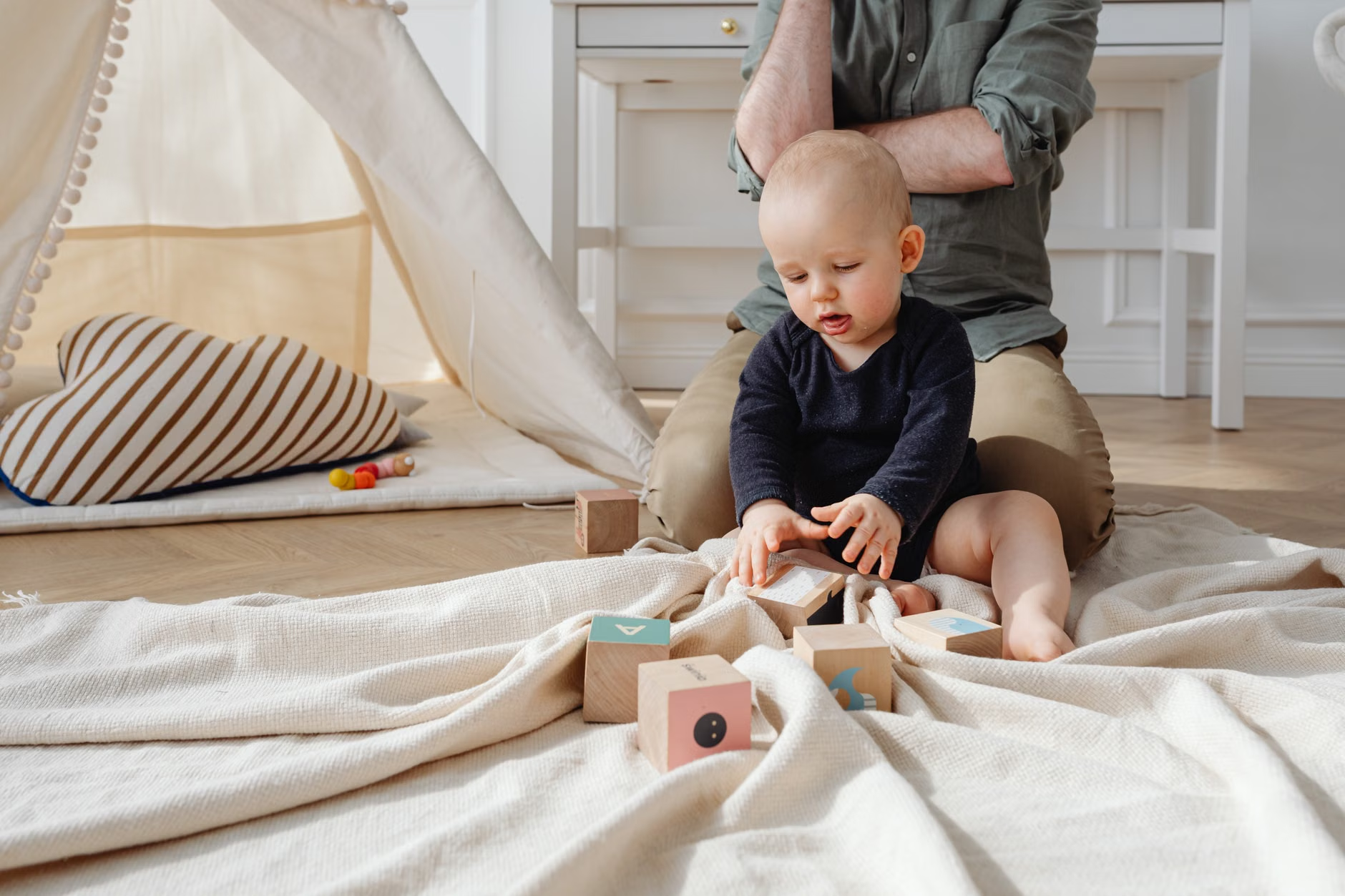
Why does this matter now? We are living in an era where the environmental impact of plastic production is increasingly scrutinized. Most mass-market toys are made from virgin plastics that are difficult to recycle. By borrowing, you are effectively extending the life cycle of these items, reducing the demand for new production, and teaching your children that items don’t have to be owned to be enjoyed. This is a practical, tangible lesson in sustainability that resonates far more than any lecture.
Why Less is More: The Psychology of Curated Play
There is a persistent myth that a larger volume of toys equals a happier, more engaged child. However, research in early childhood development often suggests the opposite. The “Paradox of Choice”—a concept popularized by psychologist Barry Schwartz—applies to children as much as adults. When a child is presented with a mountain of toys, they often struggle to focus, leading to what many parents identify as “boredom in the middle of plenty.”
When you utilize a toy library, you are forced to curate. You might bring home three high-quality items for two weeks. Because the selection is limited and intentional, children tend to engage more deeply. They build, they experiment, and they master the mechanics of the toy. By the time they have exhausted the possibilities, it is time to return the items and swap them for something new. This cycle prevents the “boredom” that leads to the next desperate purchase. It turns playtime into a series of curated experiences rather than a static collection of objects.
| Feature | Buying New | Toy Library |
|---|---|---|
| Financial Cost | High upfront cost | Low recurring fee |
| Storage Space | Constant accumulation | Minimal, rotating stock |
| Sustainability | High waste/disposal | High reuse/sharing |
| Variety | Limited to your budget | Access to premium brands |
How to Integrate the Toy Library Model Into Your Routine
Transitioning to a circular model requires a shift in mindset. It isn’t just about finding a library; it’s about changing how you view gift-giving and milestone celebrations. Many parents worry that a lack of “stuff” makes a birthday or holiday feel incomplete. The reality is that the memory of an experience—a day spent at the park with a borrowed high-end balance bike or a complex building set—is far more potent than the memory of receiving another box that will end up in the donation bin.
Step 1: Audit your inventory. Start by categorizing the toys you currently own. Which ones are played with daily? Which ones haven’t been touched in three months? Use this to identify the “gap” in your child’s development versus what you have in storage.
Step 2: Locate your local hub. Many cities now have non-profit toy libraries. If there isn’t one in your immediate neighborhood, look for online subscription-based toy rental services. These services often ship curated boxes to your door. While they have a higher price point than local, volunteer-run libraries, they still offer a net saving compared to buying equivalent items new.
Step 3: Establish a rotation rule. If you don’t have a formal library, create a “home library” system. Put 80% of your current toys in opaque bins in the attic or garage. Keep only 20% in the living area. Every two weeks, swap the bins. This mimics the circular economy on a micro-scale and keeps the “newness” factor alive without spending a dime.
Common Misconceptions and the Truth About Hygiene
A common hesitation among parents considering toy libraries is the hygiene factor. “Are these toys clean?” is the number one question asked by new members. It is a valid concern, particularly for parents of infants and toddlers who are still in the “everything goes in the mouth” phase. However, most professional and community-run toy libraries operate under strict sanitization protocols.
These organizations typically use industrial-grade, non-toxic sanitizers and follow health department guidelines to ensure that every toy is cleaned between users. In many cases, these toys are cleaner than the ones sitting in your own living room, which may have been collecting dust or hidden under a sofa for months. When you visit a library, observe their check-in process. Do they have a designated cleaning station? Do they have a policy for damaged or lost parts? These are signs of a well-run, professional operation.
Another misconception is that the toys will be “old” or “broken.” In reality, toy libraries often stock high-end, durable wooden toys from reputable brands that are designed to last for years. These are toys that are often too expensive for the average parent to justify buying retail, but perfect for borrowing. You are essentially gaining access to a “premium” play experience for a fraction of the cost.
Managing the “Missing Piece” Anxiety
What happens if your child loses a piece of a borrowed set? This is the fear that stops many parents from ever signing up. First, understand that toy library administrators are human. They understand that play involves wear and tear. Most libraries have a small, tiered fee structure for lost pieces. It is usually nominal—a few dollars to cover the replacement cost of a puzzle piece or a block.
When you start, treat it as part of the “subscription cost.” If you lose a piece once a year, you are still thousands of dollars ahead compared to the cost of buying those toys outright. Teach your children to respect the items by creating a “toy inventory” checklist when you bring a new box home. Checking the pieces together as a family before and after play is a great way to build responsibility and organizational skills.
The Long-Term Impact on Your Parenting Philosophy
Choosing a circular-economy approach to parenting is an act of rebellion against the “buy-consume-discard” culture. It forces you to slow down. It invites you to be more intentional about what enters your home. When you stop viewing toys as disposable commodities, you start viewing them as tools for learning. This shift in perspective is the most valuable gift you can give your children.
As they grow, they will learn that they don’t need to own everything they want. They will learn the value of community sharing and the importance of taking care of shared resources. These are the foundations of a sustainable future. By the time your children reach their own adulthood, the habit of conscious consumption will be second nature to them, all because you decided to change the way you managed their toy box today.
If you are struggling with the clutter, start small. You don’t need to get rid of everything tomorrow. Just stop buying new items for a month and see what happens. You will likely find that your children are just as happy, if not more so, with what they already have. When you are ready to expand their horizons, look for a local library or a reputable rental service. The freedom from clutter is worth more than any plastic gadget on the market.
Frequently Asked Questions
1. Is it really cheaper to join a toy library than to buy toys secondhand on platforms like Facebook Marketplace?
While buying secondhand is also a sustainable choice, it requires you to store, clean, and eventually resell or donate the items yourself. A toy library removes the “management” aspect. You get the benefit of variety without the burden of long-term storage or the hassle of listing items for sale when your child outgrows them. For busy parents in their 30s and 40s, the time saved is a significant hidden financial gain.
2. How do I find a reputable toy library in my area?
Start by searching for “toy library near me” or checking with your local council or municipal community center. Many libraries are run as non-profits or community initiatives. If you are in a more remote area, look into national or regional online toy subscription services that ship curated boxes. Always check their sanitization policies on their official website before signing up.
3. What if my child gets really attached to a toy we borrowed?
This is a common concern. Most toy libraries have a policy where you can “buy out” the toy if your child loves it, or you can simply return it, wait a few weeks, and borrow it again later. This is actually a great opportunity to teach children about the concept of “sharing with the community.” Explain that the toy needs to go back so another child can have a turn, just as they will get to borrow something new soon. It helps develop empathy and patience.
Official Resources for Further Reading:
- International Toy Library Association (ITLA) – Learn more about the global movement and find resources on how to start or find a library.
- Ellen MacArthur Foundation – For a deeper understanding of circular economy principles and how they apply to household consumption.
Final thought: Your home is a sanctuary, not a warehouse. By choosing to borrow rather than hoard, you are creating a space that prioritizes experiences over plastic, and sustainability over convenience. Start your journey toward a clutter-free life today.