The most effective way to help your child navigate the transition to primary school isn’t by drilling them on phonics or flashcards, but by strengthening their cognitive flexibility—the mental ability to switch between thinking about two different concepts or to think about multiple concepts simultaneously.
- Cognitive flexibility is a predictor of academic success: It allows children to adapt to changing classroom rules, complex social dynamics, and shifting task requirements.
- Play is the primary vehicle for development: Structured games that require rule-switching are more effective than passive learning for building executive function.
- Consistency over intensity: Five to ten minutes of focused, playful practice daily yields better results than hour-long sessions that lead to burnout.
You’ve likely noticed the shift. One day, your child is playing with blocks in a familiar preschool environment where the rules are flexible and the pace is self-directed. The next, they are entering a primary school system that demands rapid shifts: stop doing this, start doing that, sit still, listen, change subjects, walk in a line, share materials, and follow a rigid bell schedule. For a child in the 5-to-7 age range, this is a massive cognitive load.
If they struggle to “pivot,” it isn’t necessarily a behavioral issue. It is often a sign that their executive function—specifically their cognitive flexibility—is still under construction. When a child gets stuck on a task or has a meltdown because a plan changed, they are essentially hitting a “brain traffic jam.” Here is how you can help them clear the road.
Why Cognitive Flexibility Matters in the Classroom
Cognitive flexibility is one of the three core pillars of executive function, alongside working memory and inhibitory control. Think of it as the “mental gear-shifting” mechanism in the brain. In a primary school setting, this skill is tested dozens of times an hour.
Consider the difference between home life and school life. At home, if a child is drawing and gets hungry, they can often just stop and grab a snack. At school, they must inhibit that impulse, wait for a designated time, and transition to a completely different activity—perhaps math or reading—without lingering on the drawing. When a child lacks this flexibility, they become prone to frustration, “freezing” when tasks change, or showing difficulty in understanding that a rule that applied in one context (e.g., “we can talk while we color”) does not apply in another (e.g., “we must be silent while the teacher reads”).
Research published by the Center on the Developing Child at Harvard University emphasizes that these executive functions are not fixed at birth; they are developed through experience and practice. By playing games that require children to hold two different sets of rules in their minds and switch between them, we are literally strengthening the neural pathways in the prefrontal cortex.

Game 1: The “Switcheroo” Sorting Challenge
This is the gold standard for building flexibility. It forces the child to categorize objects based on one attribute, and then suddenly change the criteria.
How to play: Gather a collection of mixed items—buttons, colored blocks, or plastic animals. Tell your child, “First, let’s sort these by color.” Once they have sorted them into piles, wait about thirty seconds, then say, “Switch! Now, let’s sort the same items by shape (or size).”
The “Why”: This forces the child to inhibit their previous sorting rule and engage a new one. It prevents them from getting stuck in a single pattern of thinking. If they struggle, guide them by asking, “Which group does this round blue piece belong to if we are sorting by shape?”
Common Mistake: Don’t make the categories too complex at first. Stick to obvious physical attributes. The goal isn’t to test their knowledge of items, but their ability to re-categorize.
Game 2: The “Reverse Simon Says”
Standard Simon Says builds inhibition, but “Reverse Simon Says” builds high-level cognitive flexibility. In this version, you add a rule-switching component.
How to play: Start with standard rules: “Simon says touch your nose.” Then, introduce the “Switch” rule. When you say “Switch,” the rules flip. Now, they must only do the action if you don’t say Simon says. Or, even more challenging: when you say “Switch,” they must do the opposite of what you say (e.g., if you say “Jump,” they must crouch down).
The “Why”: This requires the child to hold two conflicting rule sets in their working memory and toggle between them on command. It mimics the school environment where they might have to “work with a partner” for one task and “work alone” for the next.
Game 3: The “What If” Storytelling Loop
Primary school often involves hypothetical scenarios: “What would you do if you lost your pencil?” or “What if you finish your work early?” Developing the ability to mentally simulate these scenarios is a key component of flexibility.
How to play: Start a story about a character going to school. Every few sentences, pause and throw in a “Flex-Ball.” For example: “Leo was walking to his desk to start his math worksheet… but suddenly, the teacher announces that it’s time for recess instead! What does Leo do with his math sheet?”
The “Why”: This helps the child practice “Plan B” thinking. It reduces anxiety about sudden changes because they have practiced navigating them in a safe, imaginative space. It moves them away from rigid, linear thinking.
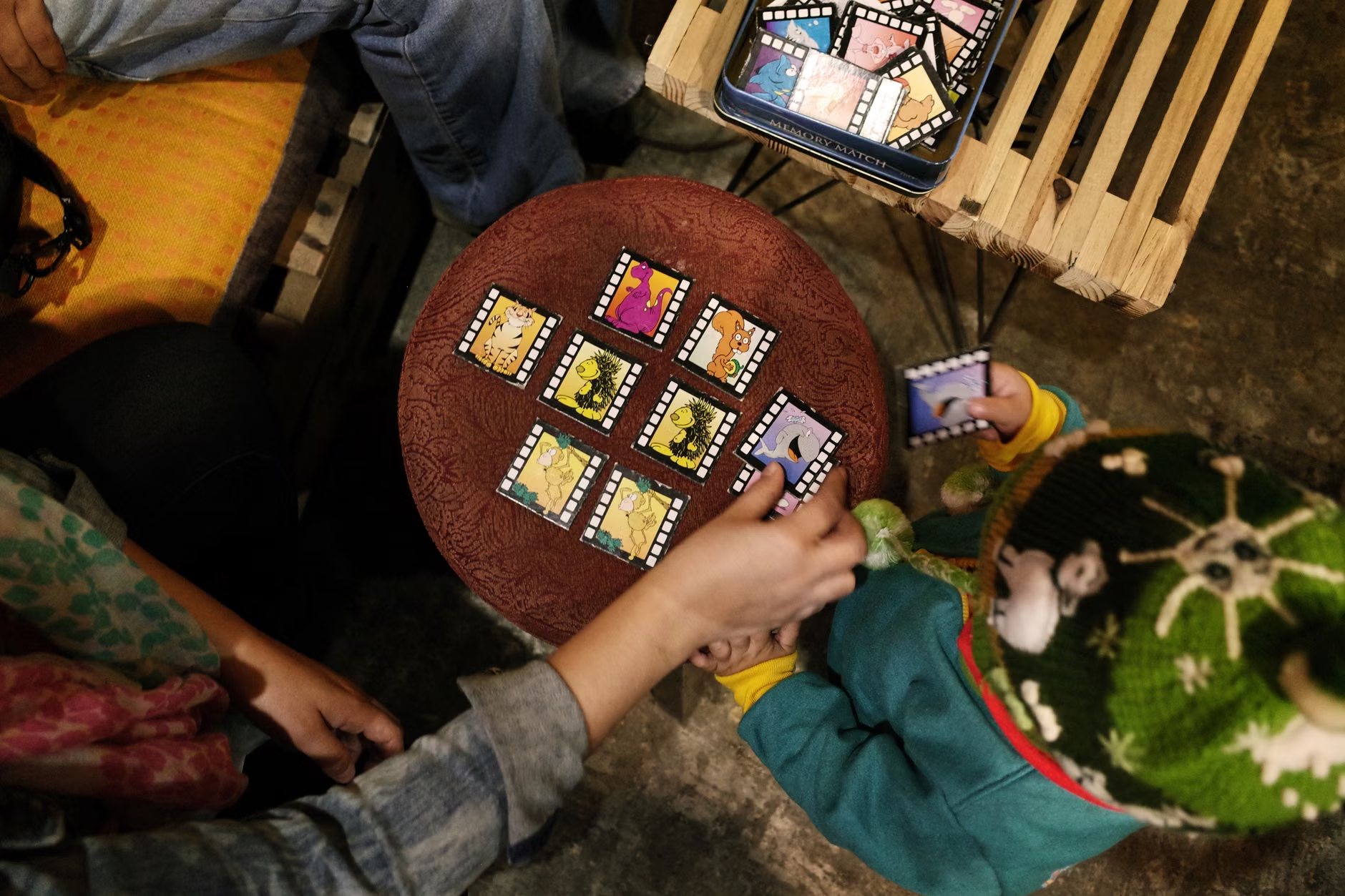
Game 4: The Rule-Changing Card Game
You don’t need fancy equipment for this. A standard deck of cards works perfectly.
How to play: Lay out a series of cards. The first rule: “If the card is red, put it in the left pile. If it is black, put it in the right pile.” After 10 cards, shout “Change!” Now, the rule is: “If the card is a number, left pile; if it is a face card (Jack, Queen, King), right pile.”
The “Why”: This is a classic neuropsychological task (a simplified version of the Wisconsin Card Sorting Test). It provides immediate feedback. If they put a red card in the “number” pile after you’ve changed the rule, you can gently correct them. It teaches the brain that rules are not static, but contextual.
Game 5: The “Alternative Uses” Challenge
This is a fantastic way to develop divergent thinking, which is the creative side of cognitive flexibility.
How to play: Pick a common household object—a paperclip, a spoon, or a sock. Ask your child, “How many ways can we use this?” A spoon is for eating, but could it be a shovel? A drumstick? A tool to hold a paper together? Could it be a boat for a toy mouse?
The “Why”: This trains the brain to look past the “functional fixedness” of objects. In school, this translates to the ability to see a problem from multiple angles. If a child can’t solve a math problem one way, they are more likely to attempt a different strategy rather than just giving up.
Comparative Analysis: Structured Play vs. Free Play
It is important to note that while free play is vital for social development, it does not always challenge cognitive flexibility in the same way that structured, rule-based games do. The following table highlights the differences:
| Feature | Free Play | Cognitive Flexibility Games |
|---|---|---|
| Core Goal | Exploration & Creativity | Executive Function & Adaptation |
| Rule Structure | Self-imposed/Fluid | External/Fixed but Switchable |
| Mental Demand | Low-to-moderate | High (requires inhibition & switching) |
| Best For | Emotional regulation & social bonding | Academic readiness & focus |
You should aim for a balance. If your child is easily overwhelmed by structure, start with shorter sessions of these games. If they are highly rigid and struggle when plans change, prioritize these games as a way to “exercise” their flexibility muscle.
Common Pitfalls and How to Avoid Them
The most common mistake parents make is turning these games into a test. If you treat it like a test, the child will feel the pressure, their cortisol levels will rise, and their ability to think flexibly will actually decrease. Remember, the brain’s “executive” functions are sensitive to stress. Keep the tone light, use humor, and celebrate the mistakes as “brain-stretching moments.”
Another pitfall is over-complicating the rules. Start with one simple rule, and only introduce the “switch” once they have mastered the first rule. If they are constantly failing, they will stop wanting to play. The goal is to keep them in the “Zone of Proximal Development”—the sweet spot where the task is challenging but achievable with a little bit of support.
Integrating Flexibility into Daily Routines
You don’t need to set aside a special “game time” to build these skills. You can integrate them into the transition periods that already exist in your day. For example, if you are driving to school, play a game of “Opposites.” When you say “Up,” they say “Down.” When you say “Fast,” they say “Slow.” Then, add the “Switch” rule: “Now, only say the opposite if I say the word ‘Magic’ first.”
These micro-sessions are highly effective because they occur in real-world contexts. They show the child that mental flexibility is a tool they can use in everyday life, not just something they do at a desk.
The Role of Nutrition and Sleep
While games provide the “exercise,” your child’s physiology provides the fuel. Research consistently shows that sleep deprivation significantly impairs executive function. A child who hasn’t had enough sleep will struggle with cognitive flexibility regardless of how many games they play. Similarly, a diet high in processed sugars can lead to energy crashes that make the “switching” required in these games much harder to execute.
If you notice your child is consistently struggling to pivot, look at the basics first. Are they getting at least 10–11 hours of sleep? Are they having a steady intake of complex carbohydrates and proteins? These are the foundational supports for the cognitive work you are doing.
When to Seek Professional Advice
It is normal for children to struggle with transitions, especially during the first few months of primary school. However, if you notice that your child is consistently unable to adapt to changes, exhibits extreme emotional distress that persists for months, or seems unable to follow even the simplest two-step instructions, it may be worth speaking with a school counselor or a pediatrician. They can help rule out underlying issues like sensory processing sensitivity or ADHD, which often manifest as difficulties with executive function.
Most of the time, however, these skills are simply lagging behind the demands of the environment. With patience and consistent, playful practice, you will likely see a significant improvement in their ability to “go with the flow.”
Final Thoughts: The Long-Term Benefit
By investing time in these games, you are doing more than just helping your child survive the primary school transition. You are equipping them with a lifelong skill. Cognitive flexibility is linked to better conflict resolution, higher creativity, and increased resilience in adulthood. It is the ability to look at a setback, realize it is just a change in the rules, and figure out a new way to succeed.
Start small, keep it playful, and remember that you are the most important coach your child has. Your patience during their moments of “stuckness” is the best teaching tool you have.
Frequently Asked Questions
- Q: How long should these games last?
A: Keep them short. 5 to 10 minutes is usually the “sweet spot” for a 5-to-7-year-old. Anything longer than that often leads to fatigue, which works against the goal of building cognitive flexibility. - Q: What if my child refuses to play?
A: Don’t force it. If they aren’t in the mood, they won’t be in the right headspace to practice the cognitive switching. Try modeling the game yourself—play it with your partner or another child. Often, they will want to join in once they see how fun it is. - Q: Are there apps that help with this?
A: While some apps claim to train executive function, most research suggests that face-to-face, interactive play is far more effective. The social interaction and the physical handling of objects provide sensory feedback that screens simply cannot replicate.
For more information on child development and executive function, you can consult resources like the Center on the Developing Child at Harvard University, which provides evidence-based guides on supporting these essential brain-building skills.