Nature immersion is not a luxury or a “nice-to-have” weekend hobby; it is a biological necessity that resets a school-age child’s nervous system and restores cognitive focus in as little as 20 minutes.
Key Takeaways
- The 20-Minute Reset: Research shows that just 20 minutes of “soft fascination” in nature significantly lowers cortisol levels and restores the “directed attention” kids exhaust during school hours.
- The Boredom Threshold: Expect a 15-minute “whining phase” when transitioning from screens to nature; this is a neurological adjustment period, not a sign that the activity is failing.
- Gear Over Gadgets: High-quality, waterproof footwear and moisture-wicking layers are more important for a successful outing than any specialized nature-exploration toy or app.
If you are in your 30s or 40s, you likely remember a childhood where “nature immersion” was just called “going outside until the streetlights came on.” Today, for our school-age kids, the outdoors has become a scheduled event. Between the pressure of extracurriculars and the siren call of high-stimulation digital worlds, the natural world can feel, well, a bit boring to a ten-year-old.
But here is the reality: your child’s brain is tired. Not just “sleepy” tired, but cognitively depleted. The modern school environment requires constant “directed attention”—the ability to ignore distractions and focus on a specific task. This is a finite resource. When it runs out, you get irritability, poor impulse control, and “brain fog.” Nature offers the only known cure: Soft Fascination. This is the state where the brain is engaged by clouds, rustling leaves, or a flowing stream without requiring effortful focus.
This guide isn’t about teaching your kid to survive in the wilderness. It’s a practical, grounded checklist to ensure they get the neurological benefits of nature without the logistical headache for you.
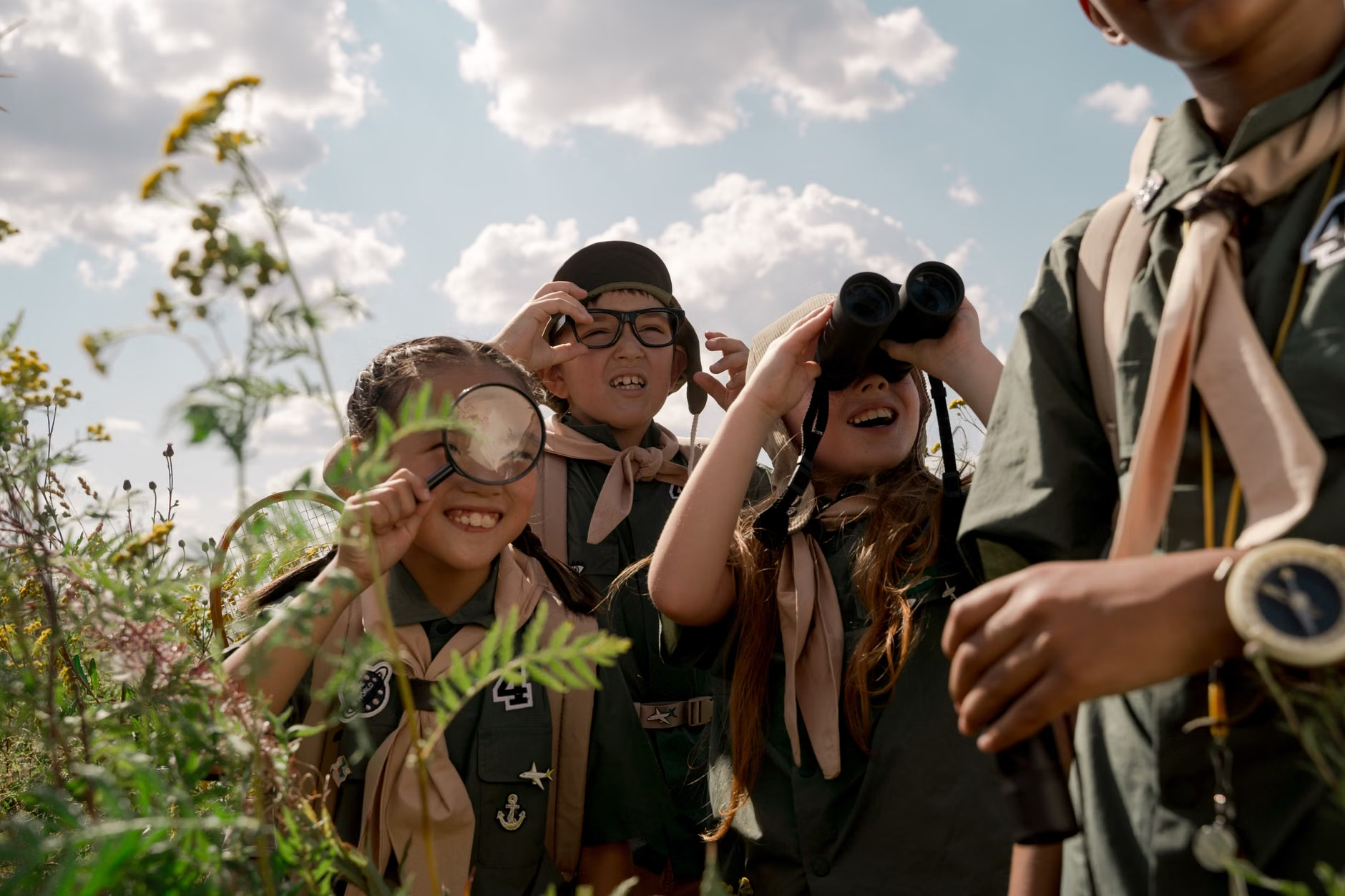
The Science of Why Your Kid Needs to Get Muddy
Before we get to the “how,” we need to understand the “why” so you don’t give up when the first complaint of “there’s a bug near me” happens. There are two primary scientific frameworks at play here: Attention Restoration Theory (ART) and the Biophilia Hypothesis.
ART, developed by Rachel and Stephen Kaplan, suggests that urban environments and digital screens drain our cognitive reserves because they demand “hard fascination”—sudden noises, bright lights, and fast-paced movements that force the brain to react. Nature, conversely, provides “soft fascination.” Watching a beetle crawl across a leaf doesn’t demand your attention; it invites it. This allows the prefrontal cortex to rest and recharge. For a child who has spent six hours navigating social hierarchies and long division, this is the equivalent of a battery fast-charger.
Then there are phytoncides. These are airborne chemicals emitted by plants to protect them from rotting and insects. When humans breathe them in, our bodies respond by increasing the activity of “natural killer” cells, which boost the immune system. This isn’t “woo-woo” science; it’s a cornerstone of Japanese Shinrin-yoku (forest bathing) research. Even a city park with enough trees can provide this benefit.
| Feature | Digital/Urban Environment | Natural Immersion |
|---|---|---|
| Attention Type | Directed (Hard Fascination) | Involuntary (Soft Fascination) |
| Nervous System | Sympathetic (Fight/Flight) | Parasympathetic (Rest/Digest) |
| Cognitive Load | High (Drains energy) | Low (Restores energy) |
| Sensory Input | Overwhelming/Artificial | Multisensory/Rhythmic |
The takeaway for parents: If your child is acting out after school, they don’t need a lecture; they need a tree. The table above shows that the transition from a classroom to a forest is a physiological shift, not just a change of scenery.
The Gear Checklist: Removing the Physical Friction
The number one reason nature outings fail is physical discomfort. If a child is cold, wet, or has a blister, the “soft fascination” window closes immediately. You don’t need expensive mountaineering gear, but you do need a strategy. Cotton is the enemy of nature immersion. When cotton gets wet (from rain or sweat), it stays wet and pulls heat away from the body.
1. The “Feet First” Rule
Invest in one pair of dedicated trail shoes or waterproof boots. School sneakers are often mesh-based; one step in a puddle and the day is over. Look for footwear with a “gusseted tongue” (where the tongue is attached to the sides of the shoe) to keep debris and water out. Pair these with wool-blend socks. Even in summer, thin wool socks wick moisture better than cotton and prevent the friction that causes blisters.
2. The Layering System
School-age kids have high metabolic rates—they get hot while running and freeze the moment they stop to look at a rock. Use the three-layer system:
- Base: Synthetic or wool tee (no cotton).
- Mid: A fleece or “puffy” jacket for insulation.
- Outer: A windproof and waterproof shell.
3. The “Comfort Kit” in Your Bag
You are the pack mule, but keep it light. Your bag should contain:
- A “Sit Pad”: A small square of closed-cell foam. This allows kids to sit on damp logs or cold rocks comfortably. If they can sit, they will stay longer.
- High-Protein Snacks: Nature burns more calories than sitting on a couch. Avoid pure sugar, which leads to a crash. Think nuts, jerky, or cheese sticks.
- A Basic First Aid Kit: Specifically, include tweezers (for splinters/ticks) and antihistamine cream.

The Psychological Checklist: Breaking the “Boredom” Barrier
This is the part most parents struggle with. You drive 40 minutes to a beautiful trailhead, and within 30 seconds, your 8-year-old says, “Can I play on your phone?” or “This is boring.”
Understand the Boredom Threshold. In a world of dopamine-loop apps (TikTok, Roblox, YouTube), the natural world feels “slow.” It takes about 15 to 20 minutes for a child’s brain to downshift from the high-stimulation digital world to the subtle stimulation of nature. This is the Critical Transition Zone.
How to Manage the First 20 Minutes
Don’t try to “sell” the beauty of the landscape. Instead, give them a “low-stakes mission.” This bridges the gap between structured play and free exploration.
- The “Find 5” Challenge: Find 5 things that are the color red, 5 things that feel rough, and 5 things that smell like something else.
- The Sound Map: Sit silently for 2 minutes. Every time they hear a sound, they mark a “dot” on a piece of paper relative to where they are sitting.
- The “Micro-Hike”: Give them a 1-meter piece of string. They lay it in a circle on the ground and have to “hike” that circle with their eyes, finding every tiny thing inside it.
The Golden Rule: Once you see them enter a “flow state”—where they are digging a hole, building a stick fort, or watching ants—stop talking. Do not interrupt them to take a photo or point out a “cool bird.” Your goal is to fade into the background so their immersion can deepen.
The Urban Nature Checklist: No Forest? No Problem.
You don’t need a National Park to achieve nature immersion. For many of us in our 30s and 40s living in suburban or urban hubs, “wilderness” is a three-hour drive. The good news? The brain doesn’t care about the size of the forest, only the density of the nature.
The “Pocket Park” Strategy
A small park with three old-growth trees and a messy garden bed can be more immersive than a manicured golf course. Look for “wild edges”—the parts of the park where the mowers don’t go. This is where the biodiversity is.
Citizen Science: Making it “Productive”
For school-age kids who love technology, use it as a bridge rather than a barrier. iNaturalist or its kid-friendly version, Seek, are game-changers. They allow kids to take a photo of a plant or bug and use AI to identify it. It turns a walk into a real-life Pokémon Go.
- The Goal: Identify three species you’ve never seen before.
- The Result: They start looking at the “green wall” of the park as a collection of individual, living things.
| Setting | Immersion Activity | Parental Role |
|---|---|---|
| Backyard/Balcony | Container gardening or bird feeder observation. | Provider of seeds and dirt. |
| Urban Park | Mapping the “wild” corners; identifying urban trees. | Safety monitor and “Seek” app assistant. |
| Local Creek | Rock flipping (looking for macroinvertebrates). | The keeper of the dry towel and spare socks. |
| State Forest | Off-trail navigation and “sit spots.” | Navigator and snack distributor. |
Safety, Risk, and the “Scary” Parts of Nature
As parents in a hyper-cautious era, we often transmit our anxieties to our kids. “Don’t touch that, it’s dirty,” or “Get down from there, you’ll fall.” However, risky play is a vital part of nature immersion. Climbing a tree or balancing on a log teaches a child “proprioception”—the sense of where their body is in space.
The “Benefit-Risk Assessment”
Instead of thinking “Is this safe?”, ask “Does the benefit of this activity outweigh the risk?”.
- Example: Climbing a tree. Risk: Falling and a scraped knee or a broken arm (unlikely if low). Benefit: Building confidence, core strength, and spatial awareness.
The Real Dangers (and how to mitigate them):
- Ticks: This is a legitimate concern in many regions. Use an EPA-registered repellent (like Picaridin), wear long pants tucked into socks, and always do a “tick check” the moment you get home. Focus on the hairline, armpits, and behind the knees.
- Weather: Check the radar, not just the forecast. If lightning is within 10 miles, head in. Otherwise, “there is no such thing as bad weather, only bad clothing.”
- Getting Lost: Teach the “Hug-a-Tree” rule. If a child realizes they are lost, they should stay in one place (next to a tree) and whistle or call out. Give every child a small safety whistle to wear on their zipper.
The “After-Action” Checklist: Bringing the Calm Home
The benefits of nature immersion shouldn’t end when you get back into the car. To make this a habit, you need to integrate the experience into your home life. This reinforces the child’s identity as someone who “belongs” in nature.
1. The “Nature Table”
Allow your child to bring home a *limited* number of “treasures” (check local laws first—National Parks are a no-take zone). A cool rock, a dried seed pod, or a fallen feather. Create a small shelf or tray where these can be displayed. This serves as a visual anchor for the calm they felt outside.
2. The “Big Story”
On the drive home, ask one specific question: “What was the most surprising thing you saw today?” Avoid “Did you have fun?” which usually gets a one-word answer. “Surprising” forces them to scan their memory for a specific detail, reinforcing the neural pathways created during the immersion.
3. The Sensory Transition
Nature immersion can be overstimulating in its own way. A warm bath or shower immediately after returning helps “wash off” the day (and any potential allergens or hitchhiking bugs) and signals the body to move into a relaxed evening mode.
Common Pitfalls to Avoid
Even with the best intentions, we often sabotage the immersion experience. Here is what to avoid:
- The “Education” Trap: Don’t turn the walk into a lecture. You don’t need to know the Latin name of every tree. If you focus too much on “learning,” it starts to feel like school. Let them just be.
- The Pacing Problem: A child’s pace is 1/3 of an adult’s. If you are focused on “reaching the summit” or finishing the 3-mile loop, you will be frustrated. Nature immersion is about the 50 feet around you, not the 5 miles ahead of you.
- The Photo Obsession: When you pull out your phone to take a “cute” picture of them playing, you pull them out of their flow state. They become performers for your social media rather than participants in the wild. Take one photo at the start, then put the phone on “Do Not Disturb” and keep it in your bag.
The Bottom Line: Start Small, Stay Consistent
You don’t need a grueling weekend camping trip to see results. The most effective nature immersion is the one that actually happens. The “20-5-3” Rule is a great framework for busy parents:
- 20 minutes: Spend 20 minutes in a green space 3 times a week (a local park is fine).
- 5 hours: Spend 5 hours a month in a “semi-wild” space (a state park or nature preserve).
- 3 days: Spend 3 days a year fully “off-grid” (camping or a remote cabin).
Start with the 20 minutes. Put the “Comfort Kit” in your car today. The next time the house feels chaotic and the kids are bouncing off the walls, don’t reach for the remote. Reach for the door handle. Their brains—and your sanity—will thank you.
Useful Official Resources:
- Child & Nature Network – Research and Toolkits
- National Recreation and Park Association – Science of Nature
- US Forest Service – Kids in the Woods Programs
Frequently Asked Questions
Q: What if my child is genuinely terrified of bugs or dirt?
A: Don’t force immersion. Start with “controlled nature.” This could be a picnic on a blanket (a “safe zone”) or using tools like magnifying glasses and bug jars that provide a physical barrier between the child and the insect. Exposure should be gradual; the goal is curiosity, not a panic attack.
Q: How do I handle nature immersion in extreme winter weather?
A: The “immersion” doesn’t have to be long. In sub-zero temperatures, even 10 minutes of observing how ice forms on a puddle or watching winter birds can provide a reset. The key is high-quality thermal layers and a “hot chocolate bribe” waiting in the car or at home immediately after.
Q: Is it still “nature immersion” if they are playing with toys like trucks or dolls outside?
A: Absolutely. In fact, for many school-age kids, bringing “indoor” toys into a “wild” setting is a great way to spark imaginative play. A plastic dinosaur in the living room is just a toy; a plastic dinosaur in a forest of ferns is a prehistoric adventure. The environment still provides the sensory benefits regardless of what they are playing with.
Note: Always follow local guidelines regarding trail safety and wildlife. If you are in an area with high tick activity or dangerous wildlife, prioritize safety gear and education before heading out.