The most effective way to help a pre-teen navigate the turbulent shift from childhood to adolescence is to move them beyond the one-word answer of “fine” by providing a structured framework for emotional literacy.
- Granularity matters: Teaching a child to distinguish between “annoyed,” “frustrated,” and “resentful” reduces the likelihood of impulsive behavioral outbursts.
- The 15-minute rule: Journaling for just 15 minutes a day, three times a week, is scientifically associated with lower cortisol levels and improved executive function in adolescents.
- Avoid the “Fix-it” trap: The primary purpose of an emotional journal is self-regulation, not parental problem-solving; your role is to provide the tool, not the analysis.
If you have a child between the ages of 10 and 13, you know the scenario well. You ask, “How was your day?” and receive a grunt, a shrug, or a flat “fine.” It isn’t necessarily defiance; it is often a lack of linguistic tools. As their brains undergo massive synaptic pruning and reorganization, the emotional centers—the amygdala—are firing rapidly, while the prefrontal cortex, responsible for impulse control and articulation, is still under construction.
An emotional-vocabulary journal isn’t just a diary; it is a cognitive training ground. By naming an emotion, a child activates the prefrontal cortex, which helps “cool down” the amygdala. This is the physiological basis of the phrase “name it to tame it.”
Why “Fine” is a Developmental Dead-End
When a pre-teen relies on a limited vocabulary to describe their internal state, their world becomes binary. Everything is either “good” or “bad,” “fine” or “annoying.” This lack of nuance leads to a phenomenon known as emotional granularity deficiency. Research in developmental psychology suggests that individuals with low emotional granularity are more susceptible to prolonged stress because they cannot identify the specific source or nature of their discomfort.
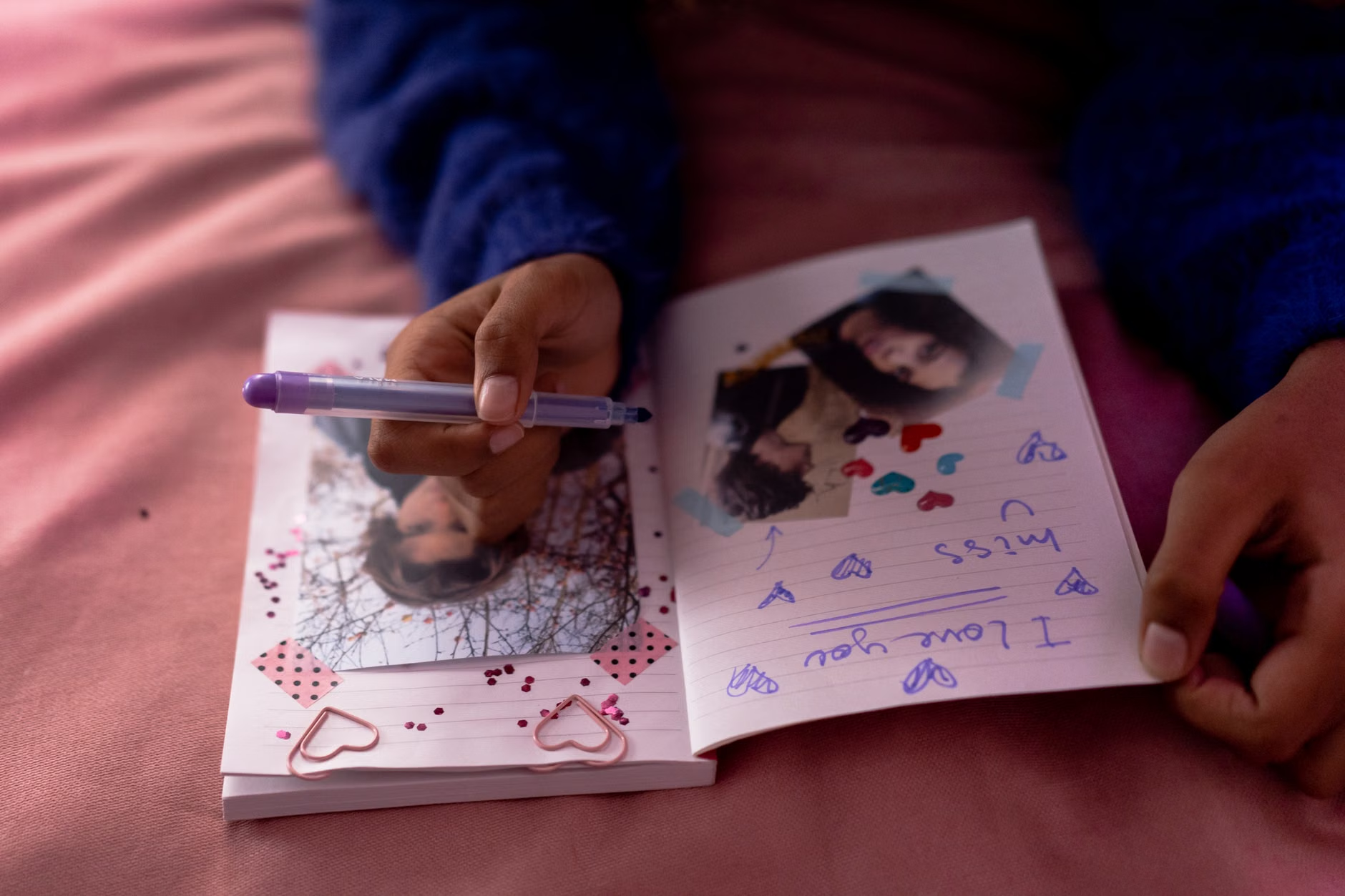
Consider a hypothetical 12-year-old named Sam. If Sam is feeling “upset,” he might lash out at his younger sibling. If Sam has the vocabulary to identify that he is actually feeling “overwhelmed by his math homework” and “insecure about his social standing in the lunchroom,” he is no longer just “upset.” He has specific targets for resolution. The journal provides the space to bridge that gap between feeling and expression.
The Neuroscience of Naming Feelings
When we use functional MRI (fMRI) to observe the brain during emotional tasks, we see something fascinating. When a person labels an emotion with a descriptive word, the activity in the limbic system—the seat of our fight-or-flight response—decreases, while the ventrolateral prefrontal cortex—the area associated with cognitive control—lights up. This is not just a psychological theory; it is a biological shift.
For a parent in their 30s or 40s, this means that every time your child writes down “I felt anxious because of the group project,” you are helping them physically regulate their nervous system. You are teaching them that emotions are data points, not threats. This is arguably the most important skill they will carry into their adult lives, impacting their future romantic relationships, workplace communication, and personal resilience.
Building the “Emotional Lexicon”
You cannot expect a pre-teen to start writing deep reflections if they don’t have the words. Start by building a “word bank” at the back of their journal. Categorize emotions into intensities. For example, instead of just “mad,” include “frustrated,” “irritated,” “enraged,” and “disappointed.”
| Basic Label | Nuanced Alternatives | Contextual Application |
|---|---|---|
| Sad | Melancholy, dejected, discouraged, lonely | Use “discouraged” for school setbacks. |
| Mad | Frustrated, indignant, resentful, annoyed | Use “indignant” for perceived unfairness. |
| Scared | Anxious, apprehensive, intimidated, nervous | Use “apprehensive” for upcoming events. |
Encourage your child to use this table as a reference. When they are stuck, ask, “Do you feel ‘mad,’ or are you actually feeling ‘intimidated’ by the situation?” This small shift from a demand to a collaborative inquiry changes the entire dynamic of the conversation.
Setting Up the Journaling Routine: A Practical Guide
The biggest mistake parents make is turning the journal into a homework assignment. If it feels like a chore, it will fail. The goal is to make it a low-stakes, high-reward activity.
1. The “No-Correction” Rule: Never, under any circumstances, read their journal without permission, and never correct their grammar or spelling. If they know you are grading their emotional output, they will censor themselves. This space must be theirs alone.
2. The “Prompt-Free” Option: While some kids like prompts (e.g., “What was the hardest part of today?”), many prefer a blank slate. Offer both. If they are struggling, provide a simple template: “The high point, the low point, and one thing I learned about myself.”
3. The Frequency Factor: Don’t demand daily entries. Start with three times a week. The consistency is more important than the volume. Use a physical notebook rather than an app. The tactile act of writing engages different motor pathways in the brain than typing, which aids in cognitive processing.

Addressing Common Roadblocks
You will encounter resistance. “This is stupid,” or “I have nothing to write about.” This is normal. When this happens, do not double down on the importance of the journal. Instead, acknowledge the resistance. “I get that it feels like extra work. We can try it for ten minutes on Sunday nights only, and if it’s still not working, we can reassess.”
Another common hurdle is the “privacy paradox.” Your child might fear you will judge them for what they write. You must be explicit about the boundaries of privacy. Tell them, “This is your private space. The only reason I would ever step in is if I am genuinely worried about your safety or the safety of others. Otherwise, this is for you.”
The Role of the Parent: Facilitator, Not Auditor
Your role is to model the behavior. Do you journal? If you sit down at the kitchen table with your own notebook for 15 minutes while they do theirs, you are demonstrating that emotional maintenance is a normal part of being a healthy human being. If you only tell them to do it, it becomes a task you are imposing on them. If you do it together, it becomes a shared family ritual.
When you share your own reflections—without oversharing inappropriate details—you show them that even adults struggle to name their feelings. You might say, “I felt really frustrated at work today because my project didn’t go as planned, and I had to write that down to stop feeling so annoyed about it.” This validates their experience and makes the practice feel less like a clinical intervention and more like a tool for life.
Hidden Benefits: Beyond Emotional Regulation
Beyond the obvious benefits to emotional health, there are secondary advantages to this practice that are often overlooked. One is the development of narrative coherence. When a child writes about their day, they are practicing organizing their thoughts into a coherent story. This is a foundational skill for academic writing, critical thinking, and conflict resolution.
Another hidden benefit is the reduction of “rumination.” Rumination is the cycle of repetitive, negative thinking that often plagues pre-teens. By putting these thoughts on paper, they are externalizing the loop. Once a thought is written down, it no longer needs to be held in the working memory. This frees up mental bandwidth for other things—like sleep, focus, and hobbies.
When to Seek Professional Help
It is crucial to understand that an emotional-vocabulary journal is a tool for self-reflection, not a treatment for clinical mental health conditions. If your child’s journal entries consistently reflect signs of self-harm, hopelessness, extreme withdrawal, or intense anxiety that prevents them from functioning in daily life, the journal is not the solution.
If you notice a consistent pattern of dark themes or a lack of improvement in their overall mood over a period of several weeks, it is time to consult with a school counselor or a child psychologist. The journal can be a valuable artifact to share with a professional—with the child’s permission—but it should never replace professional guidance when it is needed.
Action Plan: Getting Started This Week
If you want to introduce this today, keep it simple. Don’t go out and buy an expensive, complex guided journal. Buy a simple, high-quality notebook with a pen that feels good to write with. The simpler the tool, the less pressure there is to “do it right.”
Step 1: Select a notebook and a pen together. Let them choose the color or style. This gives them agency in the process.
Step 2: Spend 10 minutes on the first day creating the “Word Bank” together. Don’t make it a lecture. Make it a game: “How many words for ‘happy’ can we come up with?”
Step 3: Agree on a time. Sunday night is often a great time to reflect on the past week and look ahead to the next. It helps manage the “Sunday Scaries” that many kids experience.
Step 4: Check in, but don’t check up. After a week, ask, “How did the journaling feel? Was it helpful to get some of those thoughts out?” If they say no, ask, “What would make it better?”
The goal is not to produce a perfect journal; the goal is to give your child a safe, private, and effective way to process their internal world. As they enter their teenage years, this will likely become their most trusted confidant—and that is a win for both of you.
Frequently Asked Questions
1. What if my child refuses to write in the journal?
If they refuse, don’t force it. Forcing a journal will only create resentment. Ask them if there is a different way they’d prefer to track their feelings—perhaps a mood-tracking app or even a voice memo. The goal is emotional processing, not the medium itself. If they still refuse, wait a month and try a different approach, perhaps by modeling your own journaling more visibly.
2. Should I offer rewards or incentives for journaling?
Avoid external rewards. Journaling is an intrinsic practice. If you reward them, they will stop doing it as soon as the reward disappears. Instead, focus on the intrinsic reward: “I noticed you seemed much calmer after you wrote in your journal tonight.” Positive reinforcement of the result is far more effective than rewarding the activity.
3. How do I handle it if I accidentally see something that concerns me in their journal?
This is a delicate situation. If you see something that indicates they are in immediate danger, you must act. However, if it is something concerning but not an emergency, the best approach is to address the behavior or the situation, not the journal entry. For example, if they write about feeling bullied, don’t say, “I read in your journal that you’re being bullied.” Instead, say, “I’ve noticed you’ve been a bit quiet lately; is there anything happening at school that’s bothering you?” Always protect the sanctity of the journal.
For further reading on emotional development in adolescents, you can visit the American Psychological Association’s resources on parenting or the Child Mind Institute, which offers extensive, evidence-based guides on navigating the pre-teen years.