- Sensory Integration Matters: Nature immersion isn’t just “play”; it’s a critical neurological workout that builds proprioception and fine motor skills faster than indoor synthetic toys.
- The “Toolkit” Approach: You don’t need expensive gear. A curated kit of simple, natural materials allows for open-ended play that prevents the “overstimulation burnout” common with battery-operated gadgets.
- Consistency Over Duration: Short, daily 15-minute sensory sessions in a local park are more effective for a toddler’s cognitive development than one long, stressful weekend excursion.
You’re likely familiar with the “nature deficit” warnings that seem to pop up in every parenting forum these days. But for those of us juggling a remote job, household chores, and the sheer unpredictability of a toddler, the idea of a “grand nature adventure” sounds more like a logistical nightmare than a developmental milestone. The reality is that you don’t need to head to a national park to provide high-quality sensory input for your child.
The “Nature-Immersion” sensory toolkit is a practical framework designed to bring the complex, unrefined benefits of the outdoors into your daily routine. It’s about leveraging the unpredictability of the natural world to help your child develop essential cognitive, physical, and emotional regulation skills. Let’s break down how to build this toolkit and why it works better than the latest plastic trend in your living room.
Why Nature-Immersion Trumps Synthetics for Toddler Brains
In the world of child development, sensory integration is the process by which the brain receives, organizes, and interprets information from the senses. When a toddler plays with a plastic toy, the sensory feedback is predictable: the button clicks, the light flashes, the sound repeats. It is a closed loop.
Nature, by contrast, is an open-ended sensory explosion. When a toddler touches tree bark, the texture changes from rough to smooth depending on the angle. If they drop a rock, it makes a different sound on grass than it does on pavement. This variability forces the brain to constantly recalibrate its motor planning and sensory processing. Research from the International Journal of Environmental Research and Public Health consistently highlights that exposure to natural environments is linked to improved attention spans and reduced stress markers in young children.
For parents, the “why it matters” is simple: you are building a more resilient, observant, and physically coordinated child. It’s not just about “getting them outside”; it’s about providing the “data” their brain needs to grow. When a child balances on a uneven log, they are engaging their core and vestibular system (balance) in a way that a flat, carpeted playroom simply cannot replicate.

Building Your Baseline Nature-Immersion Toolkit
You don’t need to be an expert in botany or survival skills to start. In fact, the best kits are those that minimize your intervention. The goal is to provide a “menu” of sensory experiences that are portable and accessible.
Here is how to curate your toolkit. Focus on these four sensory categories:
| Sensory Category | Natural Elements | Developmental Goal |
|---|---|---|
| Tactile (Touch) | Bark, moss, smooth stones, sand | Texture discrimination & fine motor control |
| Auditory (Sound) | Dried leaves (crunching), hollow logs (drumming) | Cause-and-effect & sound differentiation |
| Proprioceptive (Body) | Uneven terrain, heavy rocks, climbing | Core strength & spatial awareness |
| Visual/Olfactory | Wildflowers, pine needles, damp soil | Color recognition & scent association |
Common Mistake: Many parents try to turn nature play into a “lesson.” Avoid the urge to lecture about “this is a pinecone” or “this is an oak leaf.” At this stage, your role is the facilitator, not the teacher. Your child needs to experience the weight, the smell, and the resistance of these objects without being interrupted by a vocabulary drill.
Step-by-Step: The 15-Minute Sensory Reset
If you’re feeling overwhelmed, start with the “15-minute reset.” This is a micro-intervention that works perfectly for those days when the walls of the house feel like they are closing in.
- The Pre-Check: Keep a small canvas bag by the door. Include a magnifying glass, a small notebook, and a dedicated “finds” container (like an old egg carton).
- The Transition: Don’t frame it as “we are going for a long hike.” Frame it as “let’s go find three textures.” It lowers the pressure for both you and the toddler.
- The Engagement: Once you are in a park or even just a backyard, sit down. Your posture matters. If you are standing, you are a supervisor. If you are sitting, you are an observer.
- The Guided Exploration: If your child is wandering aimlessly, offer a prompt: “I wonder if this rock is heavier than that stick?” Let them compare. Use the “wait time” rule—count to ten before you offer any help or comment.
This approach forces you to slow down your own pace, which is often the biggest hurdle for parents in their 30s and 40s. We are conditioned to be efficient. Nature-immersion is, by design, inefficient. That inefficiency is exactly where the developmental magic happens.
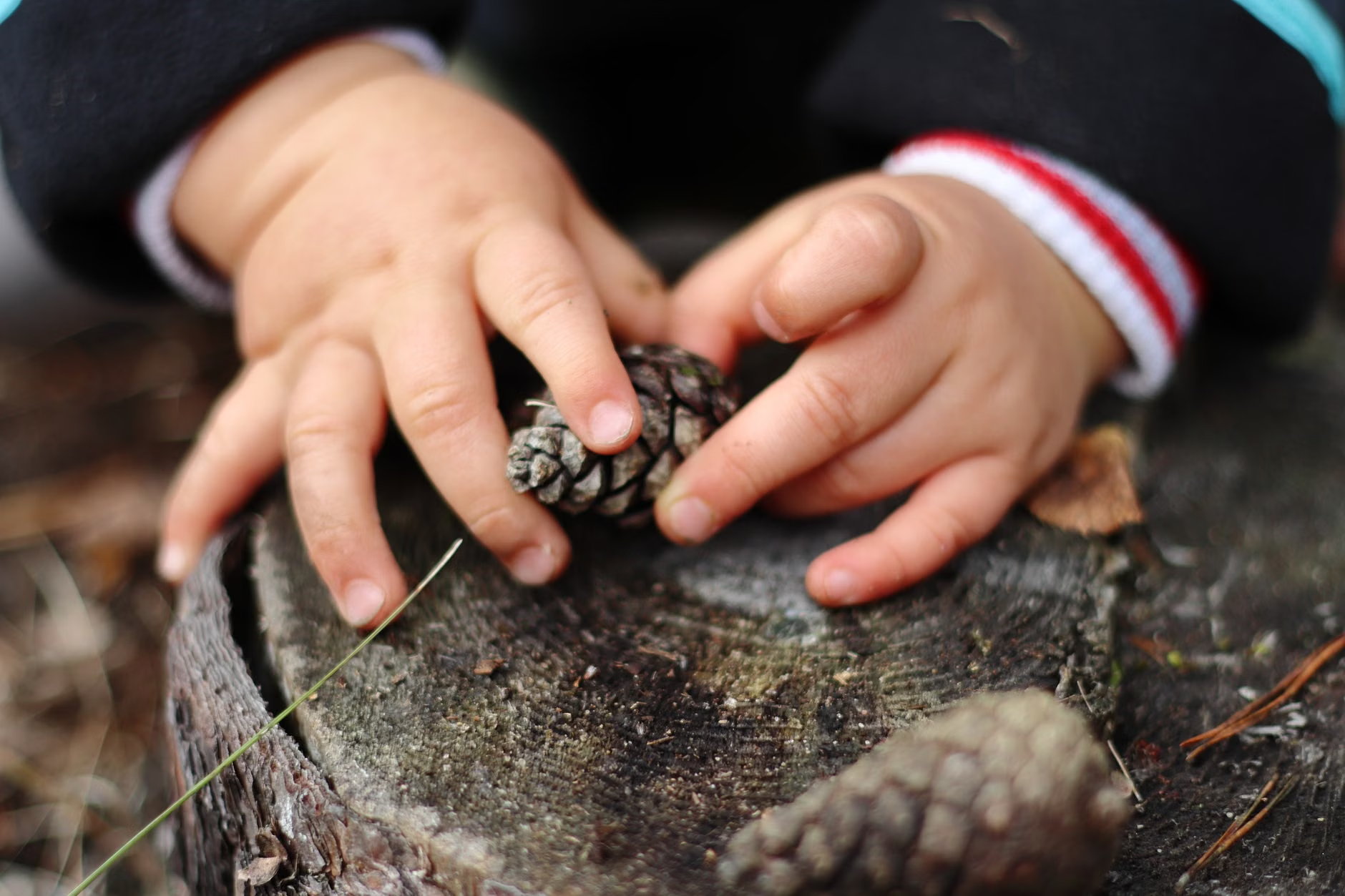
It’s a common misconception that all children instinctively love the outdoors. If your toddler is hesitant—perhaps they dislike the feel of grass or are afraid of bugs—don’t force the contact. This is where your toolkit becomes a bridge.
If the child is “sensory defensive” (a term often used in occupational therapy for children who are hypersensitive to touch), start with a “contact-less” approach. Use a tool. Use the magnifying glass to look at the grass without touching it. Use a stick to poke the mud. By creating a barrier between the child and the “scary” element, you allow them to process the sensory input on their own terms.
The “Hidden Cost” of Convenience: Be wary of “nature kits” sold in stores that are essentially just plastic containers of pre-sorted rocks. These defeat the purpose. The benefit of nature-immersion lies in the search. The act of scanning the ground, identifying a potential item, deciding if it’s worth picking up, and then physically retrieving it is a complex executive function task. Buying a pre-made set removes the cognitive heavy lifting.
Advanced Strategies: Integrating Technology and Documentation
While the goal is to get away from screens, technology can be a helpful tool for the parent-facilitator. Use a simple, non-distracting app to identify a plant or a bird, but use it as a reference, not a distraction. Show your toddler the screen for ten seconds to identify the flower, then put the phone away and look at the real thing for ten minutes.
Another powerful strategy is the “Nature Journal.” For a toddler, this is simply a notebook where you glue a leaf or trace a shape. This creates a tangible memory of the sensory experience. It reinforces the neural pathways associated with the activity, turning a fleeting moment into a reference point for future play.
Addressing Safety Without Killing the Curiosity
Safety is the primary concern for most parents. The fear of ticks, poison ivy, or falls is real. However, the best way to manage this is through “risk assessment” rather than “risk avoidance.”
Teach your child the “two-finger touch” rule. If they are unsure about a plant or a surface, they use two fingers to gently touch it. This limits the surface area of skin exposure and prevents the “grabbing” reflex that often leads to accidents. For ticks and other pests, it’s about habit-building: checking the gear and the clothing immediately upon returning home. Make it a game—a “nature inspection” ritual.
Remember that the goal is to foster independence. If you are constantly hovering, you are signaling to the child that the environment is dangerous. By having a prepared toolkit and a set of “safety protocols” (like the two-finger touch), you provide a structure that allows them to explore with confidence.
The Long-Term Impact on Family Life
Integrating these sensory practices isn’t just about the toddler; it changes the family dynamic. When you commit to even short, intentional moments of nature immersion, you are setting a precedent for a lifestyle that values observation and physical engagement over passive consumption.
In our current culture, we are bombarded by “optimal” parenting advice. Many of these strategies are expensive, time-consuming, or require specialized knowledge. Nature-immersion is the antithesis of this. It is accessible, free, and scientifically grounded. It requires nothing more than your presence and a bit of curiosity.
As you move forward, keep a record of what works. Does your child prefer the tactile experience of water and mud? Do they enjoy the auditory challenge of finding different sounds in the woods? Tailor your “toolkit” to their specific sensory profile. This personalization is what separates a generic outdoor walk from a truly developmental sensory experience.
Ultimately, your role is to open the door. The world outside will do the rest of the teaching. Don’t worry about the dirt on their clothes or the fact that they spent 20 minutes staring at a beetle. Those minutes are the building blocks of their future cognitive flexibility. Keep it simple, keep it consistent, and trust the process of natural development.
Frequently Asked Questions
1. How do I handle a toddler who is afraid of bugs or getting dirty?
Start with “barrier play.” Use tools like a small shovel, a magnifying glass, or a pair of kid-safe tongs to interact with the environment. This gives the child a sense of control and a physical buffer, which reduces anxiety while still providing the sensory input of the natural world.
2. Does nature-immersion require expensive gear or specialized clothing?
Absolutely not. In fact, expensive gear can sometimes be a hindrance. Focus on comfortable clothing that allows for full range of motion. The only “essential” is a pair of sturdy, comfortable shoes that can handle uneven terrain. Everything else, like a magnifying glass or a collection bag, can be improvised with household items.
3. How much time should we spend outdoors to see a real developmental benefit?
Consistency is far more important than duration. Aim for 15 to 30 minutes of intentional, focused sensory play at least 3–4 times a week. It is much more effective to have short, frequent interactions with nature than to force a single, exhausting three-hour excursion on the weekend, which often leads to burnout for both parent and child.
For further reading on the neurological benefits of outdoor play, you may refer to the Nature Play QLD research resources or the Children & Nature Network’s comprehensive research library.