- Risk vs. Hazard: A risk is a challenge the child can perceive and manage (like a high branch), while a hazard is a hidden danger they cannot foresee (like a rusted metal pipe). Focus on managing risks, not eliminating them.
- The 60-Second Scan: Before letting your child loose in an unmanicured area, perform a quick scan for three things: overhead deadwood, sharp debris, and stagnant water quality.
- Active Supervision: Move from “hovering” (constant intervention) to “active observation” (watching for capability limits), which builds your child’s spatial awareness and resilience.
The most effective way to keep your child safe in a suburban park isn’t to wrap them in bubble wrap, but to teach them how to read the environment. You’ve likely seen the shift: modern suburban parks are moving away from standardized plastic playgrounds toward “nature-play” areas—spaces with logs, rocks, uneven terrain, and actual dirt. While these spaces are brilliant for cognitive development and physical coordination, they don’t come with the “safety rating” of a rubber-matted slide. As a parent in your 30s or 40s, you’re likely balancing the desire to give your kids freedom with the nagging anxiety of, “What if they fall?”
Understanding the Difference Between Risk and Hazard
The biggest mistake parents make when assessing a park is conflating risk with hazard. In the world of outdoor play, these two terms mean very different things, and understanding the distinction is your first step toward true peace of mind.
A risk is a challenge that is visible and manageable. When your child looks at a fallen log, they see the height, the texture of the bark, and the distance to the ground. They can decide whether to crawl over it, balance on it, or jump off it. This is “risky play.” It helps children develop proprioception (the sense of where their body is in space) and executive function (the ability to plan and execute a movement). When they take a small risk and succeed, their confidence grows. Even when they slip, they learn the physical consequence of gravity.
A hazard, on the other hand, is a hidden danger. A hazard is something the child cannot perceive or control. A piece of broken glass hidden in tall grass, a rusted metal pipe protruding from the dirt, or a rotten branch that looks sturdy but snaps instantly under weight—these are hazards. Your job as a parent in a nature-play environment is not to remove all the risks, but to scan for and mitigate the hazards.
Think of it like driving. The “risk” is the traffic and the weather, which you can see and adapt to. The “hazard” is a faulty brake line or a deep, hidden pothole that you can’t see until it’s too late. You don’t stop driving because of traffic; you scan for the mechanical failures and stay alert for the road conditions. Apply this same logic to the park.

The 60-Second “Park Scan” Routine
You don’t need a degree in landscape architecture to assess a park. When you arrive at a natural play area, take one minute to do a “hazard sweep.” This isn’t about being paranoid; it’s about setting the stage for safe autonomy. Here is the step-by-step process I use to ensure a space is safe enough for exploration.
1. The Overhead Check (Look Up)
In wooded areas, the biggest danger is “widow-makers”—large, dead branches hanging precariously above the play zone. Before letting your child run toward that perfect climbing tree, scan the canopy. If you see brown, brittle leaves or limbs that look disconnected from the main trunk, steer the play area toward a different section of the park. It takes five seconds and prevents the most unpredictable type of accident.
2. The Surface Scan (Look Down)
Walk the perimeter of the area where your child will be. You are looking for sharp, man-made objects. Suburban parks are often adjacent to walking paths or residential fences, and trash (especially glass or metal) can easily migrate into play areas. A quick kick through the tall grass or a sweep around the base of trees is usually sufficient to clear the immediate area of dangerous debris.
3. The Stability Test (The “Touch Test”)
If your child wants to climb on rocks or logs, do a quick stability check. Give the log a firm push with your foot. If it rolls or shifts significantly, it’s not stable for climbing. If you’re unsure about a tree branch, pull on it with your body weight before letting them climb. If it’s rotten, you’ll know immediately. This teaches your child that natural structures aren’t static like plastic playground equipment—they change with the weather and decay.
| Element | Assess for Risk | Assess for Hazard |
|---|---|---|
| Logs & Stumps | Height, slipperiness, slope. | Sharp nails, termite rot, hidden insects. |
| Creek/Water | Depth, current, cold temperature. | Hidden debris under water, steep drop-offs. |
| Trees | Branch thickness, reachability. | Dead overhead branches, sharp metal wire. |
Transitioning from Hovering to Active Observation
Many of us were raised in a “go outside and come back when the streetlights turn on” era. Today, we are often criticized for “helicopter parenting,” but the truth is that our environment has changed. Parks are busier, and traffic is faster. However, the urge to hover—to stand two inches from your child every time they step on a log—actually prevents them from learning how to assess their own safety.
The goal is Active Observation. This means you are present and watching, but you are not intervening unless a genuine hazard appears or your child reaches a point of genuine distress. Here is how to calibrate your involvement:
- The “Wait and See” Rule: If your child is struggling to climb a rock, count to ten before saying anything. Often, they will figure out a new way to use their feet or find a better grip. If they look at you, mirror their struggle with a calm expression rather than a panicked one: “I see you’re trying to find a foothold. Where can you put your toe?”
- Verbal Coaching vs. Physical Assisting: Instead of grabbing them to “help,” use verbal prompts. “Is that branch feeling sturdy?” or “Do you have three points of contact?” This forces the child to think about their own stability.
- The Threshold of Frustration: There is a difference between a “good challenge” and “frustration.” A good challenge leads to a breakthrough. Frustration leads to tears. If you see the frustration rising, that’s your cue to suggest a different activity or offer a tiny hint, not to take over the task.
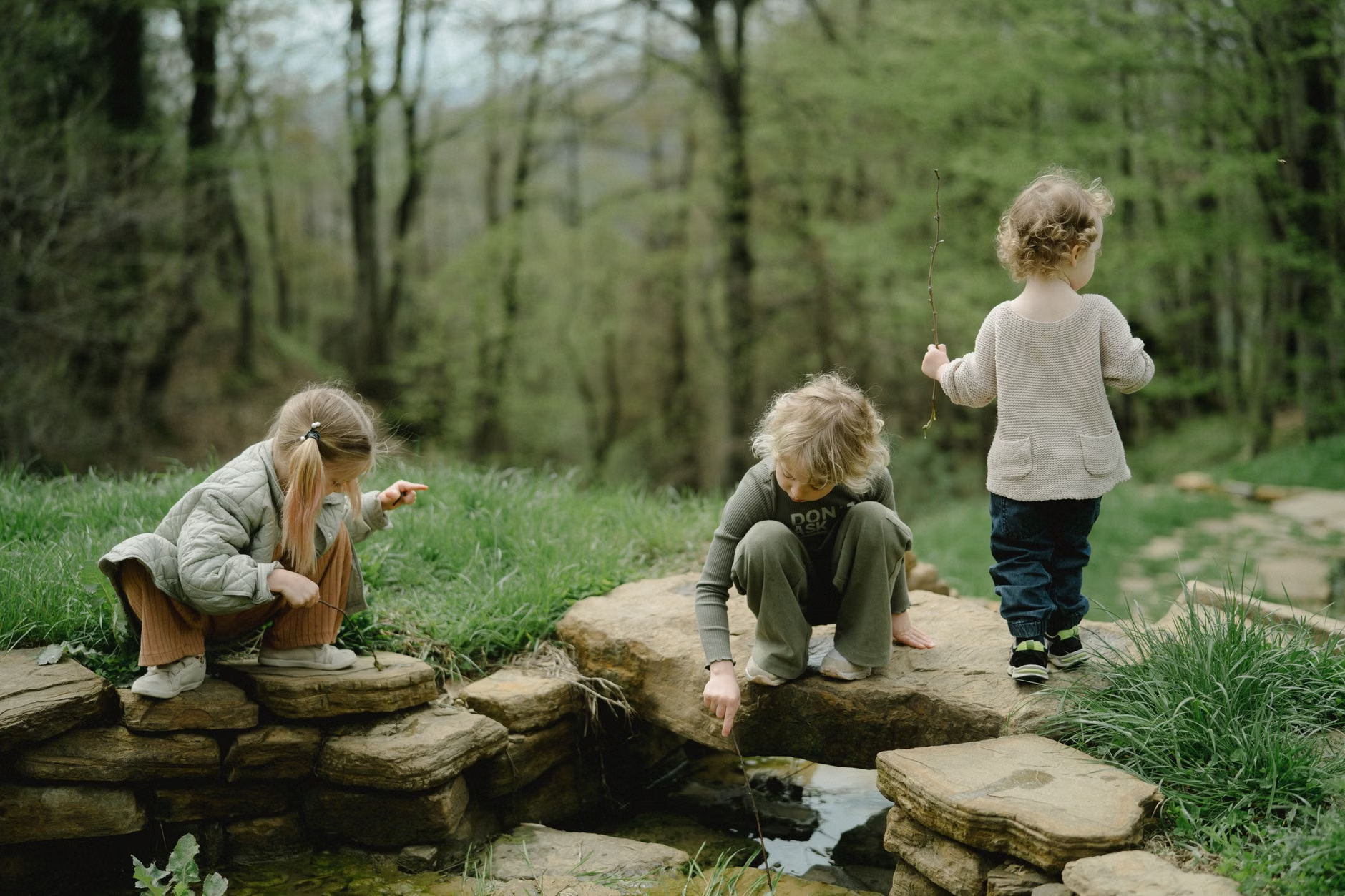
Why “Wilder” Parks Are Actually Better for Development
It’s tempting to prefer the sterile safety of a modern, brightly colored playground. Everything is rounded, the impact-absorbing surface is uniform, and there are no surprises. But research into child development consistently shows that standardized playgrounds can actually lead to more accidents, not fewer. When an environment is completely predictable, children stop paying attention. They zone out, get bored, and start acting recklessly because they assume the environment will always catch them.
In a nature-play area, the environment is constantly changing. A log might be slippery today because it rained; it might be dry tomorrow. The child has to adjust their grip and their speed accordingly. This “attentional demand” is exactly what builds a child’s brain. They learn to read the environment, which is a far more valuable skill than simply learning how to go down a slide.
Furthermore, nature-play environments are inherently less crowded. The play is usually more imaginative because a stick can be a sword, a fishing rod, or a wizard’s staff. When you give them a plastic slide, it’s just a slide. When you give them a clearing with some logs, you give them an open-ended narrative. This fosters creativity and social problem-solving, as children have to negotiate with each other about how to use the space.
Common Mistakes Parents Make in Nature-Play
Even with the best intentions, we often fall into traps. Here are the three most common mistakes I’ve observed (and definitely made myself):
1. Over-dressing for the Environment
If you dress your child in their “good” clothes, you will inevitably spend the entire time saying, “Don’t sit there, it’s dirty,” or “Watch your sleeves.” This ruins the point of nature-play. Dress them in clothes you don’t mind getting stained or torn. When the child knows they are allowed to get dirty, they engage more deeply with the environment. If you’re worried about the cold or wet, invest in high-quality waterproof gear (like mud boots and rain suits) rather than restricting their movement.
2. The “No-No” Reflex
We are conditioned to say “No, be careful!” as a default reaction. But “be careful” is a meaningless phrase to a child. It doesn’t tell them what to watch out for. Instead of “Be careful,” try specific, observational language: “That log is wet, it might be slippery,” or “That rock is loose, check if it moves before you put your weight on it.” This replaces fear with information.
3. Miscalculating the “Fall Zone”
Parents often worry about the height of a climb without considering the landing. A two-foot drop onto soft mulch or grass is very different from a two-foot drop onto hard-packed dirt or exposed tree roots. Before you panic about the height, check the landing. If the landing is safe, the risk of a fall is significantly reduced.

The Long-Term Benefit: Building Resilience
If you follow this approach, you aren’t just helping them play safely today; you are building a foundation of resilience. When a child learns to assess their own limits, they carry that skill into other areas of life. They become the teenager who understands their limits in a car, or the young adult who knows how to evaluate a new, unknown situation before diving in headfirst.
The “risk-benefit” assessment isn’t a chore. It’s a way to slow down and connect with your child. Instead of looking at your phone while they play, you are observing them, learning their capabilities, and helping them navigate the world. You’ll find that as you get better at this, your own anxiety levels drop. You start to see that they are capable of much more than you thought, and they start to see you as a partner in their exploration rather than a source of restriction.
Remember: You are the scout, but they are the explorers. Your role is to clear the path of hazards, identify the risks, and then let them do the heavy lifting of figuring out their own way forward. It’s a messy, muddy, and sometimes nerve-wracking process, but it’s the most authentic way to let them grow.
Frequently Asked Questions
What should I do if my child is clearly out of their depth in a natural play area?
If they are visibly panicked or stuck, don’t just pull them off. Instead, get down to their level and talk them through the move. “I see you’re stuck. Can you put your left foot on that lower rock?” If they still can’t manage it, provide just enough physical support to get them to a stable spot, then help them climb down. The goal is to help them succeed, not to rescue them from the challenge entirely.
Are there certain times of year when suburban parks are inherently more dangerous?
Yes. Early spring is a high-hazard time because of the “thaw-and-freeze” cycle. This can make soil unstable and cause branches that were weakened during winter to drop suddenly. Additionally, tall grass in late summer can hide hazards like uneven ground or sharp objects. Always adjust your “60-second scan” based on the season—be extra vigilant about overhead hazards in the spring and ground-level hazards in the summer.
At what age can I stop doing the hazard scan?
You don’t necessarily “stop,” you just shift the responsibility. As children reach 7 or 8, start involving them in the scan. Ask them, “What do you see here that might be tricky to climb?” or “Does that tree look like it has any loose branches?” By the time they are 10 or 11, they should be able to perform the scan themselves. This process teaches them the habit of environmental awareness, which is a lifelong skill.
Further Reading & Resources:
- National Park Service: Health and Safety Guidelines (General principles on outdoor safety that apply to all park environments).
- National Recreation and Park Association (For understanding how public parks manage natural play spaces).
Note: Always prioritize local signage and park rules. Some suburban parks have designated “natural play” zones that are officially maintained, while others are simply untended woodland. Always check for specific local warnings regarding wildlife or area closures before you head out.