- Shift, Don’t Just Save: Energy-buffer pricing relies on “load shifting”—moving high-energy tasks like laundry or dishwashing to off-peak hours when electricity is cheapest.
- Automation is Mandatory: Manually tracking energy prices is unsustainable for busy parents; using smart plugs and IFTTT-style automation is the only way to realize consistent savings.
- The “Buffer” Reality: You aren’t just saving money; you are acting as a shock absorber for the grid, which prevents utility companies from firing up expensive, dirty “peaker” plants during high demand.
If you have ever stared at your monthly electricity bill and wondered why it feels like you are paying for a small luxury car, you aren’t alone. For most of us in our 30s and 40s, the “smart home” has historically been about convenience—turning the lights off with a voice command or seeing who is at the front door while we are stuck in a meeting. But there is a much more practical, wallet-friendly evolution happening right now: Energy-buffer pricing.
At its core, this isn’t just about turning off lights. It’s about leveraging the way utility companies price electricity based on the time of day. By using automation to “buffer” your energy usage—shifting your heavy consumption to times when the grid is under-utilized—you can transform your home into a cost-saving machine. Let’s break down how this works, why it matters for your household budget, and how to set it up without needing an engineering degree.
What Exactly is Energy-Buffer Pricing?
Electricity grids are a bit like highways. During “rush hour”—typically between 4:00 PM and 9:00 PM when everyone gets home, starts cooking, turns on the AC, and runs the laundry—the grid is congested. To prevent a total collapse, utility companies often have to fire up secondary, less efficient, and much more expensive power plants. They pass these costs on to you via “Time-of-Use” (TOU) or “Dynamic Pricing” plans.
Energy-buffer pricing is the strategy of using smart technology to “buffer” or delay your home’s energy consumption. Instead of running your dishwasher the moment you load it at 6:00 PM, an automated system holds that task until 2:00 AM, when electricity prices might be 50% lower. You aren’t losing any functionality; you are simply changing the timing of the energy draw.
Why does this matter for a family? Because electricity costs are often the most variable part of a household budget. By automating these “energy-heavy” chores, you can shave 15% to 30% off your monthly bill without actually changing your lifestyle. You get the same clean plates and dry clothes, just at a lower price point. It’s the ultimate “set it and forget it” financial hack.
The Mechanics of Load Shifting: Why Your Timing Matters
To understand the “buffer,” you have to understand the “peak.” Most utility companies divide the day into three tiers: Off-Peak (the cheapest, usually late night to early morning), Mid-Peak, and On-Peak (the most expensive).
The “buffer” concept is based on the idea that your appliances have a degree of temporal flexibility. Your dishwasher doesn’t care if it runs at 7:00 PM or 2:00 AM, provided the dishes are clean by the time you wake up. Your washing machine doesn’t care when the cycle starts, as long as the clothes are ready to be transferred to the dryer.
Here is a breakdown of how different appliances fit into the “buffer” strategy:
| Appliance | Buffer Potential | Reasoning |
|---|---|---|
| Dishwasher | High | Can be pre-loaded and set to run on a delay. |
| Washing Machine | Medium | Requires a manual step (moving to dryer) unless you have a combo unit. |
| Electric Vehicle (EV) | Very High | Can charge exclusively during the cheapest hours. |
| HVAC System | Low/Medium | Can be “pre-cooled” or “pre-heated” before peak hours begin. |
The most important insight here is that you are essentially acting as a grid stabilizer. When you shift your load, you reduce the stress on the utility company’s infrastructure. In some regions, utility providers even offer “demand response” programs where they will pay you or provide bill credits for allowing them to slightly adjust your thermostat or delay your EV charging during extreme grid stress. This is the “pro” version of energy-buffer pricing.
Building Your Automated Buffer: A Step-by-Step Approach
You don’t need a million-dollar smart home setup to start. In fact, the most effective systems are often the simplest. If you are starting from scratch, here is the hierarchy of implementation you should follow to avoid getting overwhelmed.
Step 1: Audit Your Current Energy Plan
Before you buy a single smart plug, check your local utility provider’s website. Are you on a flat-rate plan, or a Time-of-Use (TOU) plan? If you are on a flat rate, shifting your load won’t save you money because the cost is the same regardless of time. You need to switch to a TOU plan first. Warning: Ensure your household habits can actually accommodate the shift. If you run everything during the day, a TOU plan might actually increase your costs. Use the utility’s “bill comparison” tool before switching.
Step 2: The “Smart Plug” Entry Point
For “dumb” appliances—like that older dishwasher or a portable dehumidifier—a simple smart plug is your best friend. Look for plugs that integrate with platforms like Home Assistant, Alexa, or Google Home. These plugs allow you to set schedules or, even better, trigger actions based on energy price APIs (where available in your country).
Step 3: Utilizing Native Smart Appliance Features
If you have newer, “connected” appliances, check their native apps. Most modern smart dishwashers and dryers have a “delay start” or “smart grid” feature built-in. These are often superior to smart plugs because they communicate directly with the appliance’s controller, allowing for more granular control (like skipping the heated dry cycle to save even more power).
Step 4: The “Pre-Cooling” Strategy for HVAC
Your HVAC system is the single biggest energy consumer in your home. Instead of just turning it off during peak hours, use a “pre-cooling” strategy. If peak pricing starts at 4:00 PM, program your thermostat to lower the temperature to a comfortable level at 3:00 PM, then allow the temperature to drift up slightly during the peak window. The thermal mass of your home will keep it comfortable for hours, effectively “buffering” the energy usage.
Common Pitfalls and How to Avoid Them
Even with the best intentions, it is easy to fall into traps that negate your savings. Let’s look at the most common mistakes I see households making when they start this journey.
The “Efficiency Paradox”: Do not prioritize energy-buffer pricing over the actual efficiency of the appliance. A 10-year-old, inefficient dishwasher running at off-peak rates may still cost more than a modern, Energy Star-rated unit running at peak rates. Always prioritize upgrading your hardware first if the appliance is nearing the end of its life cycle.
The “Manual Override” Failure: Life happens. Sometimes you need that load of laundry done now. Do not build a system so rigid that you feel stressed when you have to override it. Always ensure your automation platform has an easy “disable for today” button. If your automation makes you feel like a slave to your utility provider, you won’t keep doing it for long.
Over-Automating: You do not need to automate your toaster or your coffee maker. Focus on the “big movers”—appliances that draw high wattage for long periods. A smart plug on a lamp saves pennies; a smart controller on an EV charger or a heat pump saves hundreds of dollars annually. Focus your efforts where the ROI is highest.
The Hidden Trade-Offs: What Nobody Tells You
There is a social and practical side to energy-buffer pricing that often gets overlooked. For example, if you are running your dishwasher at 2:00 AM, is it loud enough to wake up the kids? Noise pollution is a real factor. If your home has thin walls or the laundry room is near a bedroom, you may have to sacrifice “off-peak” savings for “sleep-through” peace of mind.
Another factor is maintenance. Running appliances at odd hours means you are rarely around when they finish. If a load of laundry sits in a damp washing machine for six hours before you get to it, you are going to end up with musty-smelling clothes. This leads to re-washing, which doubles your energy consumption and wastes water. Always account for the “human cycle time.” If you can’t get to the laundry until 7:00 AM, the cycle shouldn’t end before 6:30 AM.
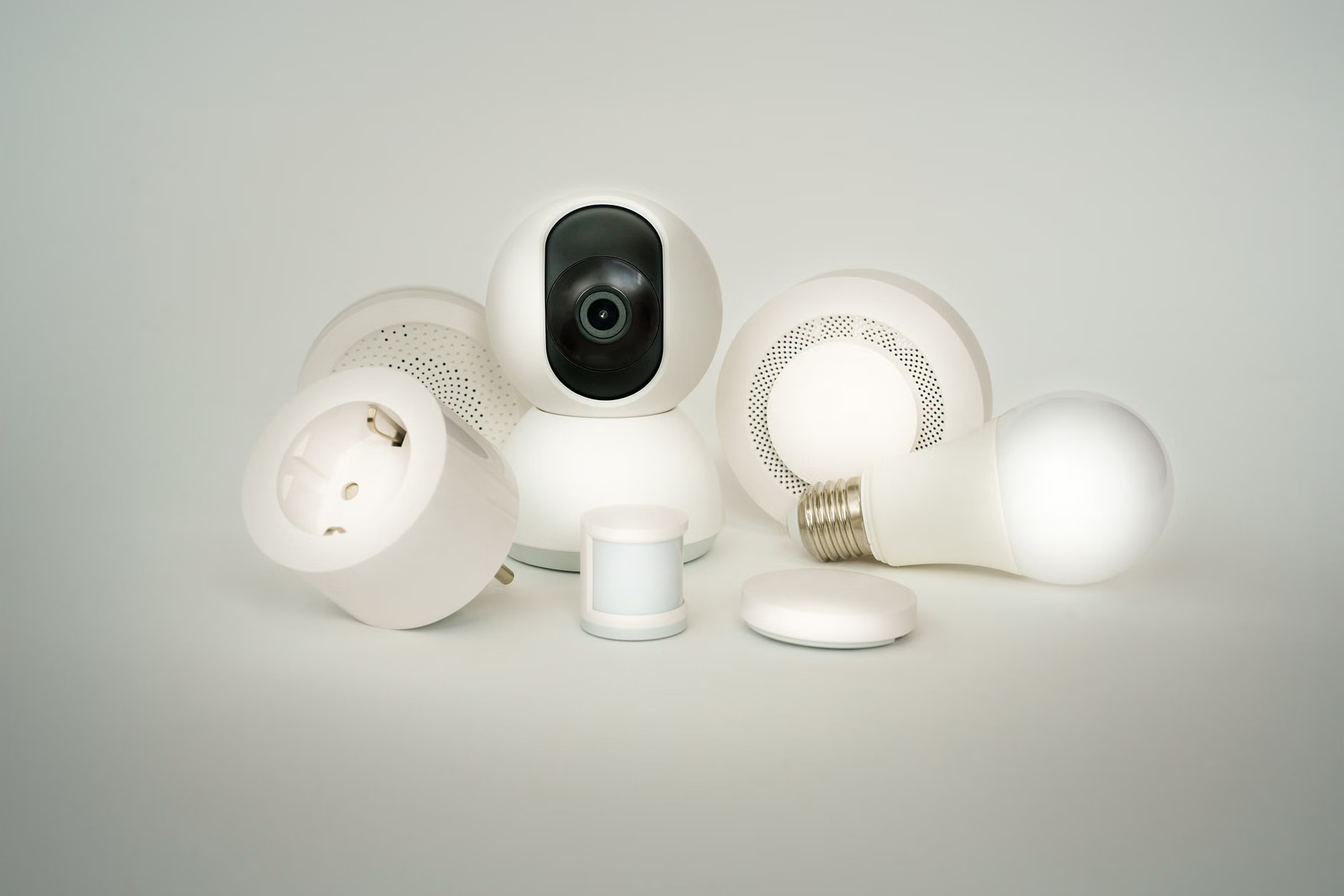
Finally, consider the safety of your smart plugs. If you are plugging a high-draw appliance (like a space heater or a heavy-duty washer) into a smart plug, ensure the plug is rated for that specific amperage. A cheap, generic smart plug can be a fire hazard if overloaded. Always look for safety certifications like UL (Underwriters Laboratories) or the equivalent in your country.
Decision Criteria: Is This Right for You?
How do you know if you should dive into this? Use this simple decision matrix:
- Do you have high variance in your energy costs? If your utility bill is flat-rate regardless of time, the effort of automation is not worth the financial return.
- Are you willing to tolerate some “inconvenience”? If you need your clothes dried immediately every single time, this strategy will cause friction.
- Is your home “connected” enough? If you have zero smart devices, the upfront cost of hardware (plugs, thermostats, hubs) might take 2-3 years to pay back. If you already have some smart tech, the ROI is much faster.
If you find yourself in the “yes” category for at least two of these, start small. Put one smart plug on your dishwasher and track the savings for one month. If you see a dip in your usage graph during peak hours without any change in your quality of life, expand to the next appliance.
Looking Ahead: The Future of Energy Management
We are moving toward a world of “Virtual Power Plants” (VPPs). In the near future, your home won’t just be an energy consumer; it will be a participant in the energy market. Your EV will charge when the grid has an excess of wind or solar power and potentially sell that energy back to the grid when prices spike. This is the ultimate “energy buffer.”
For now, focus on the basics. Master your Time-of-Use schedule, automate your heavy-duty appliances, and keep an eye on your usage data. It’s not just about saving a few dollars; it’s about taking control of a utility that has historically been a “black box” in our monthly budget.
Start by checking your current utility bill for “Time-of-Use” options. If they exist, calculate your potential savings based on your current habits. Most providers offer an online calculator that will show you exactly what you would have paid under a TOU plan over the last six months. That is your baseline. If the savings are there, start your automation journey today. Your future self—and your monthly budget—will thank you.
Frequently Asked Questions
1. Does running appliances at night increase the risk of fire or water damage?
Running appliances at night is generally safe if they are well-maintained. However, ensure that your appliances are in good working order and that any smart plugs used are rated for the high wattage of the appliance. Always check for leaks around washing machines and dishwashers periodically, regardless of when you run them.
2. What if my utility company doesn’t offer Time-of-Use pricing?
If your utility only offers flat-rate pricing, energy-buffer pricing will not save you money on your bill. However, you can still practice “energy-conscious” habits to reduce your overall consumption, which is good for the environment. Check with your local energy regulator to see if TOU plans are being introduced in your area soon, as many regions are transitioning to this model.
3. How do I know if a smart plug is safe for my dishwasher or washer?
Check the label on the smart plug for its “Amperage” or “Wattage” rating. Most standard smart plugs are rated for 10A or 15A. A typical dishwasher or washing machine can draw significant power. Ensure the plug’s rating is higher than the peak draw of the appliance. If in doubt, look for plugs specifically marketed as “Heavy Duty” or “High-Wattage” compatible.
For further reading on energy efficiency standards and grid management, you can check resources like the International Energy Agency (IEA) or your local government’s energy department website (e.g., Energy.gov in the US or Gov.uk in the UK).